
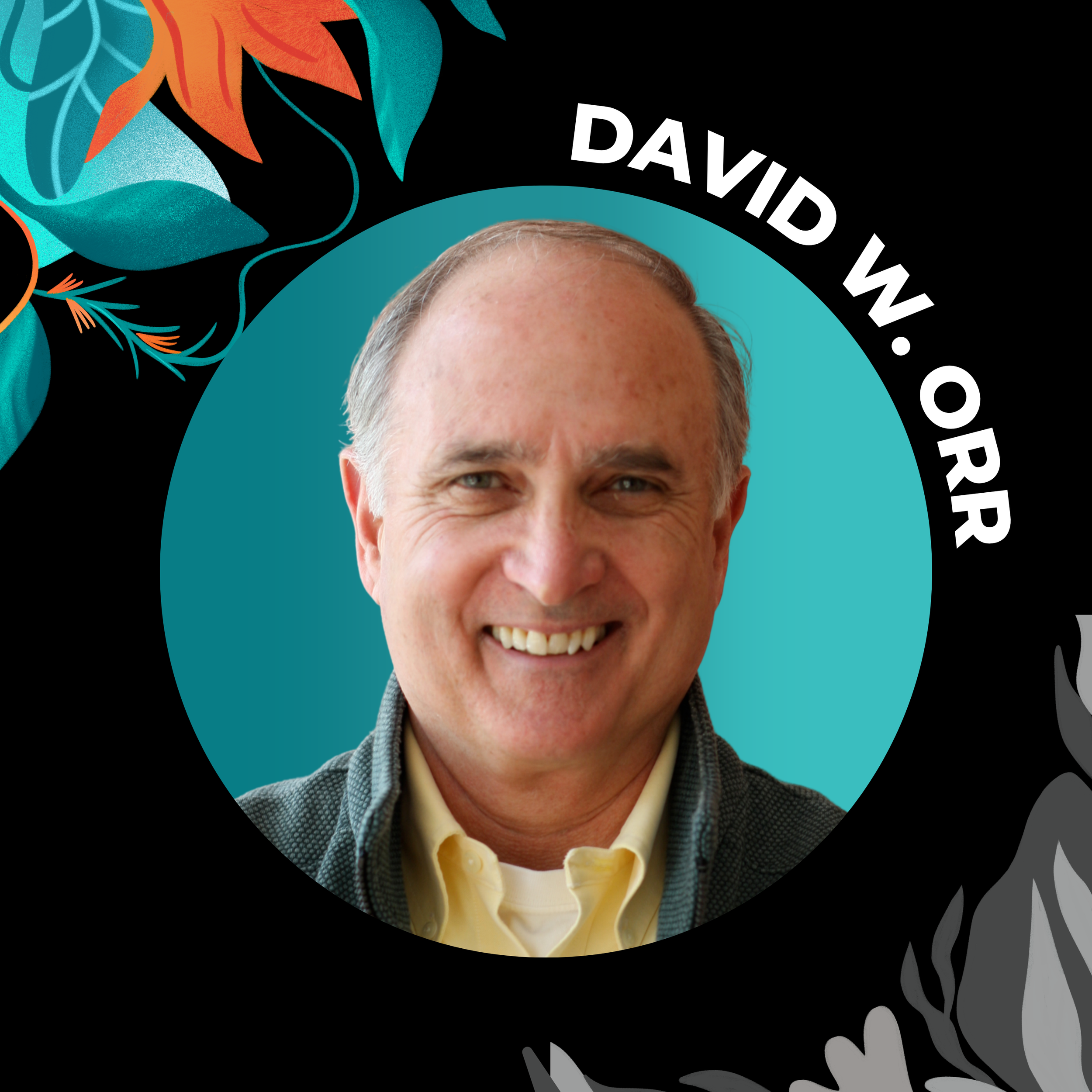



Democracy may not survive the intensifying ecological and social crises of our time. David W. Orr, professor emeritus of environmental studies and politics, argues that democracy is being undermined by concentrated wealth, corporate power, and an economic system built around endless growth. Reversing this trajectory requires more than political reform. It demands education at all levels that cultivates ecological understanding, democratic citizenship, practical skills, and a deep sense of kinship and common purpose with one another and the wider living world. Highlights include:
How democratic decision-making was the default throughout humanity's long nomadic egalitarian past and remains the default in many other animal communities;
Why the rights and protections built into modern democracy have favored property owners and concentrated wealth, while failing to protect the equitable sharing of resources or the interests of future generations of human and nonhuman life;
How the rise of corporate personhood, neoliberal market fundamentalism, and the resulting concentrated wealth has undermined democratic government, particularly through corporate influence over elections and policymaking, and why money must be removed from politics;
How neoliberalism has transformed not just economics but our understanding of human relationships, encouraging us to confuse selfishness with self-interest and weakening our sense of shared purpose;
Why the environmental movement lost political influence by speaking largely to itself rather than engaging the broader public, leaving an opening for the political right to exploit that indifference;
How broadly shared concerns about clean air, clean water, corporate power, and the influence of AI could bridge political divisions and create common ground across the political spectrum;
Why ecological literacy, democratic citizenship, and an understanding of limits to growth must become the foundations of education so that no one graduates from any level of education without understanding how Earth works and how we govern democratically;
Why strong democracy depends on people working together toward common purposes, and how practical education, hands-on skills, and early experiences in nature can build local resilience, social connection, and a sense of kinship with the living world;
Why recognizing nature and animal communities as kin with rights is essential to limiting human domination.
MENTIONED IN THIS EPISODE:
Book: Dangerous Years: Climate Change, the Long Emergency, and the Way Forward by David W. Orr
Book: Ecological Literacy: Education and the Transition to a Postmodern World by David W. Orr
Book: Down to the Wire: Confronting Climate Collapse by David W. Orr
Book: The Great Transformation: The Political and Economic Origins of Our Time by Karl Polanyi
Article: The Missing Politics in Environmental Education, Revisited by David W. Orr
Podcast episode: Creating an Ecocivilization with guest Jeremy Lent on the OVERSHOOT podcast
-
David Orr (00:00):
Democracy has to begin to recognize that rights are intergenerational. Our obligations go back to a distant past and also into a distant future. We're in this link of being. We must learn that we're kin to all that ever lived and all that is living, and that by our forbearance and wisdom will live. We lie in the lap of great intelligence, was how Emerson put it, and I can't think of much of a better way to say it. And to honor that intelligence, then that becomes something that ought to be baked into our conversations, our politics, our economy, all this stuff. It is complicated. It is portentous. It's a matter of life and death for us as a civilization, but it's also incredibly interesting. I mean, what else do you want to study? It also happens to be central to whether we're going to survive or not and how we survive, whether as a kin on the planet with everything that's ever lived and everything that will live, or as creatures at war with each other engaged in a eventually futile, vain act of self-devastation.
Alan Ware (01:00):
That was environmentalist, political scientist, and award-winning scholar, David Orr. In this episode of the OVERSHOOT Podcast, David explains the critical need to recognize why democracy and ecological integrity are deeply intertwined and why we need to desperately fight for both.
Nandita Bajaj (01:29):
Welcome to OVERSHOOT, where we tackle today's interlocking social and ecological crises driven by humanity's excessive population and consumption. On this podcast, we explore needed narrative behavioral and system shifts for recreating human life in balance with all life on Earth. I'm Nandita Bajaj, co-host of the podcast and executive director of Population Balance.
Alan Ware (01:54):
I'm Alan Ware, co-host of the podcast and researcher with Population Balance. With expert guests covering a range of topics, we examine the forces underlying overshoot, the patriarchal pronatalism that fuels overpopulation, the growth-obsessed economic systems that drive consumerism and social injustice, and the dominant worldview of human supremacy that subjugates animals and nature. Our vision of shrinking toward abundance inspires us to seek pathways of transformation that go beyond technological fixes toward a new humanity that honors our interconnectedness with all of life. And now on to today's guest.
(02:33):
Dr. David Orr is professor emeritus of environmental studies and politics at Oberlin College in Ohio USA. Orr is author of eight books, including Dangerous Years: Climate Change, The Long Emergency, and The Way Forward, Ecological Literacy, and Down to the Wire: Confronting Climate Collapse, as well as co-editor of five others. He has published over 250 articles, reviews, book chapters, and professional publications. He co-founded the Atlanta Environmental Symposium, the Meadow Creek Project, and the Oberlin Project. He's been awarded nine honorary degrees and a dozen other awards, including a National Achievement Award from the National Wildlife Federation and a Lifetime Achievement Award from the North American Association for Environmental Education. And now on to today's interview.
Nandita Bajaj (03:26):
Hi, David. Welcome to OVERSHOOT. We're delighted to have you with us. Thank you so much for joining us.
David Orr (03:32):
Well, indeed, Nandita, Alan, thanks for the invitation. Great to be here with you.
Nandita Bajaj (03:35):
Yeah, it's really our pleasure. You've spent decades thinking and writing about our ecological crises, the implications of those crises for our political and economic systems, as well as for the future of life on Earth. And you've also been very influential in advancing the ideas of ecological literacy and how fundamental environmental education is to all education. You're also among the relatively few academics who have combined environmental scholarship with hands-on large scale experimentation in more sustainable living. There's so much to unpack from your wealth of knowledge and experience, but we'll only be able to scratch the surface of that in today's interview for which we are really excited.
(04:24):
We can start with your work on democracy. You've written that we're facing two related existential crises, a global crisis of rapid climate change and what you describe as potentially lethal threats to democracy. And you've argued that we need stronger democracy in order to address climate change while also acknowledging that climate change itself poses a major threat to democracy. And before getting into the discussion of how climate change and democracy affect each other, we'd like to start with your sense of why democracy is so important. Those of us who've grown up in established democracies, however imperfectly realized, often take democracy for granted without having to define or defend it.
(05:11):
But that assumption of continued democracy seems less secure today as urgent problems multiply and as authoritarian alternatives gain support and more technocratic approaches promise to bypass the often slow and messy processes of democratic decision-making. So this may seem self-evident to many of us, but let's begin with how you describe why democracy is worth defending.
David Orr (05:40):
I think that's the question of our time as democracy fractures here in the United States and in Europe and India and elsewhere, that is the issue. If democracy is worth saving, then we have to be able to answer that question and not just from the head, but also from the heart. It has to be something that connects us. To answer it, if you go back in time, democracy call it 1.0, occurred everywhere. There were models of democracy where sitting around campfires and so forth, people decided that it needed to be a joint decision, that no one person had the power or the right to make that decision. And somebody stands up and says, I disagree. That's democracy 1.0. 2.0 is what we know as Greek democracy that most influenced the Western world. The Greeks added the idea of rational thinking to the conduct of the public business, and that was a major improvement.
(06:27):
It had its flaws. I mean, it left out what they called barbarians and women and slaves and so forth, but the very idea that we could meet and discuss important complicated issues. Democracy 3.0 is the US and French examples. That's Thomas Jefferson in that hotel room in Philadelphia writing the Declaration of Independence and the French Revolution and the Rights of Man and so forth. And we're now poised at the final stage of Democracy 3.0. It either collapses or it advances to something called Democracy 4.0. And the flaws of 3.0 are evident. Our constitution in the American case gave all kind of rights to property owners, but it excused slave owning. Slaves were just part of the property. It ignored Native Americans. These people have been here on this continent for thousands of years. Maybe we should ask them how it works and get some advice about this.
(07:21):
They didn't do that. Posterity is mentioned one time in the constitution, but not thereafter. And so 3.0 was a failure in that sense. And the big failures of 3.0 I think can be summarized as climate change. In 3.0, basically wealth was given a pass and however you earned it was okay. It put minimal restrictions on it. It didn't say that wealth ought to be fairly shared or anything of the kind. It just gave property a pass. And once we found property in fossil fuels and fossil energy, and that became the driver of it, there are a lot of things that would have caused problems in democracy 3.0, but that was the fatal thing. Once we set all those fossil fuel stores on fire, and that's climate change. So it will destroy not just democracy, it poses a lethal threat to everything else, but it's kind of where all of our sins of avarice and economy and so forth all converged around climate change.
(08:16):
And Bill Rees's work I think is exceptional in this case in talking about overshoot. He's described it, that is the problem. We're just too many, taking too much, imposing too long a shadow on our future generations. So trying to build a democracy that works is complicated and I don't pretend to have an answer to it. Matter of fact, I don't think there is an answer. There's lots of different things. You have to have a smarter citizenry. Thomas Jefferson was probably the most articulate of the founders on the importance of education. In this case, it means people graduating from schools at any level understanding Earth system science, how the Earth works as a physical system. And then secondly, you have to have people who believe in democracy. It is a messy thing. I mean, Churchill's famous aphorism that it's the worst form of government except for all the others ever tried, I think kind of summarizes it, but we don't know another way to do the public business that's better.
(09:13):
The heritage of democracy, it was the one form of governance that honored human dignity and rights and so forth when it was exercised, but it gave people standing in that legal sense of the word and in the moral sense of the word in the larger conduct of the public business. Where it failed is in 3.0, we gave no real rights to posterity. And so 4.0 has to begin to recognize that rights are intergenerational. Our obligations go back to a distant past and also into a distant future. We're in this link of being. We must learn that we're kin to all that ever lived and all that is living and that by our forbearance and wisdom will live. And a lot hangs in the balance now because we can deprive future generations of life and liberty and all the other things that go with that. Democracy 4.0 has got to involve the rights of future generations and the rights of nature, other species to live and exist.
(10:10):
And that's a complicated thing, but around the world, you see the movement in this direction, starting in Ecuador and India and lots of places there are rights-based organizations that are making very strong cases and they're being accepted by courts also in the European court system. And then there is this whole thing of systems thinking. Donella Meadows, who was a dear friend before she passed all too early, her last book was called Thinking in Systems. And we have to begin to think in systems and that's where the Western enlightenment fell apart. In education, no students should leave school without understanding how the Earth works as a system and then how humans are part of that system. We're part of the community of nature. We're just kin. We're in a family, a discordant family. There are lots of disagreements and that's where government comes in. Government is the alternative to bullets.
(11:00):
Government is the place where we meet in an arena, but you have to give standing to the other parties. They have to be recognized in all of their dignity and so forth, but the disagreements and there are certain rules that bound those disagreements. So we're here in a situation of having to think through how government works as a total system, got to begin to coordinate this. So there's a question of how you build overshoot into both the educational practice as opposed to endless forever growth and how you build it then into government. There needs to be restraint based on some kind of sense that there are limits to how many, how much, where, how, and when. And the last thing I'd say about this, in the beginning of the US environmental movement, say if it starts with Rachel Carson in 1964 with publication of Silent Spring, there was a movement that was very much political.
(11:55):
Keith Caldwell at the University of Indiana drafted, for example, a political scientist, drafted the National Environmental Policy Act and also the Endangered Species Act. And so there was a sense that this government needed to be engaged in the rethinking of this calibration of humans in the natural world. Part of the problem is that education in Democracy 3.0 was Cartesian. It came out of the enlightenment era and you took nature, this big buzzing confusion, and you busted it up into pieces. And so you had departments of this and this and this and this. The larger conversation was how does this cohere into a big argument where the pieces fit together, Donella Meadow's 'thinking in systems' where that becomes the reflex. And then of course, I'll end with this, that gets into this whole subject of economics. The system can't grow forever, period. And yet the economic world is pretty much based certainly since the late 1940s on endless growth forever.
(12:50):
But the idea that economies ought to grow forever is actually a pretty recent idea. It grows out of the '40s, '50s era. That of course had its own political economy. You had whole corporations and so forth engaged in this idea that things grow forever. Anyway, it's a tough issue.
Nandita Bajaj (13:07):
Well, you've done an incredible job so succinctly saying so many things about the different forms of democracy that we've had and why democracy 4.0 is going to need to reclaim our connection to our ecological reality, our biophysical material basis in our governance decisions. And I also appreciated this point about democracy is not a new concept as anthropological and archaeological evidence suggests very strongly that we have a deep history with it. Our pre-empire, pre-so-called civilization groups were largely egalitarian democratically governed groups and that represents 97% of our history. And we also see evidence that we have an inherent egalitarian bias that has for much of history prevented us from being dominated by others, including through the use of methods such as ridicule and ostracism, exile, and even execution, as many of our guests have talked about.
Alan Ware (14:13):
And you've also talked quite a bit about how we've come to such a weakened state of US democracy now as we try to build that 4.0 democracy that looks ahead to the future wellbeing of humans and non-humans. We're starting from a weakened state, and I wonder if you could describe some of that process that's gotten us to this weakened state.
David Orr (14:37):
In the US case, which I know best, the anti-federalists way back when made the case against the Constitution based on a real suspicion of governance of all kinds. And the idea was to break it down to the lowest possible level. And there was a grain of truth in that. In a current debate, people who take up the word resilience come back on distributed this, distributed energy system, distributed food systems, distributed financial systems, and there's a case to be made there. I wouldn't dismiss it. The US Civil War hardened some of those divisions. The Civil War was fought over slavery. There's just no getting around that point. It was the right to own other humans. And that was, of course, enshrined, as I mentioned earlier in the Constitution. Slaves were property. After the Civil War, I think we had a choice. The US Reconstruction was a brief moment where we saw or we could see a unified multicultural governance system.
(15:33):
And there were cases where African American communities did extremely well on their own, Wilmington, cities, all the way later out in Tulsa, Oklahoma, places that were then undermined by white racism and KKK and direct violence. In that era, for me, one of the key mistakes that was made had to do with the right of corporate power. The 14th Amendment was twisted around eventually in a court case, I think it was 1886. It ostensibly gave the right of personhood to corporations. So once you give corporations the legal rights of persons, you and I are people, we live for a time, we die, we have certain rights, we have morality, we have the rights of personhood. Corporations are just large abstractions searching for the highest rate of return. That's all they are. And they can never be people. They can pose as people. They can say we do it all for you today, but it's all just BS.
(16:28):
So if you run the film fast-forward into a series of court decisions where the court said, Yes, that's right. They are persons. And oh, by the way, they can give unlimited amounts of money to campaigns. You couldn't have asked for more mischief to undermine a democracy. And one of the weaknesses of Democracy 3.0 is how we think about corporations in this case. They should not be given the rights of persons and money should be taken out of politics. We should have the same separation between money and corporations and politics as we ostensibly or once did have between religion and politics. That ought to be a firewall you cannot cross over. Elon Musk cannot put money into political campaigns. You can't corrupt democracy that way. It's just so easily corrupted. After World War II, there was a debate about freedom and democracy and so forth, and the group called the neoliberals, Hayek and Friedman and Ayn Rand and what's now called neoliberalism, kind of a misleading term, but it basically meant let markets do everything.
(17:29):
And so it started a 40 or 50 year long war against the idea of we the people. It was we the corporations do these things and you people just sit there passively. The Great Transition book by Karl Polanyi written back in 1944 uncovered this. If you destroy the social roots of democracy and make it a corporate dominated, then a lot of things go out of it. You can't afford to do bridges and roads and schools and healthcare and the market doesn't pick those things up. That's a government function. And so we shifted, if you just look at this as pronouns, we shifted from 'we, ours and us' to 'I, me and mine'. And a result, I think Donald Trump is kind of the upshot of that world. He didn't cause it, he just surfed that wave. But I think that the wave was set in motion by a hardcore ideological group that of course was funded by people who had every reason to get government off their backs.
(18:24):
And so when Reagan appealed to this in 1980, he was appealing to the Koch brothers and to every oil company and coal company. They didn't want regulation. It cost them money. That's kind of the history of neoliberalism. It's a sad story of undoing that part of democracy where we the people. And in the '30s, I live in a little town here where we've got a middle school built by the WPA, building still standing. It is a great building, a post office down the street. We did things collectively and we kind of, not perfectly, but we clawed our way out of depression. And then that leads, and I'll end with this, kind of the blind alley because we didn't really get out of the depression. World War II got us out of the depression. It was the arms industry that got us out, and that's a whole nother chapter in this.
(19:07):
If we build a democracy, it depends a good bit on making weapons and killing people and something we call defense or now war. And so we've compounded our problems and I'm off on another tangent, so I'm out on a long limb. So please say something and get me off this limb.
Alan Ware (19:22):
Well, I might get us even farther out on the limb where I'm thinking of how mass democracy 3.0 grew up at the same time with fossil fuels in the early 1800s and with settler colonialism taking over the world. So there was fuel for that growth and the elites could share it, especially to prevent social unrest and rebellion as you saw in Europe with the Paris Commune and countries like Britain looked at that and said, Well, maybe we should extend rights to people so we don't have social revolution. But we haven't had mass democracy in a time of contraction, and that is my concern that 4.0 has to be born in a totally different time for mass democracy of not expansion, but contraction.
David Orr (20:06):
I agree. And there's no guarantee that it can be. We do not know whether we can rise to the occasion or not, but I think my reason for optimism is based on a number of things, but if you could say do a magical global poll and get the questions right, do you want to breathe dirty air? No. Drink dirty water? No. Have a corporate- dominated future? No. AI dominate your decisions? No. You get the questions right, and I think you'd find the difference between right and left just disappear. The means by which we might rearrange our public business would still be there. We can quarrel about those things, and those are good quarrels to have. Change the metaphor. If you're standing on the edge of the Grand Canyon and you ask people how they participate in the government and the bridge that connects this side and that side of the Grand Canyon has been turned into a toll bridge.
(20:54):
And so the average citizen, and this is verified in any number of political science studies, the average citizen, you and I, don't have any real say in this. We can write letters, we can complain and so forth, but what matters in the end is the guys, the last people, mostly guys, that were in the office lobbying for the flow of money to fund a campaign. And so on this side of the Grand Canyon, what we clearly want, which actually resembles a good bit of what Scandinavians have, what we clearly want is not what we get. The rules and regulations on this side of the Grand Canyon are written by corporate lawyers and corporations and big donors and so forth. And that's more true now than ever before, but I take some comfort in that. And then if that's true, and I think there's empirical evidence that it is true, then the question comes down to two things.
(21:39):
One is to organize that dissent into some effective political movement at a scale, I think it has to be global in some ways, at a scale that we haven't yet realized, but the technology now allows us to organize globally. And the other question is how do you actually fund it? Because the big money still supports the other side. And I think that there are answers to that, but I don't see an easy solution unless something happens. Campaign finance reform we've kicked around for years, but it's hard for me to see how we get across that bridge as a 4.0 democracy without dealing with a question of money and politics. It is so corrupting and so pervasive. So the whole system is just a system of legalized bribery and that has to be reckoned with.
Alan Ware (22:28):
Right. We can hope that people have responded to corruption in recent years, everywhere from Orban to some areas here in the US, and people are mentioning it in polls as a concern. Yeah, and you hope that we don't have to go through total catastrophe like a Great Depression for people to demand centralized state power, redistribute. As FDR said, I welcome the hatred of the elites basically, which if you hear that 1936 campaign speech, I think it's pretty amazing by today's standards. As you said, it was probably the war, more that got America out of that hole. So that brings to mind the Walter Scheidel's 'great leveler' thesis that it takes those calamities of war, revolution, state collapse, financial depression to really bring about the change. But I think you're right that there is, and as we talked about egalitarian bias, I think all of us have that to be more like a Sweden than a US or Brazil that we have that ingrained.
David Orr (23:28):
Yeah. Some of that, Alan, is you remember the quote from the woman? I've forgotten the exact nature of it, but the quote was, Keep government out of my Medicare. There's a certain level. When I was in grad school, Kenneth Boulding, the great economist, came to Penn and gave a talk. And I remember him saying, he stuttered badly, but he was a brilliant, brilliant man. But he said in a stuttering voice, Never underestimate the power of stupidity, but the power of stupidity in human affairs. And I think that that brings in education. I think education needs to be primed. It can't rid us of stupidity, but it can make us a little less stupid and a little more demanding of facts, data, logic, and history and so forth.
Alan Ware (24:08):
Yeah. And we've weakened our civics education in a place like the US as STEM has taken over more and more of the focus and we're kind of losing the ability to well use evidence, reason, deliberate, compromise, all of the elements you talk about that are needed to be a full democratic citizen.
David Orr (24:27):
Yeah. And I worry too about this morning, I got a political advertisement from an unnamed candidate, and with it, there were attachment that led me to some deep fakes, and that was scary. They were so authentically appearing and had Trump, Obama, and Biden. If I had seen that in a newscast five years ago, I would've thought that's real, but we're now faced this whole AI thing and the capacity to do serious harm to civic dialogue, but they're playing the public for fools, and that's where education I think has to step up to the challenge.
Nandita Bajaj (25:02):
Yeah. And you've mentioned the work of Donella Meadows with thinking in systems, and of course she was the lead author of the 1972 report, Limits to Growth, which informed us about the converging environmental crises. And so many of the predictions that were made in that report are pretty much on par with where things are today in reality. And speaking of systems, you've written about the disappointing results of the environmental movement with greenhouse gas emissions continuing to climb, wildlife disappearing at greater rates, and ecosystems continuing to be degraded. Why do you think the environmental movement has been so ineffective in changing this overall trajectory?
David Orr (25:47):
Well, that's a really good question. It's one I've wrestled with a lot. I published an article a couple years ago called The Missing Politics of Environmental Education. And the fact is, look in our situation here, I live in a little college town over in Ohio, and if I go south of here to Wellington, which is a working town and agricultural community, eight miles away, I get no standing. If I walked into a bar there and started talking about environmental this, environmental that, I'd be thrown out. And it's not because people are stupid. I think it's because in a way, we as a movement in the United States in particular, walked away from politics and we wrote great books and great articles in science, and we met in exotic places and had important conversations and we did a lot of good stuff, but we didn't much include the local communities in that, and we should have.
(26:36):
And as the years went by, I think the hardcore right wing exploited that advantage. They went into the laboring classes and the working classes. We should have been talking to labor and workers and farm workers and so forth. I think those were conversations we should have been having, and we didn't have them often enough. And I blame myself for that as well. I mean, I think we wrote a lot of good stuff. I think if history was written by the people who were right about the issues, it would be a different history. It's written by the winners of it all too often, people that win either on a battlefield or in the marketplace. Keith Caldwell, I mentioned earlier, Lynton Keith Caldwell wrote the Environmental Policy Act, and that still reads well. He wrote the Endangered Species Act, and that's kind of literature of a high order.
(27:21):
So we began early on with politics. And the issues, I've got to be honest though, the issues are so complex, I'm not sure how you can convey all this stuff to people. You mentioned the Limits to Growth. Back in the early 70s, I was teaching in Atlanta and working part-time for Governor Carter. And when the book came out, a colleague and I decided to organize a citywide or region-wide conference for three days on the limits to growth and the future of Atlanta. And so we did a big deal event. We were on the news media and so forth, and Jimmy Carter co-sponsored it. And later, probably around 2004, he and I were at dinner at Emory University in Atlanta, and he looked over at me at dinner and said, Do you remember the conference we did on the limits to growth? And I said, Yes, sir, I do. And he said, Well... and he was looking down at his plate the whole while.
(28:06):
He said, Well, it's a good thing we did it because if we hadn't done it, Atlanta would have really grown. And of course, Atlanta was two and a half times the size then that it was back in the early '70s. And we didn't convert that idea of limits into something that was accessible to laboring people and working people and middle class people even. I don't think we made a movement of that, but it was saying the same thing that you say when you talk about carrying capacity. Carrying capacity says there are limits and you can't get around them. And if you try to get around them, you're going to fail. And eventually it all comes undone.
Alan Ware (28:45):
And what are some of the... I know you've touched on some of them a bit, but the fundamental challenges we'll face trying to maintain democracy in the face of climate disruption specifically.
David Orr (28:56):
Boy, Alan, that's a good question. I think we're in a battle for truth and not that there is a capital T, truth that you and I and Nandita have, it's not that. Battle for the ideas, the validity of ideas, data, fact, logic, history, rational argument. And I think that a world of deep fakes scares me. A world fought out online scares me. Sherry Turkle's writings on the effects of computers and computerization on us as people, I think is a light. And most people really do want face-to-face contact, but you look at the number of people going down the street like this with a cell phone in their face. There'd be an argument about whether that's addiction or not, but it certainly is a bad habit if it's not an addiction. And you see numbers like eight to nine or 10 hours every day spent with a screen of some sort.
(29:46):
We have to get unhooked first, and then there are lots of issues. Let me put it this way. I'm tempted to go into abstractions. Let me say three levels I think that bother me. One is that level of neoliberalism. It changed not just our economics, but how we think about stuff and how we think about our relationships. And I saw in the generations of kids I taught, they began to confuse selfishness with self-interest. Everything is self-interested. Every living thing is self-interested. That's fine and that's good. Selfish is something else, but they conflated the two. And that was part of the success of the whole neoliberal movement, convinced us all that we're just nothing but consumers and self-maximizers and so forth. And we're bigger than that, but we have to be reminded, I think, that we are bigger than that. We're better than that. I think you go back to peel another layer or two off that onion and you get down to core values.
(30:39):
Our operating system in the Western world was based on the idea that we could dominate nature. The whole idea of domination of nature was just nuts. You can't dominate nature. And then when you say we dominate nature, wait a minute, who's the we? It's usually a few scientists manipulating nature for private gain to get control over us. The idea to dominate nature is a political idea. And a few people are dominating nature, not for us, but for their private gain. You see this with the whole AI movement. And so you begin to peel this apart and get down to, wait minute, what are we being governed by? We're being governed by this old defunct idea that we dominate the natural world. And no, we accommodate parts of it, but the more we learn about the natural world, the more we find that there was intelligence infused throughout the whole thing.
(31:26):
Trees have roots that know how to do things. Bugs have intentions and purposes and do all kind of birds. We used to refer to people's bird brains. We find out now that birds are pretty darn smart. And so Emerson put it that we lie on the lap of great intelligence. And I think that's true, but you kind of slap your forehead and say, wait a minute, ancient tribal cultures knew that. I mean, that's been around a long time, but the enlightenment said, no, no, no, we can dominate nature. We can put nature on the rack and torture her secrets out of hers as Francis Bacon put it. That whole idea has to go. And in combination with the natural word, we're just as Aldo Leopold put it, plain members and citizens, that fabric of life. And that intelligence is woven into all of it.
(32:07):
One of my favorite scientists, Antonio Damasio, has a passage, and again, I can't quote it directly, but molecules have certain predispositions. Can't call it intelligence. We're dealing with things for which I don't think our language suits very well, but they kind of know how to do things and they do things, but there's no language, no ideas, so forth. But that's intelligence of a certain sort. It's baked into the whole thing. And I think this is worthy of a really good conversation. What does this mean for us and how we govern? And I would say at a minimum, an attitude of humility or what Schweitzer called reverence for life. We lie in the lap of great intelligence was how Emerson put it, and I can't think of much of a better way to say it. And to honor that intelligence, then that becomes something that ought to be baked into our conversations, our politics, our economy, all this stuff.
(32:57):
It is complicated. It is portentious. It's a matter of life and death for us as a civilization, but it's also incredibly interesting. I mean, what else do you want to study? This stuff, whether you write a novel about it or you write scientific papers, this is really interesting, exciting stuff. It also happens to be central to whether we're going to survive or not and how we survive, whether as a kin on the planet with everything's ever lived and everything that will live, or as creatures at war with each other engaged in a eventually futile, vain act of self-devastation.
Nandita Bajaj (33:33):
Yeah. And as you were speaking about the need for humility and seeing ourselves as kin within Democracy 4.0, I was also reminded of a recent conversation we had with two political science researchers who study democracy within animal cultures, Will Kymlicka and Sue Donaldson. And your examples of bugs and molecules reminded me of this conversation we had with them, this very arrogant idea that only humans practice democracy. And they're looking at so many different animal cultures where there are many different ways in which they exercise voting through sneezing or stomping their feet, et cetera. And they've actually done it far, far better than we have and within ecological limits. So I feel that the humility piece that you mentioned is so crucial, but also, as you said, it's so much more enjoyable to study this than it is to study the ways in which we can dominate the planet.
(34:43):
I am a former student of engineering and I've spent the last 10 years trying to unlearn that way of thinking. Every problem is an engineering problem and we can innovate our way out of every social or ecological crisis. And I have to say that my last 10 or so years of becoming a student of ecology have been the most meaningful years because it is endless. The magic and awe and wonder of everything that we don't know, it's such a different way to relate to our planet and to all the other beings on the planet than it is to relate in a very limited way of being engineers and the royalty of the planet.
David Orr (35:31):
You mentioned of animal democracy. I've got a shelf of books on that point. It is really fascinating. And if taken at face value, which I think it should be, it implies a deeper case for democracy. And our generation and the generation coming up has got to make the case for democracy. We've got to persuade a lot of people and it can't just be flag waving and hand waving. It's got to be based on some evidence. And I think one part of the evidence is the way birds make decisions and murmurations in the sky where birds are shifting. There's some kind of collective thing going on there, but there is commonly, as you're saying, that there's somehow dialogue and they reach decisions based on some sort of common communication, probably not always and everywhere, but to a great extent a lot of places. And we've only studied some parts of this, but that ought to be bedrock.
(36:20):
But looking ahead, we've got to figure out what this case for democracy is. Shoshana Zuboff simply says, It's the best idea we've come up with to protect dignity and so forth. And C.S. Lewis comment was that simply no man, male, should have the right to rule over others. And he mentioned in passing that he didn't have the right to rule over a hen house. And you think about that, what democracy does is to distribute governing energy so that nobody, there's no king. That's what's at stake in the United States right now. Authoritarianism has come back in with a vengeance and thank goodness a lot of people are reacting to it, but we don't know yet whether we can overcome that authoritarian. That's a cultural thing. We can win the election big time, but then we've got to do this hard work of taking power back and beginning to rethink how power then is distributed across governing organizations. Thanks for bringing the point of animal democracy in that's an important part of the case I think we have to make.
Nandita Bajaj (37:18):
And then speaking of making a stronger case for democracy, as you've stated about our broader ecological predicament, "There is no good outcome that does not require something like a second democratic revolution." Could you elaborate on what you see as the essential elements of that revolution?
David Orr (37:36):
One is going back into the American revolution. There was beginning in the 1770s, there were what were called the committees of correspondence. And so letters went back and forth and much the same with Diderot and Montesquieu and the European Enlightenment. There's a period of conversation of people hashing through differences and possibilities. That's one thing. We need that conversation. For another thing, I think we need to figure out how to begin to better engage young people in civic education. It's got to start early in democratic settings, more like democratically run schools and then expand from there, but it's got to be built into so nobody graduates even from any level of schooling without understanding how the Earth works and how we govern it democratically. And then part of that case, third point would be, I have quoted in some of my writings from W.E.B. Du Bois about the distribution of basic competence.
(38:28):
People know how to do things and we need to have that kind of broad-based resilience of people who know how to work with their hands and do things and build things. And the assumption I think is that intelligence is reflected by how many degrees you have. I once wrote an article for when I was writing for conservation biology saying that intelligence is randomly distributed up and down the socioeconomic educational ladder. You find as many stupid people at the bottom or at the top. I mean it's not a function of degrees and so forth. So I think there's a way to begin to tap into this. And I think this is Du Bois's point. And this is part of this whole argument about resilience. I think we need to rethink how we provide power, food, finance and so forth at the local level and tap into that resilience.
(39:11):
And there are way too many really qualified, hyper-capable people looking for something to do and they're unemployed and on a sideline. And this is not going to get to the question, but this is completely sideline, but I gave a talk once at Warren Wilson College about a year and a half ago, and it was after Hurricane Helene had come up the coast, took a left turn in North Carolina, went over to western North Carolina and just wreaked havoc. And the talk, Warren Wilson sits on a mountain in the Swannanoa Valley. The Swannanoa River, which is normally not much wider than the couch I'm sitting on, was a 40-foot wide raging flood going down the river. It's something like they estimated 45 miles an hour and where it joins the Broad River in Asheville. I mean, you can't begin to describe it, but we've all seen pictures and we're going to see more of it.
(39:57):
The slides in Nepal are just, again, an example of this. It's just worldwide now. So what's that democracy look like? And at Warren Wilson that night, I suggested, just kind of off the top of my head, I think it was in Q&A, how about a whole new major in liberal arts education, a first, second, and third responding and do it as a liberal arts kind of thing. And people come in, men and women come into the course and the first thing that they learn is how to operate heavy equipment. The first responders, the things just happen and you got to lift buildings off people and get the debris out off the roads and so forth. So you learn about heavy equipment, you learn those skills. Second responding is you begin to learn how to put it back together again. And the financing of it, well, that's economics and banking.
(40:38):
The sociology of having to reconstruct communities, well, that's sociology. And the psychology of it is how you deal with people who are suffering from post-traumatic stress syndrome. They just lost their neighbors and their family. They need counseling. And the architecture of it is how do you rebuild resilient communities powered by sunshine? And you can go down through what's called a liberal arts curriculum and you can find courses and capabilities in any one of those disciplines that could be weaved into a major, the first, second, and third responding. Third responding simply is how do you deal with the long-term consequences? And that gets into spiritual things and so forth. But beginning to harness, in this case, young men are adrift. I worry about young men in this case. Women come to Oberlin College in larger numbers than men. I think that's true across the country now.
(41:22):
It's not that we don't have a problem yet still with women's issues, but men are drifting off into the MAGA movement and so forth, unemployed large numbers, and spend an awful lot of time on dark sites on the web. Let's give them something to do. And one thing we know that's going to have to be done, our future's going to be punctuated with disasters, floods, heat waves, rising sea levels, on and on. That's our future. That's baked into the hard numbers of the planet. So then the question is what do liberal arts institutions have to do about that? And they're suffering right now. Eighty some, I think I've been told, will go out of business this year. All right, what can liberal arts do, majors do to help those institutions that needs to be done in the world? And every one of those places, I don't care where you are, is going to have floods, fires, storms, incredible heat waves.
(42:08):
That's our future. So do the liberal arts have anything to say about that? And part of that is going to be politics. How do you weave together a community capable of solving its own problems? We better start by rebuilding a local capacity of smart, competent people. That's what we're going to need. That can be jumpstarted, I think, by liberal arts education that are wondering how do we survive in this world where education has become all technical and occupational and career-oriented and universities will always be better at that than small liberal arts colleges are. That's democratic and relearning the skills of democracy and how to converse at a local level. If that's not a liberal art, that phrase has no meaning at all. I mean, that's the whole thing about liberal arts is to educate people liberally in the arts of getting together and getting along together and doing things together.
Alan Ware (42:55):
And those are examples of responding to those extreme climate events through an interdisciplinary lens that liberal arts could provide and compared to the current climate of STEM emphasis and like you said, the liberal arts being starved for funding. And I think it also brings in the local governance element and reminded me of subsidiarity, which I think you talked about in the book of that way of governing, of relegating to the lowest level of government possible where you can feasibly get something done. And we had on Jeremy Lent, who's quite a wide ranging thinker who talked about the Rojava in Syria and Kurdistan that had neighborhood councils at the bottom and regional councils moving up and a very integrated bottom up kind of governance that seem very richly democratic.
David Orr (43:46):
Yeah, Jeremy's a great thinker on this. His book Ecocivilization is worth a read, but all his three books are worth reading. There's a point you can't run a viable democracy with dumb people. You have to educate them and draw them out. And I think the capacity, I think that back to the Du Bois quote, There is capability at the grassroots we don't tap, but people know how to do things and I think we have to tap that, but then also learn to honor it. Jeremy's put this into a large scale 35,000 foot vision that I think is quite compelling, but I think the core of it, and I think Nandita, this builds in I think the case for democracy. The initiative starts with capable, smart, well-educated, thoughtful citizens working together that have the habits of coming together.
Alan Ware (44:32):
And as you've talked about, the ideas are very important too, and ideally universities would be the place that would generate the useful ideas that we need for this predicament. And I've heard you mention that our ideas are "too puny for our circumstances." So what do you think, especially universities these days, despite producing so much scientific knowledge about our ecological overshoot, have been really so ineffective in helping us confront it?
David Orr (44:59):
That quote was taken Reverend William Barber. We did two conferences at Oberlin before I retired on the state of American democracy. At the end of the second event, room was packed. There was press there from all over and William Barber ended his comments by saying to this largely college academic audience, "Our ideas are too puny for our circumstances." And he repeated it and the place just went wild. I wrote an article recently, Fast Thinkers and Slow Learners that you guys have seen and read. The thing that troubles me about higher education, and I'm a loving critic of it, there's so much good to praise and so forth. One is its dependence on outside funding largely from corporations and federal government, and that skews the learning a bit. The second thing is it's discipline centric. You rise or fall within a discipline based on your publication record largely.
(45:49):
And so the conversations tend to be a series of small conversations and the question of getting them linked up together to large questions, ideas adequate to our circumstances. If I had to give some examples from what I've seen in Oberlin and other places, computer science was praised the most, cheerleading. It was all about how to do it, why to do it, and what the dangers were. And now lo and behold, the people that are bringing it to us are saying, We don't know how to control this. Well, we knew that. I had a conversation with Joe Weizenbaum, brought him to talk to 50 students back in 1987. He was the inventor of the first chat, what now we call ChatGPT. He called it ELIZA. He did it in 1970s, the book called Computer-Powered Human Reason, still in print, great book. He came down to a conversation that I organized back in 1987 and he said, Hey, we don't need it.
(46:39):
Not good for us. Won't control it. Now we're finding out that ChatGPT is there and it's advising people to take suicide and kill people and do all these things. And that deserved a bigger conversation than we gave it for decades. Now we're scrambling around trying to fit how does this fit STEM programs? And in that article, Fast Thinkers, Slow Learners, I mentioned a couple ideas that are heretical. Is there or should there be forbidden knowledge? And if you answer that, yes, then you've got a problem. If there is forbidden knowledge, how do you forbid it? How do you do anything about it? If there's not, then fine, pedal to the metal. But that should have been the basis of a large conversation. But I raised that point at a couple of talks at big universities and the first knee-jerk response is, Oh, you're for throttling knowledge. No, I'm not.
(47:27):
I'm asking, is there things that we shouldn't know or we can't responsibly deploy in the world or govern? And now I find out, yeah, there are things. AI is one of them. Nuclear weapons another. Are there big conversations we ought to have? In Democracy in a Hotter Time, one of my authors in the book I edited, the title of his article is called No Innovation Without Representation. Now there's a big idea. So you guys are having fun doing this, but we don't want what you're going to produce. Why isn't there some public mechanism by which we can have some influence? And that's not Luddism or anything else. It's just a question of how far democracy goes. Are there some things we shouldn't be doing? In the Alamogordo moment, Robert Oppenheimer, there's this moment where they were ready to set off the first test, but there's still a larger chance than zero that that first test would set off the hydrogen in the atmosphere and burn up the whole planet.
(48:26):
I don't know what you'd do with that. It was a fraught moment. The Japanese killed us and bombed Pearl Harbor and all this kind of stuff and we're trying to end the war and save American lives. But there was a non-zero chance that you were going to ignite the atmosphere. And apparently I'm told there still is. At some point it could happen. And then the interesting thing, when they finally get their Alamogordo bomb to explode, the test works and Nolan shows the euphoria in the room. And then there's another scene where the bomb's dropped on Hiroshima and they go, Oh my God, what did we do? And at the end of his book on AI, Kevin Roose, who was a tech writer for the New York Times until very recently, Kevin ends the book, very last page by talking to some of the people working on AI.
(49:08):
And the last guy is quoted as saying, It was a blast. It was great. It was just so exciting and so much fun. So wait a minute. It was really fun to develop a technology that could badly cripple the human prospect, but that was fine. I'm glad you had fun doing it. But how do you get permission? Now, there's a big conversation here of how far democracy extends. We're in such a hurry to develop this stuff that wait a minute. What's the hurry? Well, the hurry is driven by capital markets, not by good judgment, not by public consideration. Why not have some, take time out, put that technology on the shelf and debate it, inform people and treat people like adults and organize at federal expense conversations about the deployment of this stuff. You can't have a democracy and nuclear weapons. The decision to blow up the planet and end it all will be done by two or three people.
(49:59):
It'll be a Putin and a Trump and whomever. There'll be two, three, probably guys to end it all and neither can they control. This is part of what I did in my doctoral work, but once the first bomb goes off, it's awfully hard to prevent escalation because you've interrupted command control, you've got tired people working against some crisis and they're exhausted and that's not anything designed for humans. Humans can't make those kind of decisions, certainly not in those kind of conditions, but the idea of having a democracy, a real democracy, that's a big conversation. But we've come to accept, well, AI, that's great. Let's applaud that. So STEM programs are mostly cheerleading. They're not debated about how we actually do things in the world or what we shouldn't do. And if we should do it, but we can't control it, what does that mean? There's a series of questions about this, but if you raise this, the kill switch on those debates starts with the words, you're a Luddite. But people who never read the history of the Luddite movement, actually they had a pretty good batting average.
Alan Ware (51:01):
Yeah. And they didn't like what it was doing to their work process a lot of the times, right? They didn't always reject technologies. They just didn't like technologies that actually made them kind of do their work more poorly, faster, but lower quality. They wanted to maintain quality, not have it go down. I like how you mentioned, well, that Pacific Garbage Patch, you mentioned that that's a wonderful example of itinerant professional vandals of engineers, lawyers, everybody that produced the plastics, the chemists were very nicely rewarded in their careers for expanding plastics, and I'm sure the fossil fuel industry telling us that it's all recyclable, it's all fine, it'll end up just fine. So that's the siloed thinking in the universities, people excelling in their disciplines, creating innovations in service to capital that can't be questioned democratically and that end up coming back on us.
David Orr (51:55):
Alan, you're saying that better than I wrote it, so I'm going to try to remember what you're saying. I'm going to quote you and then plagiarize.
Alan Ware (52:02):
Great.
Nandita Bajaj (52:03):
As you've written also, democracy has always demanded a great deal from citizens. This is a quote from you. Now it requires learning how to be dual citizens in a political system and in an ecological community and knowing why these are inseparable. And this is something we've already been talking about quite a bit, but could you talk a bit more about what? We understand the why, but what do people need to learn to become dual citizens and how would that understanding help democracies navigate the long emergency?
David Orr (52:38):
Two things that come to mind. We don't work together much anymore and doing things together, whether it's gardening or recovering after a storm or whatever, I think it's collaboration in communities is really important. When we built the Adam Joseph Lewis Center on the Oberlin campus, the college didn't put any money into it and didn't have anything to do with it. They told me that you could do it as long as you could raise the money for it, but you can't go to any donor likely ever to give to Oberlin College. And I used to joke that left me the Columbia Drug Cartel until they told me, No, no, no, we'll take it from them too. You go elsewhere. So what we did was we organized the programming phase that included about 250 kids, and some of this was an academic class that we ran on campus.
(53:22):
And the building was designed to be collaborative. It's now 25 years old and undergoing a renewal phase, but the kids that got involved in that were involved with architects, engineers, planners, and eventually builders. And the building as it operates now has a staff of kids that work on the landscape, in the garden, in the orchard, tending to the living machine to processes wastewater and so forth. So it's participation. One of the keys, whether it's my first, second, third responder, major, or kids working with architects and engineers to design and build a building on a college campus, which is then subject to all kind of rules for labor and all that, but there's the participatory part of it and it's educational in a way. So democracy has that necessary element, I think, of participation. And you participate differently with people that you have worked with or you are working with.
(54:14):
You know them by first name. You can joke, you can kid, you can disagree with them, but you know each other and you're in some ways codependent on them. The Children and Nature's Network founded by Richard Louv does some of the same things. It's a little bit more abstract. It goes back to your question about dual citizenship. It's one thing to be a citizen in a human setting. It's another thing to be a citizen in an ecological setting. And I think the first thing there is to get kids out so nature is not something threatening. It's something you go into. You walk in the woods, you play in the woods, the seashore, along the riverbank. You're in nature, you're in natural systems. I think it's really important that that citizenship begins with a dialogue, a dialogue not about words, not about arguments necessarily, although you can learn ecology later, but it's in finding out that this is a friendly place.
(55:02):
You like animals and you like birds, and if you sit quietly, you'll see a lot of them. And so the idea of citizenship in this dual sense is getting to know the other. And it's different in human settings, but natural settings, but the goal is the same. It's to learn kinship and there's an art and science to kinship. And with democracy, you would want to graduate up into reading theories of democracy. I mean, start with Pericles and go through Robert Dahl and read democratic theory. That gives it the erudite phrase, and those are important parts to it. You need words wrapped around that experience. In nature, you learn, first of all, your home. It's kin. You like being there. Later you can read systems ecology textbooks, and you can learn about ornithology and all kinds of other things. That gives it words in a context, but the start is the same.
(55:53):
The start is to change the valence of a subject from negative to positive. Yeah, I like working with people. Yeah, I like being in nature. And it sounds a little frivolous to say that we're citizens of nature, but we'll never ever limit ourselves and what we take out of nature unless we see it as kin, something that has its own rights and its own establishment and its own animal communities. So anyway, that's probably more than you asked for, but I think the process is the same.
Nandita Bajaj (56:20):
And, art of what worked well in pre-empire societies was the fact that they were small and whether they chose it or not, mostly it was negative feedback loops that caused them to really think about their dependence on ecological integrity to consider ecological values into the democratic thinking and governance. That in today's, not just non-democratic institutions, but even democratic institutions within kind of the social justice vanguard, has totally gone missing. Because democracy is so weakened, there's a rightful focus on social equality and advancing that. But we have really left aside any concern for or any recognition that we are wholly dependent on our ecosphere and that absolutely needs to be included in our democratic decision making. And, you've been very good in both your writing and teaching about recognizing the role of humor and levity in this kind of work. And I wonder if you could share some examples of what it is that we can learn from the role of humor amid our unraveling crises.
David Orr (57:39):
In this book on, it's called Peripheral Vision, I wrote this and I'll be very quick. "Sigmund Freud, whose sense of humor is seldom remarked, once wrote a book about it. His famous face on the cover of the book of the 1963 edition glares out at the reader as if daring you to tell a joke or even to read the book. It is erudite in the manner of studying that proverbial darkness with a flashlight. I read it and still do not understand why I laugh at jokes beginning with a famous psychologist goes into a bar in Vienna. So the point of this is laughter is a lubricant in sticky times and self-deprecating time that rises humility, punctures our inbred tendency toward pomposity and self-importance. Humor of the non-lethal sort comes easier with less baggage, psychological and material than one hauls around. Unencumbered, it's easier to summon empathy and a kind of laughter that lifts us up.
(58:31):
Humor and humility I think walk hand in hand. Genuine humor comes from the heart, not from a calculated mind or vengeful spirit. It is applied empathy, a feeling for the other. Laughter involving self-deprecating spontaneous humor also comes from the heart as a kind of tacit acknowledgement of how ridiculous we are. A spindly-legged, big- brained, adolescent, pretentious, but mostly clueless species with one foot over the edge, or as comedian Conan O'Brien puts it, we're all flawed, absurd, and wallowing in the mud together. The other sort of humor posing his wit comes solely from the brain, is often a weapon to cut, hurt, establish pecking order and presumably elevate one over the other." But I think we've been through a very unique decade in our culture without humor, wisdom, foresight, joy, friendship, collaboration. I think it's been a hard decade on us and I think I'd put humor at the top of the list of things to restore.
Nandita Bajaj (59:27):
Wonderful words. David, thank you so much. That was a wonderful passage to end on and a really important message about humility and humor and how important they are during these especially dark times. And thank you so much for sharing your wisdom, your decades of work doing incredible thinking and writing and also living as a true example of a dual citizen. We are really grateful for your guidance in the field and also this great conversation today. Thank you, David.
Alan Ware (1:00:02):
Thanks, David.
David Orr (1:00:03):
Well, Nandita, thank you. And Alan, thank you. I appreciate the time with you. I enjoyed it.
Alan Ware (1:00:07):
That's all for this edition of OVERSHOOT. Visit populationbalance.org to learn more. To share feedback or guest recommendations, write to us using the contact form on our site or by emailing us at podcast@populationbalance.org. If you enjoyed this podcast, please rate us on your favorite podcast platform and share it widely. We couldn't do this work without the support of listeners like you and hope that you will consider a one-time or recurring donation.
Nandita Bajaj (1:00:36):
Until next time, I'm Nandita Bajaj thanking you for your interest in our work and for helping to advance our vision of shrinking toward abundance.