
Beyond Human Supremacy (Replay)
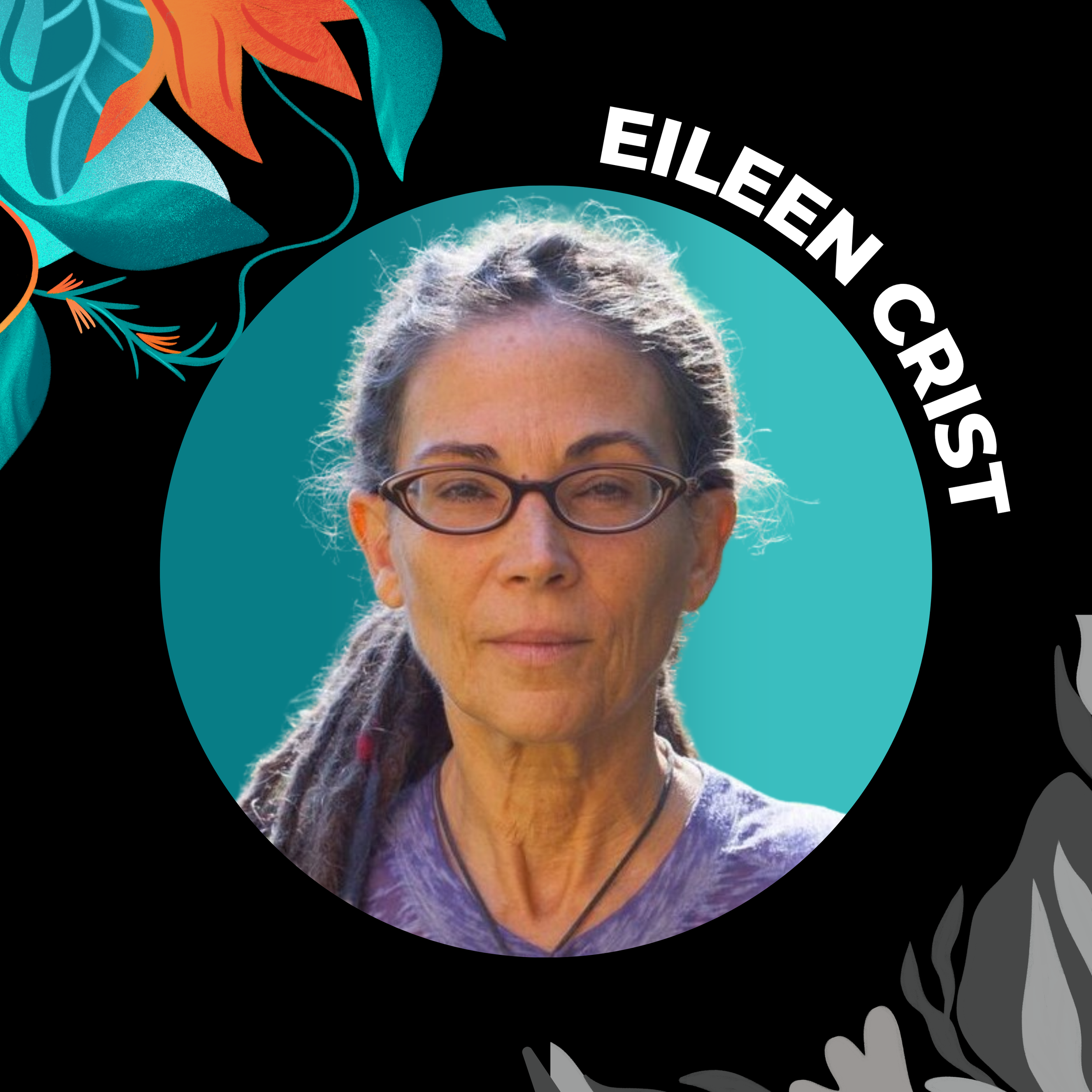



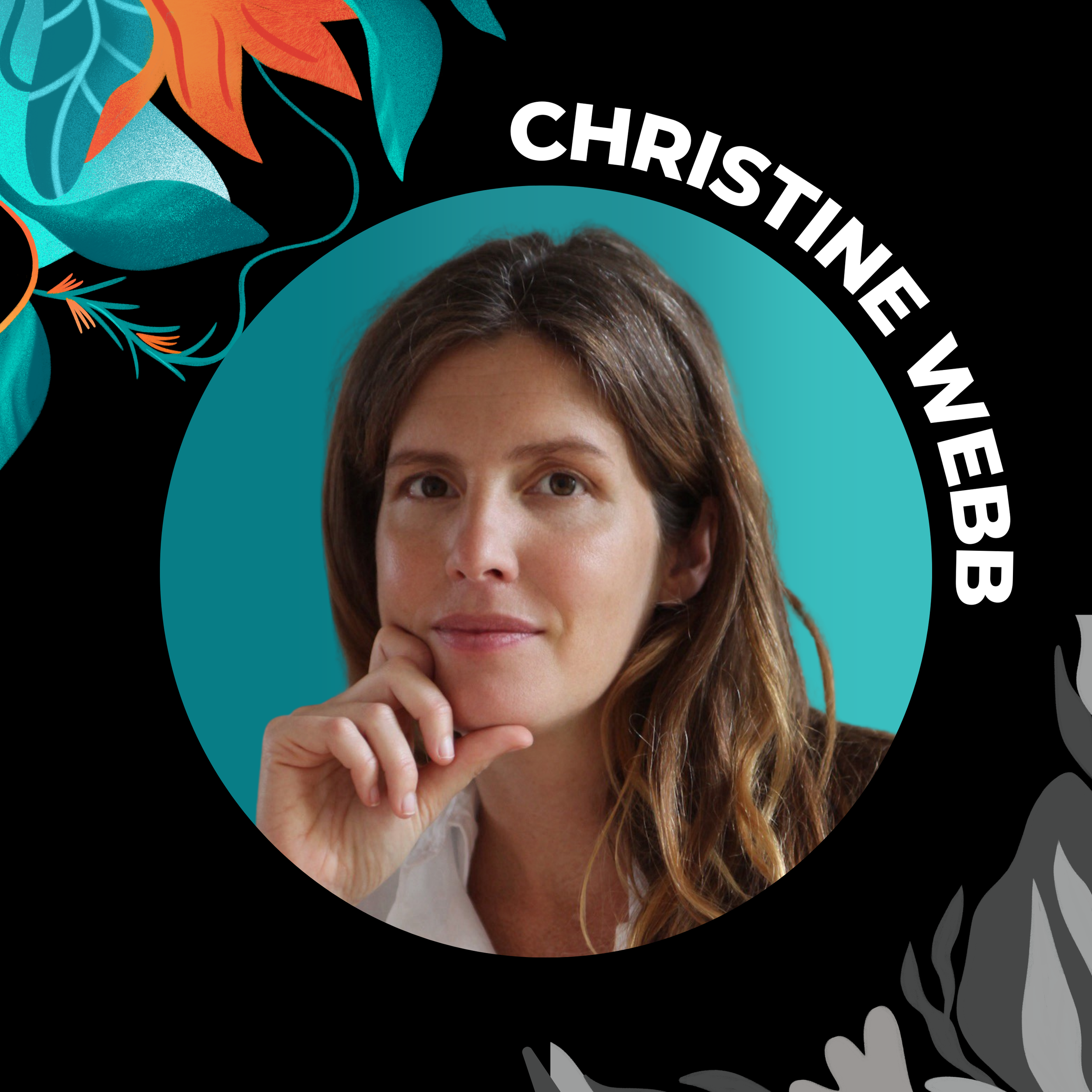
Republished from August 2022. The worldview of human supremacy is driving the human expansionism that is devastating the living world. Philosopher and environmental writer Eileen Crist, author of Abundant Earth: Toward an Ecological Civilization, offers a compelling alternative - reimagining ourselves as "Earthlings" and creating societies that make space for the flourishing of all life. Highlights include:
Why the biodiversity crisis is fundamentally a crisis of ongoing and relentless human expansion and results in continued depopulation of the nonhuman world;
How the worldview of human supremacy - the belief that humans are superior to nonhumans and all of nature - is the pervasive and unrecognized force driving human expansionism;
How human expansionism began with the first expanding empires, much earlier than modern capitalism;
Why creating an ecological civilization requires 'scaling down' human activity and 'pulling back' from nature to make space for nonhuman life;
Why plant-based eating is one of the most effective ways of increasing biodiversity;
Why language is critical, and how words like "weed" and "natural resources" distort our relationship to nature;
How we need to regain our indigenous-inspired identity as responsible, interconnected Earthlings;
Why an ecological civilization will be local in terms of living and also globally connected, replacing domination with coexistence in an age of deepening ecological overshoot.
MENTIONED IN THIS EPISODE:
-
Eileen Crist (00:00:00):
Everything we are, we owe to Earth. Our bodies, of course, but also our propensity to art, science, craft, medicine, spirituality. All these human gifts were responses to an extraordinary living world that captivated our senses and imagination. So it's important to see that this planet is not a human colony. It is an oasis in the universe. And life is a mystery we will never fully comprehend, let alone recreate.
Alan Ware (00:00:32):
Those were the inspiring words of Eileen Crist, a deep, profound and compassionate systems thinker. Eileen challenges us to reframe our relationship to the planet, moving beyond human supremacy and population denial and toward a truly ecological civilization. This is a republished episode of OVERSHOOT from August 2022. We're taking a short break and we'll return with a new episode in late August.
Nandita Bajaj (00:01:09):
Welcome to OVERSHOOT, where we tackle today's interlocking social and ecological crises driven by humanity's excessive population and consumption. On this podcast, we explore needed narrative behavioral and system shifts for recreating human life in balance with all life on Earth. I'm Nandita Bajaj, co-host of the podcast and executive director of Population Balance.
Alan Ware (00:01:35):
I'm Alan Ware, co-host of the podcast and researcher with Population Balance. With expert guests covering a range of topics, we examine the forces underlying overshoot, the patriarchal pronatalism that fuels overpopulation, the growth obsessed economic systems that drive consumerism and social injustice, and the dominant worldview of human supremacy that subjugates animals and nature. Our vision of shrinking toward abundance inspires us to seek pathways of transformation that go beyond technological fixes toward a new humanity that honors our interconnectedness with all of life. And now onto today's guest, Eileen Chris taught in the Department of Science, Technology and Society at Virginia Tech for 22 years, retiring in 2020. Her work focuses on the biodiversity crisis and destruction of wild places, pathways to halt these trends, and ways forward toward creating an ecological civilization. She's co-editor of a number of books, including Gaia and Turmoil, 2011, Keeping the Wild 2015 and Cohabiting Earth: Seeking a Bright Future for All Life, 2024.
(00:02:46):
She has authored and co-authored numerous academic papers as well as popular writings. She's associate editor of the online journal, The Ecological Citizen and blogger for Earth Tongues. Her most recent book, Abundant Earth: Toward an Ecological Civilization was published by University of Chicago Press in 2019. And now on to today's interview.
Nandita Bajaj (00:03:09):
Dr. Eileen Crist, it's really wonderful to have you in our studio today. We are huge fans of your work. And your most recent book, Abundant Earth: Toward an Ecological Civilization, resonates with us for so many reasons. Well, you've done an excellent job in describing the multitude of ecological crises we face while also offering a grounded, yet inspiring vision for a more harmonious relationship with the planet. In fact, your vision of the future also very beautifully illuminates population balances tagline, shrink toward abundance. We're thrilled to have you. Welcome to the podcast.
Eileen Crist (00:03:49):
Thank you. I'm really happy to be here. Thank you for inviting me.
Nandita Bajaj (00:03:52):
Great. So one of the primary concerns that you talk about in most of your work is with biodiversity. Most people assume it's about the number of species, but you make it clear in your book that it's much more than that. Could you explain to our listeners what a fuller definition of biodiversity entails?
Eileen Crist (00:04:10):
Biodiversity includes the whole tapestry of life, not only species. And biodiversity is also a comprehensive concept in being rigorous in science and intuitively available to a broader audience. People can understand that it's about the variety of life and what this planet is all about. So biodiversity includes the levels of genes, species, and ecosystems. Genetic diversity is about genes, of course, but really it's about the entities that carry genetic variation, which is populations. So having abundant populations of animals, plants, fungi is so important. Populations are the repositories of genetic diversity, and genetic diversity gives life forms resilience, which means evolutionary strength in the face of change. Now, species diversity is an amazing aspect of this planet. Take any nature show, for example, or a picture book of tropical species, and we see that species diversity is captivating. It's a feast for the eyes. We don't even know how many species there are on Earth.
(00:05:21):
About two million have been identified, but there could be seven, 10, or 30. Scientists tend to converge on 10 million, but we don't really know. So as an example, roughly 150,000 fungi species have been described, but recent research is indicating that there could be as many as four or five million fungi species. We don't even know the majority of species of fungi, let alone their ecological roles and their relationships. And species diversity also includes subspecies. Subspecies are not less important than species. They are extensions of the genetic diversity of a species, and they are expressions of evolutionary unfolding. So lastly, we have ecosystem diversity. Ecosystems are dynamic communities of plants, animals, and other life forms that are relating with one another and with a non-living environment. So the ecosystem concept really foregrounds that the living and non-living dimensions of Earth are inseparable. And in some cases, these dimensions are even fused.
(00:06:29):
That's the case with soil, which is a hybrid living and non-living entity. And soil is a phenomenon of a living planet. So there is no soil on lifeless planets. So yes, biodiversity is a comprehensive and robust concept involving all levels of life.
Nandita Bajaj (00:06:47):
That was such a thorough and beautiful response. And I especially love the piece that you just said, that the living and the non-living are inseparable and that there's no soil without a living planet. That's such a clear example of how interconnected the biotic and abiotic are. You also speak about the different ways in which biodiversity is currently being imperiled. Can you speak to that a little bit?
Eileen Crist (00:07:13):
Yes. It is imperiled at all these levels at the genetic species and ecosystem. So at the level of genes, what we are seeing today is huge declines of wild populations. This loss of abundances is eroding genetic diversity and impoverishing the manifestations of life. At the species level, the extinction rate is a thousand times greater than natural. And it is important to state that humanity is extinguishing perfectly healthy life forms who have every right to be here as much as we do. Now, this extinction crisis is fast turning into a mass extinction event where 50 or 75% of Earth species could be terminated forever. What's more, entire ecosystems are imperiled today. Some examples are coral reefs, coastal seas, the continental shelves of seas, rivers, grasslands, wetlands, tropical forests. So something that I fear is often not understood is that Earth's remaining biodiversity is a one-time gift.
(00:08:22):
If we destroy it, that's not fixable. It's a permanent impoverishment. And another thing that I fear is that many people think that the biodiversity crisis is happening somewhere else, somewhere remote. It's happening everywhere, including your backyard.
Alan Ware (00:08:38):
As you note, there are multiple drivers of this ongoing extinction of species and the simplification and eradication of different ecosystems and the genetic impoverishment. And agriculture you highlight is playing a major role in that around the planet. What are some of those effects that you see with agriculture?
Eileen Crist (00:08:59):
Well, scientists have identified habitat destruction, killing, pollution and climate change as main drivers of the ecological crisis. But the decisive blow on biodiversity comes from a combination of two or more causes. And this is being called the one, two punch or the one, two, three punch. Amphibians are an example of this. They're among the most imperiled of animals. They have suffered from habitat loss, pollution, a changing climate, and a disease that humans have moved around the globe. But it's not only amphibians. This is the general trend. Biodiversity destruction is happening from the multiple hits that populations, species and ecologies are experiencing and cannot withstand. So now turning to the agriculture piece of your question, it's a major cause of biodiversity loss, especially industrial agriculture with its monocultures and its chemicals. In fact, recent scientific literature from the last 10 years has identified food production as the leading cause of the ecological crisis.
(00:10:12):
Why? Exactly connected to the one, two, three punch. Food production has multiple impacts on life. One is the destruction of ecosystems. For example, mangrove habitats are turned over to shrimp production. Grasslands are converted to grain monocultures and wetlands get drained for agriculture. As another highlight is the freshwater biodiversity crisis, which few people in the mainstream know about. There's been precipitous declines of fresh water populations and species. Where is the water going? Most of the water humans take goes to agriculture. Further down the line, climate change. At least 30% of greenhouse gases comes from food production. And this includes the methane of the livestock and the nitrous oxide from the fertilizers. Both of these are very potent greenhouse gases. Another connection is steep declines of big wild animals. Carnivores are killed around the world because they threaten livestock and herbivores are killed and pushed off their habitats to convert into agriculture.
(00:11:25):
A further impact of food is the killing of pollinators and the diminishment of soil biodiversity from the pesticides and the fertilizers. So this is why agriculture is so destructive. Its impact is multifaceted. And while we're on the topic of food production, let's not forget industrial fishing. Marine life is a fraction of what it was even 50 years ago. And the biggest factor of ocean life destruction is commercial fishing. Now, as a last point, I want to add that we would be remiss not to mention scale. 40% of Earth's ice-free surface is given to agriculture and some 90% of the ocean is open to fishing. So this is the toll of food production and agriculture.
Alan Ware (00:12:09):
That is quite a list. How do you think we can remedy some of the destructive impact of this global agricultural food production model?
Eileen Crist (00:12:19):
Well, there's a lot that we need to do to reverse biodiversity's impoverishment, but in connection to food, we can highlight one game changing action. And that is the benefit for Earth if humanity embraces mostly plant-based eating. Of that 40% of land that goes to agriculture that we were just talking about, 30% goes to livestock, either as crop lands to make animal feed or as range lands for grazing. So going mostly plant-based is hugely beneficial for biodiversity. And also of course, for human health and for animal welfare. This would allow a lot of land to be returned to wild nature. And the abundance of marine creatures would resurge. So that one thing that we could do, and we don't have to wait to do this relatively swiftly, is mostly plant-based eating. It would make a huge difference.
Nandita Bajaj (00:13:13):
I've read some of your work where you've appropriately described the humanization of the planet and turning it into a human food pantry. It really helps to have that visual to understand what a huge role agriculture plays. Because of course, when you first think about the impact of human encroachment, people often say, we don't take up that much space and urban development really only takes up what, 1% of the land. But what a lot of people don't realize is it's all of the energy that goes to sustain us that is using up most of the land.
Eileen Crist (00:13:51):
Absolutely. That's the population connection. It's not this sort of trivial argument that sometimes people make that if you were to take the whole population and stand them up, they'd fill the state of Texas. That's not the point. It's not the amount of space we take as physical bodies. It's the amount of space we take for food production. And as population continues to grow and as consumption continues to grow, as people become more wealthy, if that trend continues, things are only going to get worse.
Nandita Bajaj (00:14:23):
Yeah. And along that line, you've appropriately argued that a major driver of the ecological crisis is the worldview of human supremacy. I've heard the term anthropocentrism before, but can you first describe what you mean by human supremacy?
Eileen Crist (00:14:40):
Human supremacy is a worldview. And what that means is it's a big shared idea that humans are superior to all other species and entitled to do what we want to them. Human supremacy is about seizing the power of life and death over non-humans and assuming the prerogative to own all geographical space. Now, human supremacy is not so much an official doctrine. It's not something that people learn in school, so to speak, explicitly. It's much more of a background assumption that humans are above the rest of life and in charge of planetary affairs. Now, the reason that human supremacy is a worldview is because it covers a wide gamut of actions. For example, take factory farms. They're also called concentrated animal feeding operations. Sadly, this way of making meat, dairy, and eggs is spreading throughout the world. Farm animals in these operations are treated abysmally. They're reduced to objects in an industrial process.
(00:15:52):
So how could we possibly treat animals this way? Human supremacy is the operative assumption. They are beneath us and they are for us. Take another example of overtaking entire biomes. So a biome is a very large ecosystem, such as for example, grasslands around the globe. They have been turned into what we call bread baskets. Over 95% of the American prairie has been repurposed for corn, soy, wheat, and livestock grazing. Now, what gives us the right to convert an entire biome decimating and endangering its native species? It never crosses most people's minds to wonder about such excess of scale. It just looks normal from a conventional perspective. Why? Again, human entitlement is the operative assumption. And so we could multiply examples here. Commercial fishing, which is fishing out the ocean, large scale fracking of landscapes, killing contests for coyotes and sharks, or filling forests such as in Southeast Asia with snares or drowning the world in glyphosate.
(00:17:04):
This is one of the most important aspects of human supremacy because once you get the human animal divide down, everything else can follow, right? Because animals, obviously, we are so closely related with them. They have faces. We can see their emotions. We can see their intentionality. So if you can put that dividing line between animals and humans, you have the dividing line between humans and all of nature. So the bottom line is that the wide span of destructive actions that it enables is what makes human supremacy a worldview. In the environmental literature, human supremacy and anthropocentrism tend to be used in the same way as concepts, but they carry very different connotations. Anthropocentrism leans into the metaphor of the center. It literally means human-centered. And this fails to communicate the element of unequal power. On the other hand, human supremacy immediately conveys that it's about power over nature, about hierarchy between humans and the rest of life, and therefore that it's also a matter of injustice.
(00:18:14):
I do want to insert one small comment here, and that is that other thinkers, Derek Jensen in particular, and Val Plumwood, the environmental philosopher, have used the term human supremacy. So I think that human supremacy is a better term that way when we recognize how terribly we have treated and treat non-human beings and when we consider the scale of human takeover of Earth.
Alan Ware (00:18:38):
Right. I think some of this divide, it starts at such a young age, especially in Western urban and suburban environments where school are these sterile indoor spaces that are completely cut off from natural spaces. Natural spaces are visited for very brief periods for certain field trips that might not even be natural spaces. So I think very early on, we're taught that there's this firm separation between the real things we study in school that have more of this human supremacist bent and going outside into the natural world and accepting nature on its own terms, learning about it and learning to love it by learning about it. So it's a shame. And I think there is more outdoor education coming in, but it's still such a minor part of our education starting at the youngest age that builds in this human supremacy view.
Eileen Crist (00:19:28):
Very much so. This separation has become increasingly physical as well when we consider urban environments. I agree.
Nandita Bajaj (00:19:37):
Yeah. I know we've talked about this being a worldview that's shared across cultures. In your work, have you found any cultures in different times and places that have been less human supremacist?
Eileen Crist (00:19:51):
Yes. I would definitely want to talk about that. Indigenous people have had a very different relationship with nature, a more egalitarian and harmonious cosmological perspective of the connection between humans and the natural world. It's important to qualify that by saying that we don't want to idealize indigenous cultures, nor do we want to homogenize them across time and space. But still with that caveat, it's fair to say that native people have been respectful and reverent of nature. In some cases, they lived for millennia in particular regions without degrading their environments. And we can take on board some recurrent indigenous motifs that are relevant here. One is that indigenous people regard animals and plants as kin to humans. And as persons, non-humans can witness human actions. So for indigenous people, non-human beings are awake and aware, and it matters to be respectful of their lives and of their experiences in the world.
(00:21:00):
Another common thread is that indigenous people do not have a frontier mentality. Nature is not something to be constantly encroached upon and overtaken. Indeed, native means a way of life that fits in, that is enveloped by a bigger and sacred world. Another shared indigenous quality is intergenerational awareness, receiving the wisdom of the ancestors with respect to the land and passing down a preserved environment to posterity. So as a last point, I'd like to highlight some key indigenous values that are recurrent in the literature of indigenous authors. Reciprocity, gratitude, kinship, affection, respect. So considering the question of, okay, how do we overcome human supremacy, this dominant story that we are above the rest of life and entitled to use it as we will? I think it's really vital to see that it is a false story. Human supremacy is a historical inheritance. We don't have to stay saddled with it.
(00:22:10):
We are neither above nor separate from nature. We are dependent on the planet for every breath we take. On average, that's 15 breaths per minute from the day we're born to the day we die. We are beholden to life for making this perfect air. What's more, the human species emerged at a high point of biodiversity. That biodiverse world galvanized humans. Everything we are, we owe to Earth. Our bodies, of course, but also our propensity to art, science, craft, medicine, spirituality. All these human gifts were responses to an extraordinary living world that captivated our senses and imagination. So it's important to see that this planet is not a human colony. It is an oasis in the universe. And life is a mystery we will never fully comprehend, let alone recreate. Indigenous people have always understood that life works through diversity and interconnections. And human beings are invited to the table as equal partners, not as a planet's aristocracy.
Alan Ware (00:23:22):
So along with human supremacy, you've mentioned human expansionism as another primary driver of the ecological crisis. How would you describe human expansionism?
Eileen Crist (00:23:32):
Well, the two are definitely connected. Expansionism is about the growth of the human enterprise. Now we can call it endless growth, but growth is a biological metaphor and it often has positive connotations. So expansionism may be preferable. Expansionism really delivers a palpable spatial sense of humans leaving no stone unturned and no blank spot on the map. Now, human supremacy is connected to expansionism. Supremacy gives permission to the human enterprise to keep growing because the underlying assumption is that humans are entitled to sprawl over the face of the Earth. All human systems are expanding and demanding more of the planet. And since the 1950s, expansionism has been accelerating. So specifically we have continued economic growth, extraction, production and consumption of stuff and energy. Demographic human numbers continue to grow and infrastructural expansion. So more roads, cell phone towers, satellites, pipelines, electric grids and the like. And infrastructure growth is, though it's rarely considered, especially in the mainstream and conventional society, is very destructive of nature, especially when we consider highways and roads, which are multiplying without end in sight.
(00:25:02):
That infrastructure gives access for agricultural development, for mining, logging, poaching, settlements. So it enables biodiversity destruction. And of course, we need to add to human expansionism the huge waste flows that Earth cannot absorb. Agrochemicals, carbon dioxide, nitrogen, plastic, sewage, garbage, e-waste, and more. So here's another way to think about expansionism is through the idea of the technosphere. The technosphere is defined as the entire human made mass of stuff. So it includes everything. Roads, houses, fishing vessels, dishes, sidewalks, all of it. And now here I'd like to share some stats from a nature paper that was published in 2020. In 1900, the technosphere was 3% of Earth's total biomass. Biomass is the weight of all living things. So the technosphere was 3% of that. In 2020, the mass of human-made objects exceeds the weight of all living things on Earth. Buildings and infrastructures weigh more than all the world's trees and shrubs.
(00:26:18):
The mass of plastic is double the biomass of animals. So wrapping our minds or trying to wrap our minds around the swell of the technosphere is a good proxy for human expansionism.
Alan Ware (00:26:32):
And capitalism has been a very effective way of taking inputs in terms of all the natural resources got by human supremacy, turning them into products so that we can get fleeting emotions and feelings from those products, whether it's security or status or survival, and then turning it into waste and pollution on the other side. Do you see capitalism as having a unique part of this story of human expansionism?
Eileen Crist (00:27:01):
Yeah, absolutely. Capitalism is inherently expansionist because of the motive in particular of wealth accumulation. Capitalism is geared toward overproduction and like you just said, toward inciting over consumption. So capitalism keeps the extraction engine going. It keeps extraction going and it's always looking for new places to extract from. It's also seeking always to expand markets and to grow its customer base, not only by roping in more people, but by finding new populations like expanding sales for kids and for pets. Capitalism is constantly fabricating new desires through advertising. And capitalism makes endless versions of the same things, whether that's cars or crackers or lighting fixtures or pocketbooks or shoes or TVs. You name it, it's a bottomless pit of overproduction. Now, just as an example, here's another stat from that same paper. The amount of new stuff that is made every week is equivalent to the body weight of 7.8 billion people.
(00:28:20):
But I'd like to go a little further on this question of capitalism and ask, is capitalism the root problem? So some analysts imply that if only we could change the capitalist system to some kind of other economic system, everything would be fine. But capitalism is not the root problem. It came from somewhere. The drive for wealth accumulation is far older than capitalism. It's as old as civilization and empire states. The wealth that elites have pursued from the dawn of history demanded domination over the natural world. That's the key. Domination over the natural world is the key. Why? Because nature is the source of all wealth. So well before capitalism, empires turned land into human property and constantly expanded agriculture into wildlands. Empires entrenched the enterprises that are still with us, deforestation, mining, draining wetlands, constant road building, and warfare for loot and for more land and for resources.
(00:29:29):
Empires also initiated what today is called defawnation, the downfall of wild animals killing them or driving them away, especially the big ones who need a lot of space. So the domination of nature and the idea that nature is a collection of resources to turn into wealth preceded capitalism by millennia. Capitalism inherited that view and has enacted it on a far bigger scale because of some new history Oracle realities, and especially since the 19th century, specifically fossil fuel energy, of course, and machines, machinic technology, a hugely increased human population and its demands, the transportation revolution, which is entirely unprecedented in history. More recently, the growth of the middle class, full scale globalization of trade, virtual interconnectivity, which has really speeded up economic transactions, and the invention of the credit card, which fuels consumption. So all these things have superscaled the destructiveness of the system, but to supersede capitalism, to create something new, a new way of human life on Earth, we have to go to the root and end the domination of nature on which wealth production depends.
(00:30:52):
If we don't question the domination of nature, then what happens is that the solution to capitalism's problems get restricted basically to two things, regulating industries and redistributing wealth. But this solution package doesn't challenge the fact that wealth comes from plundering the Earth at the expense of countless species and wild places. Instead, this particular solution package of industry regulation and wealth redistribution is all about sharing the plunder more equally among humans.
Nandita Bajaj (00:31:29):
Right. Yeah. Another point I wanted to add is capitalism has not only fabricated desires for things, but one of the key things we look at at population balance is pronatalism. Capitalism is also taking a lead in fabricating a desire for babies. All you need to do is take a look at the multi-billion dollar baby industry, the IVF industry. You've taken one of the most consequential decisions of your life and turned it into a commodity.
Eileen Crist (00:32:02):
Absolutely in agreement with you. Of course, pronatalism is also far older than capitalism. It's connected to patriarchy. So to gender inequality and also to empires that needed expendable people to do the work that the elites didn't want to do and to fill the armies. And today in capitalism, to be consumers, which is connected to the growth of the middle class. So yeah, pronatalism is far older than capitalism.
(00:32:37):
And at this moment in history, not only can gender equality confront this trend, but we need a newfound attitude about bearing children. So I grew up as well with that expectation. It's the default expectation, sort of when are the grandchildren coming? When are you going to have children? And we need to move away from that default expectation and allow for the possibility of women to authentically choose to have no children. And the emphasis here is the authentic choice. But in order for choices to be authentic, we have to have the options be equal, right? That the expectation for having children isn't overloading people's minds so that they automatically go in that direction.
Nandita Bajaj (00:33:28):
Right.
Eileen Crist (00:33:28):
But that there is no expectation. Maybe you'll have children, maybe you won't. That it's a choice and that you can take on board all kinds of things in making that choice so that that choice is authentic.
Nandita Bajaj (00:33:41):
So well captured. Yes. And you just started alluding to the growing middle class issue as tied to capitalism. You've expressed your concern of a growing global middle class that is on track to possibly reach five billion before mid-century. What are some of the main concerns you've found in your work?
Eileen Crist (00:34:01):
Well, the global middle class has been growing exponentially since the 1990s. And it's projected to grow toward five billion or more well before 2050. Most of this coming swell of the middle class will occur in emerging economies, in particular in China and India. Now we have to note that the pandemic has stalled that growth, but not stopped it. But what we've learned from the pandemic is that these projections of a global middle class growth could be derailed from economic breakdown or civilizational collapse from climate change or war or another pandemic or something else. But with that caveat, let's turn to the impact of the middle class. So how do we define it? Middle class can be defined in terms of income, or usually it's called incomparity, but we get a better understanding of middle class and of the ecological costs of the middle class when we look at it as a lifestyle.
(00:35:03):
So entry into middle class means participating in the global economy, which moves massive amounts of stuff around the globe. Being middle class entails being surrounded by commodities, a commodity's saturated life with computers, tablets, phones, TVs, paper, clothing, imported foods, washing machines, you name it. Also middle class avails much more of services like travel, entertainment and eating out. And services, of course, have a material and energy base. They're not a dematerialized aspect of the economy. Furthermore, a middle class lifestyle, middle class status entails increased energy use. And of course, all these things are tied, right? But we can just highlight them. Increased energy use. Now we can consider one repercussion of that. As long as fossil fuels are society's main energy source and the global middle class keeps swelling, we will not be able to get a handle on climate change. Furthermore, middle class comes with car ownership usually.
(00:36:12):
There's about one billion cars globally, and we're heading to three, four or more billion in this century. Think about the implications of more manufacturing, road building, pollution, traffic and roadkill. And another middle class trend to mention, at least so far, is that it involves increased consumption of meat, dairy, and fish with our huge costs for the global ecosystem. So all these aspects of the middle class lifestyle in the aggregate are taking an immense toll. We could say that the impact of the middle class is all about excessive consumption magnified by a large population size.
Nandita Bajaj (00:36:53):
Yeah. And that meat consumption piece is quite stark actually, because if you look at the data from just the last 50 years of the increase in meat consumption, since our population has doubled from four billion to approximately eight billion, meat consumption has gone up by a factor of three and a half. Seafood consumption has gone up by a factor of four. And the greatest increase has actually happened in Asia. A tenfold increase in meat consumption, which is where you've mentioned the global middle class rise is happening much faster in the Asian economies. So the population factors simply cannot be dismissed in the growing humanization of the planet. The other related question to this is, how can we balance the rightful striving of billions for the comfort and security that billions of us already take for granted with the fact that the planet cannot withstand several billion more of us middle class consumers?
Eileen Crist (00:38:01):
The rise of the middle class is really a conundrum. On the one hand, what we're seeing, just like you were saying, you were alluding to, people want this way of life. It seems they want this way of life with its computers and gadgets, it's personal mobility and conveniences. And on the other hand, the middle class lifestyle is rapidly deciding Earth's fate because of the overwhelming demands on the planet and the overwhelming waste output. At the same time, poverty still exists. Even though in the last three decades, poverty has actually been much reduced precisely in tandem with the middle class having grown. But still, there are about one billion people who do not have electricity and other modern amenities. And this is changing as it should, right? Equity demands that if people want modern amenities and modern opportunities, they should have them. They should not be a privilege only of some.
(00:39:02):
So what's the solution, if indeed there is one, what's the solution to allow for human fairness without destroying Earth? There is not one solution. There is no silver bullet here. For starters, we can see that the global population size is crucial. Since human beings are converging toward middle class living, how many of us there are matters enormously. So we should work within a human rights framework to gradually reduce our global numbers. Population, however, is only one factor. We need to downscale economic life as soon as possible. And one way to go into this, to the how of this is to note that heating the catchphrase reduce, recycle, reuse still goes a long way. We have to reduce extraction, production and global trade. And we can do that by creating slower economies. An important way to slow the economy down is to reduce the work week.
(00:40:03):
So to work a lot less, and this will be a blessing, right? It will free time for hobbies, relationships, nature, service work, cooking. All these things are important for the good life and so many people do not have time for them. Also, we have to stop producing luxury and superfluous products and especially mass producing them. So for example, handmade jewelry from your local artist at the local market is a better way to acquire jewelry than buying it from the big box store or buying it online. Moreover, products need to be made to be durable. The constant production of new lines of products, things like phones, computers, and cars, for example, that are so materials intensive and so water and energy intensive, this is unacceptable. Stuff should be made to last. Updated in decadal timelines and made with materials that are recyclable. Reuse is all about valuing what we have, mending our stuff, passing it down and preferring to buy used rather than new.
(00:41:17):
Now, all these solutions could be pursued right away. It's about the political and social will to do so. But what is ultimately needed is a complete transformation of economic life. And this will take more time. That transformation or the heart of it is about becoming local. For example, regarding food, if we could say especially regarding food. Eating local means that human communities are zoned with farms. People need to live nearby to where most of their food is made. That way, we will know food's ecological context, what kind of labor was involved. Moreover, that means that the food will not have any food miles or far, far fewer food miles. Also, it will be food that is fresh, more nourishing, and so reducing healthcare budgets and human suffering. And local food will involve much less food waste because programs can be instituted that return food residues to the farmers to compost back into soil.
(00:42:20):
Another big piece of the local economy is to see a renaissance of the crafts. Instead of buying the standardized mass produced stuff shipped from who knows where and made who knows how, it means acquiring products from your local craftspeople. And many things that we daily consume or desire can be locally made, just like we were saying about the jewelry, but also things we use like dishware, pottery, clothing, furniture, prepared foods, art. All these things can be crafted nearby. So to circle back to the question of how do we balance middle class living with a biodiverse Earth? We do so by reducing the global population and by downscaling and transforming economic life.
Alan Ware (00:43:08):
Yeah. So that reminds us of Paul Ehrlich talking about the rectangle of human impact and one side is the number of people in a population and the other side is the average consumption for each of those people. And you've just included both in that. And like us at Population Balance, you certainly understand the critical role in lowering human numbers will create a necessary reduction in total human impact. And you've mentioned a number of two billion as a possible sustainable population. How did you reach that number?
Eileen Crist (00:43:38):
Population is the factor that scales up consumption. Even the basic aspects of human life can get scaled up unsustainably by human numbers. Basic things like food requirements, water, building materials and sanitation capacity, let alone middle class consumption that we were discussing. So simply common sensically, we can see that two billion is more sustainable than eight billion or more for Earth and for human quality of life, but there's a more rigorous rationale for two billion as a sustainable population. And it's the agronomist David Pimentel who provided a scientific analysis for this. And it involves food production. That's at the heart of the analysis. So a population of two billion can be supported by a healthy food system while also allowing expansive nature protection and the preservation of biodiversity. Pimentel specifically built into its analysis, a modern standard of living that is modest. So roughly European levels and also equitable among people.
(00:44:49):
So this is the ecological rationale of two billion. It's good for human health, good for the integrity of the planet and ethical for animals. And that's what it's all about, that win, win, win alignment, right? So is the optimal number two billion? Is it one billion? Is it three billion? We don't know exactly, but we do know that it's a lot lower than where we are and where we're headed.
Alan Ware (00:45:16):
We would agree.
Nandita Bajaj (00:45:17):
And in your book, you also mentioned, and you sort of alluded to that right now, is two aspects of lowering our consumption. You call it scaling down and pulling back as the most intelligent, two-sided strategy to address the ecological crisis. How do we do those two things?
Eileen Crist (00:45:38):
So the one involves human systems and the other involves nature. Scaling down means downscaling human systems. Pulling back means pulling back from nature, freeing the natural world to be the lively matrix of biodiversity. These two things need to be pursued together. In order to preserve Earth's biodiversity, both for its own sake and for the sake of future people, we have to protect nature on a large scale. And to be able to achieve this, humanity has to contract its demands from nature and substantially reduce pollution. So the scaling down is all about what we've been discussing, lowering the human population, transforming economic life, especially ending overproduction and valuing local living and the conservation of stuff and energy. Scaling down also means minimizing infrastructural growth and building no infrastructure in natural areas. And in fact, even removing infrastructure from wild places. Now, pulling back is about generously protecting land and seas.
(00:46:51):
Conservation scientists are urging global society to move toward protecting half of Earth's ecosystems. This is known as half Earth or nature needs half. This scale of nature of conservation is required to stop extinctions and to avert a mass extinction. It's also needed to deal with climate change. Scientists are now using the term natural climate solutions. Protecting and restoring wild places has enormous greenhouse mitigation potential, both in terms of keeping the carbon stored in the natural world and in absorbing the carbon dioxide that we have emitted. And an important last point about pulling back is that large scale nature protection inaugurates a new relationship between humanity and Earth. One of peaceful coexistence, respect and wonder, and mutual thriving.
Alan Ware (00:47:50):
So in your essay, Eathlings (We, Us), you make the point that sociocultural identity politics is interfering with the need to see ourselves as Earthlings whose ultimate ground of commonality is Earthling should supersede these other identities. Could you elaborate on the ideas you wrote about in that essay?
Eileen Crist (00:48:09):
I think that we are all feeling a sense of the fracturing of the human community these days. People are retreating into social identities for a sense of security, of knowing who they are and who they belong with. So this contracting into social identity is a response to the uncertainty and fear that many people are experiencing today. We could say that social identity is playing the role of safe zone. And life on the internet is amplifying this retreat into separate social identities. Instead of being like a collective hive, the internet is more of a collection of separate cells that are sealed off from one another. And the more time people spend in their favorite cells, the more reinforced do their convictions become. So social identities are hardening. Now, to the extent that social identities are antagonistic with other social identities, this means trouble because hostility and disdain and negative emotions have a fertile setup.
(00:49:17):
This condition that we are in is extremely dangerous at so many levels. People cannot work together exactly at the time when we need to come together and work together. And there's distrust, there's violence and there's war. So to switch gears to a brighter possibility, the identity of Earthling says this. Look, we have a shared identity. We are Earthlings among so many other non-human Earthlings. And we are all relatives. Even within our inner bodies, we are composed of non-human cells, of microorganisms that we cannot live without. And the identity of Earthling is not only shared. It is solidly real. It is permanently who we are. As long as we exist in the universe, it is permanently who we are. But other identities, they come and they go. There used to be Babylonians and Atruscans and many, many others who no one except historians has ever heard of.
(00:50:19):
And do we ever hear about them now? So I'm not arguing that people should give up their heartfelt social identities. That would be presumptuous to argue, but let's not hold on to social identity so tightly that we become indifferent and hostile to others and that we forget that before all else, we are all Earthlings.
Alan Ware (00:50:41):
Yeah. Yeah. I love that.
Eileen Crist (00:50:42):
So Earthling really invites us to open our hearts to this shared reality and to attend to the question of what is happening to all Earthlings right now on the planet.
Alan Ware (00:50:54):
Yeah. Cultural evolution is so fast and these social cultural identities are part of that cultural broth and it changes so fast, but the ground of our being is an Earthling human creature. And that will be the ground in the future too, once all these social streams have recombined or extinguished or new ones have formed.
Eileen Crist (00:51:16):
It's the forever ground.
Alan Ware (00:51:17):
Yeah. It's the forever ground. I love that.
Nandita Bajaj (00:51:19):
And it's a great segue into the next question we have for you, which is about language because so much of what you've just spoken about is also identity through language. And you've noted that the environmental movement has used language like ecosystem services, fisheries, natural resources, terms that limit our worldview. What do you see as the critical role that language plays in discussing the ecological crisis?
Eileen Crist (00:51:46):
Language is incredibly important. Concepts in particular are very important. Through a concept, what we do is we project a particular meaning on the world. And then we see the world through the lens of the concept. So when a concept becomes conventional, that is to say widely used, people forget that they're seeing the world through the lens of the concept. Instead, the concept appears to be portraying how things are. So let me walk this home with an example. Think about the word weed, W-E-E-D, right? It seems so straightforward. Everyone knows what a weed is and what the word means. But if we take a closer look, we see that it's not straightforward. It's loaded. Weed carries a world of meaning and consequences. It means unwanted plant. Weed also means a commonplace plant. So we say it grows like a weed. It's something kind of inherently contemptable.
(00:52:51):
And weed therefore is something that invites, it even deserves a weed killer. So the next thing you know, everyone has a bottle of herbicide under their kitchen sink or their garage. And the next thing you know, it's all collectively dumping into the estuary. So a simple word like weed has colored your perception, has imbued you with disdain towards certain plants, has condoned herbicides and their consequences. And of course, the word has screened the reality of the plant itself that's been labeled a weed, such as, for example, the dandelion, which is not only a pretty plant, it turns out to be a superfood. Now we can go down the line and look at concepts that are so often used, of course, like natural resources, marginal lands, fish stock, vermin, game, trophy. If we look at all these words closely, we notice that they're either derogatory of nature or of some aspect of nature or human possessive.
(00:53:55):
So it's really important to be aware of how words color perception and guide action. To give one more example, if we call an animal a pest or an invasive, what is that word saying? Effectively, it's saying that it is an animal beneath contempt and killable. Now, I do want to address the concept you brought up of the ecosystem services because scientists and others who use this concept use it with the best intentions. And it's true. We get all kinds of free services from nature. We get the air, soil, food, medicine, pollination, water filtration, storm breaks, and spongy forests trickling down the freshwater at nice speeds, right? But why do we need to call these amazing things services? Even though it is a dead metaphor, right? No one thinks that nature is actually serving us, but still it's the word of choice and it comes with a ring.
(00:54:56):
It echoes human entitlement that we are here to be served. So why not call ecosystem services ecosystem gifts? That's a metaphor as well, but it's a more beautiful one and it invites gratitude.
Nandita Bajaj (00:55:10):
That's beautiful.
Alan Ware (00:55:11):
So in general, how would you describe what an ecological civilization might look like?
Eileen Crist (00:55:17):
Well, we have touched on this question indirectly in many ways, but we can delve into it more. Between human communities of an ecological civilization, there will extend vast areas of protected land and seas that belong only to themselves. Earth's freedom will enable the resurgence and flourishing of biodiversity. And by the same token, a wild planet is the preserve of humanity's wilderness skills. So let me elaborate. Human beings have profound capacities of subtle perception. It's in our genome, in our genetic inheritance that we have lost. We have lost these capacities with modern life. And again, indigenous people show the way they exhibit extraordinary capacities of perception, of tracking wild animals, communicating with non-humans, navigating in the world and spiritual questing. So within the free expanse of nature, of an ecological civilization, human beings can be visitors guided by skilled leaders coming to wild nature to learn, contemplate, commune, perceive in expansive ways, heal and preserve the arts of survival.
(00:56:35):
We can add here also the practices of snorkeling and scuba diving that are modern gifts to the world. In an ecological civilization, the ocean is not primarily for eating. It's for witnessing a world of exquisite beauty, restored beauty, and expanding our minds through that experience. Ecological civilization also means, like we have been discussing, that human communities will be place-based with slow economies, a new culture of consumption that values conserving stuff and energy with a renaissance of local crafts and mostly local good food, plant-based and diverse. I think that it's also important to transform our concept of work. People need meaningful work for fulfillment as opposed to a job for a paycheck, right? And we also need time for the equally important parts of human life, like relationship and hobbies, nature, food preparation, meditation, physical activity. These are very important for a meaningful life. On that note, I would like to add about children, that children will be raised close to nature to sustain their spontaneous wonder for the natural world.
(00:57:55):
And children should be educated to find their gift or their calling in life. In an ecological civilization, sustainable populations will be able to persist because the institution's underlying sustainable population will be in place, namely full gender equity, children's rights, high quality family planning, comprehensive sexuality education. And let's add the elevation of adoption as a common and valued norm for creating larger families. Last point, but far from least, an ecological civilization means a fully demilitarized world. All the weapons have to go. An ecological civilization is about creating a safe world. It's not about having security, quote unquote. A world of peace is a safe world. With human communities united through ties of modest training and the lively exchange of ideas. So an ecological civilization means local in terms of living and global in terms of sustaining human connectivity so that the human mind stays open and receptive to other ways and cultures.
(00:59:15):
So I want to finish by saying that I don't offer these thoughts as a program, but rather as ideas to think with in moving toward an ecological civilization, toward a new way of human life. Many people might think that all this sounds hopelessly utopian, but it's not so. Imagination is a great human strength and dreaming underpins all social movements. We are today on the verge of catastrophic decline. It's time to dream. Reforms here and there will not be enough. We need to reimagine human life on Earth.
Alan Ware (00:59:52):
That's a beautiful vision. And to get humanity more in touch with what I think is our ultimate future, we are going to have to live of long-term imbalance. So we might as well start looking at that now seriously. That was amazing.
Eileen Crist (01:00:07):
Thank you.
Nandita Bajaj (01:00:09):
Thank you so much. That was an incredible, incredible discussion.
Eileen Crist (01:00:13):
Thank you for having me.
Alan Ware (01:00:15):
That's all for this edition of OVERSHOOT. Visit populationbalance.org to learn more. To share feedback or guest recommendations, write to us using the contact form on our site or by emailing us at podcast@populationbalance.org. If you enjoyed this podcast, please rate us on your favorite podcast platform and share it widely. We couldn't do this work without the support of listeners like you and hope that you will consider a one-time or a recurring donation.
Nandita Bajaj (01:00:42):
Until next time, I'm Nandita Bajaj thanking you for your interest in our work and for helping to advance our vision of shrinking toward abundance.