
The Ghastly Costs of Population Denial
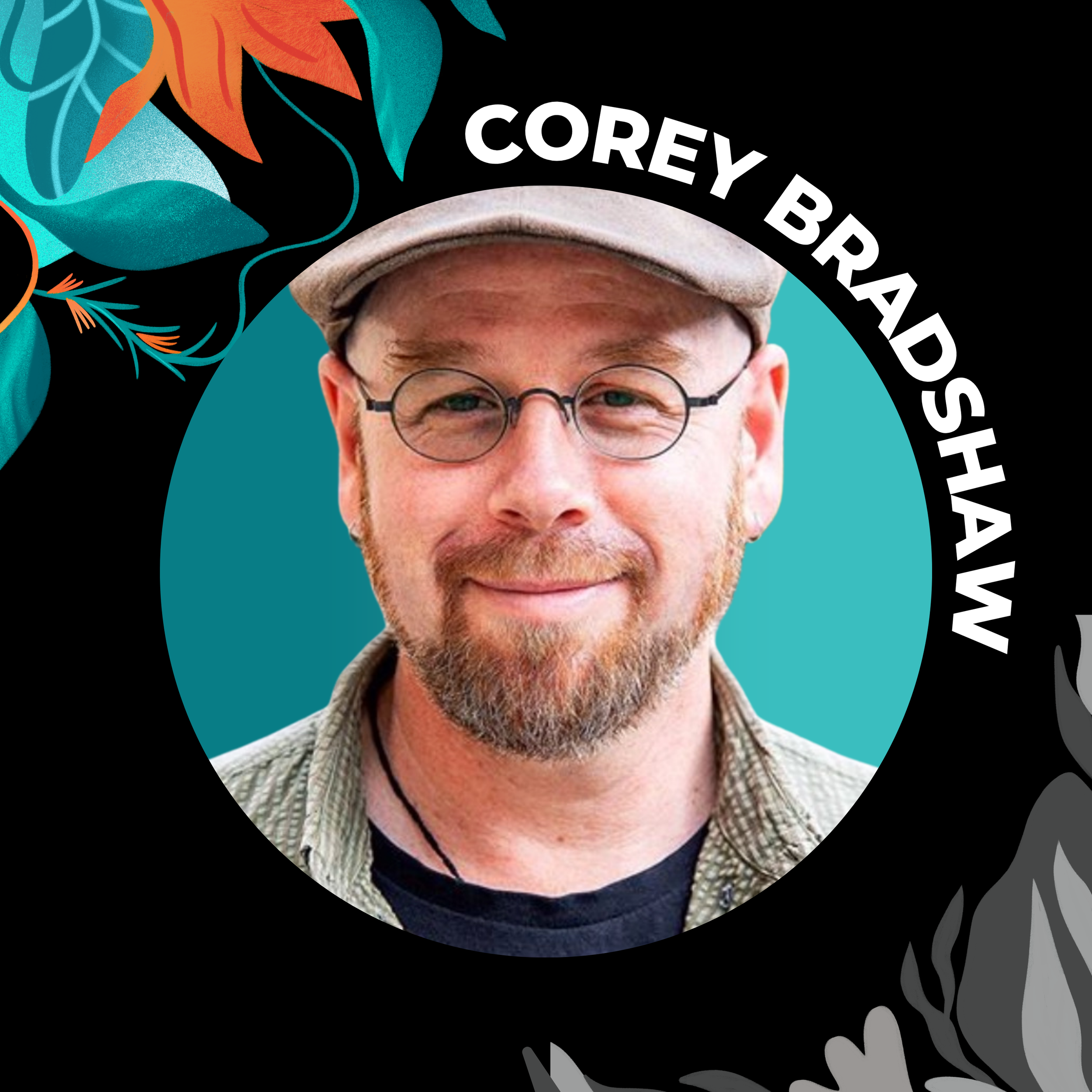



Humanity is pushing life to the brink. Mathematical ecologist, Corey Bradshaw, explains how our growing population and consumption are driving the depopulation and extinction of countless species while pushing Earth's ecosystems beyond their limits. We explore why overpopulation remains politically taboo, why fears of falling birth rates are misplaced given the evidence of better socioeconomic outcomes in aging societies, and why, although the future will be 'ghastly,' it's still up to us to make it 'less worse.' Highlights include:
How human activities shrink wildlife populations and genetic diversity, making species increasingly vulnerable to extinction through environmental shocks;
Why humanity is likely driving a mass extinction, even though we may never be able to fully measure its scale because most species remain undiscovered;
Why rising wealth and technological efficiencies have resulted in more ecological degradation, not less;
How the evidence is overwhelming that increased human population density is associated with greater biodiversity threats and ecological degradation - as well as declines in human health;
What slowing population growth rates in recent decades reveal about the planet's long-term sustainable human population;
Why fears of low birth rates and aging societies are driven more by economic growth imperatives than by evidence, which shows aging populations enjoy better socioeconomic and health outcomes;
Why discussion of population growth and overpopulation remains taboo across the political spectrum, and even within organizations like the UN Population Fund;
Why Corey is an 'optimistic pessimist' who believes the future will be worse on many objective measures but that it's up to us to make it both less worse and more equitable.
MENTIONED IN THIS EPISODE:
-
Corey Bradshaw (00:00:00):
Across the board, especially in lower income and middle income countries, when you increase population density, child health starts to go down as well as environmental integrity. So the most marginalized and most susceptible populations are the one experiencing the population affects the most. So anyone who argues that it's all about the social dynamics and it's not fair to impart any sort of suggestions about overpopulation is completely oblivious to the direct effects of overpopulation in those countries that affect those people much more than themselves. So it's arrogance that defies description. That just shows you the success of the corporate capture is so pervasive and so ideologically complete that it has duped an entire generation of people. We have this ingrained idea that overpopulation is not only not bad, in fact, we don't have enough. And if you don't do something, the world's going to end. It's taking white and calling it black. The disconnect is gob smacking.
Alan Ware (00:1:00):
In honor of World Population Day on July 11th, we are joined by ecologist Corey Bradshaw in this episode of OVERSHOOT. We discuss with Corey new research led by him that confirms that global human population is over three times Earth's sustainable carrying capacity and how population denial across the political spectrum is exacerbating our already severe social and ecological crises.
Nandita Bajaj (00:01:36):
Welcome to OVERSHOOT, where we tackle today's interlocking social and ecological crises driven by humanity's excessive population and consumption. On this podcast, we explore needed narrative behavioral and system shifts for recreating human life in balance with all life on Earth. I'm Nandita Bajaj, co-host of the podcast and executive director of Population Balance.
Alan Ware (00:02:02):
I'm Alan Ware, co-host of the podcast and researcher with Population Balance. With expert guests covering a range of topics, we examine the forces underlying overshoot - the patriarchal pronatalism that fuels overpopulation, the growth-obsessed economic systems that drive consumerism and social injustice and the dominant worldview of human supremacy that subjugates animals and nature. Our vision of shrinking toward abundance inspires us to seek pathways of transformation that go beyond technological fixes toward a new humanity that honors our interconnectedness with all of life. And now on to today's guest.
(00:02:42):
Corey Bradshaw is an internationally renowned mathematical ecologist specializing in biodiversity conservation, sustainability, and future child health. He uses mathematics to bind disparate disciplines in the sciences and humanities to reveal and predict the behavior of complex ecosystems. His goal is to limit the damage to the biosphere caused by human endeavor so that future generations can maximize health, wealth, and wellbeing. And now on to today's interview.
Nandita Bajaj (00:03:15):
Hi, and welcome to the OVERSHOOT Podcast, Corey. It's so great to have you on.
Corey Bradshaw (00:03:19):
Nice to be here. Thank you for the invite.
Nandita Bajaj (00:03:21):
Yes, of course. And Corey, we appreciate how much your research interests in global ecology, biodiversity, and the impacts of human overpopulation on social and ecological wellbeing align with the themes we explore on the podcast. In fact, not surprisingly, many of our previous guests on the podcast have been co-authors with you on several of your research projects and we especially admire your persistence in confronting population denialism that is rampant in academic and broader society and keeping the topic of overpopulation, of course, along with overconsumption on the forefront of your work. That's very much our goal at Population Balance and we're excited about unpacking all of this with you.
Nandita Bajaj (00:04:08):
So Corey, there's so many different papers that you've written. I know you've written over 400 different papers and we are going to be touching on a few today across the different disciplines. And one of the first ones we'd like to start with is the Underestimating the Challenges of a Ghastly Future paper. You were co-author with past podcast guests, Paul Ehrlich, Eileen Christ, and Mathis Wackernagel. And in that paper, you share evidence that future environmental conditions will be far more challenging than currently believed. Before we discuss future scenarios, could you help us understand where we are now in terms of the planet's general ecological health and biodiversity?
Corey Bradshaw (00:04:55):
Yeah, I guess that's kind of how I came to a lot of these topics is through the lens of biodiversity loss. So I've been studying extinction dynamics for the better part of 20 plus years and what is constantly sort of brought back is the overall degradation of natural systems and that's expressed through extinction, but it's also expressed through the precursors to extinction, which include population reduction, range size, retraction, and overall ecosystem health. So what we call ecosystem function, basically things like how well a system will resist invaders, for example invasive species, that declines as the condition or the health goes down, the expression of pathogens double, a little bit on the microbiology side of things as well. And then from that, you kind of see that no matter where you look, it's human endeavor that is ultimately the cause. Now we might be the distal as opposed to the proximal cause of these things.
(00:05:56):
For example, we introduce cats into Australia and they eat all the small marsupials. Now we're not killing the small marsupials directly, but because we brought in the cats, we are responsible. More direct things are like deforestation and koalas. It's a no-brainer. It's fascinating. I find that people try to look for all these reasons why koalas are declining in Australia and they say, "Well, it's roadkill and dogs and chlamydia," which are all things that do threaten them. It's like, Well, this is an animal that lives in and eats trees so maybe don't cut down the trees. And you might get a little bit, Oh no, but it has nothing to do with habitat loss, despite the fact that places like Queensland in the 2000s was a global deforestation hotspot and Australia has probably the lowest tree cover of almost any country on the planet barring completely desert countries.
(00:06:45):
So we don't have a lot to play with. In other words, we have little left to lose, but we still like to cut down trees and it just seems like there's a blockage there. And in some ways that's analogous to the blockage with population. It certainly couldn't be our fault because we're trying to do the right thing. So we look for other explanations in a way to forgive ourselves passively of the responsibility of doing something about it. I think I've approached the human population issue differently than most people, especially demographers, because I have that insight from natural systems that I see. And to be honest, it's a very depressing picture. And I mean, I'm not afraid to admit I have gone through depression and that's actually a real thing as I've discovered with people in my position, because every day we're dealing with bad news and it does get to us after a while. So most of my colleagues in this space either have admitted they've gone through depression or have sought other sorts of treatment because of that PTSD.
Nandita Bajaj (00:07:45):
Yeah. Thank you for sharing that. And I think you're right. A lot of people working day in, day out on these issues, including conservation, are constantly seeing the rapid decline in all the things that they set out to dedicate their careers to. And in terms of the natural decline, you've also talked a lot about us entering the sixth mass extinction and just the state of the rest of life on Earth. I wonder if you could highlight some of the key features of what we're seeing ecologically.
Corey Bradshaw (00:08:20):
Yeah. I'll actually tackle the six mass extinction question first because recently done a lot of work on that with one of my good colleagues in Italy, Giovanni Strona, but we've really just sort of dug into the mass extinction literature a bit better and done some more empirical models looking at more about the extinction rates versus what we call background rates. Now, evolution creates new species through speciation and that can be a whole host of processes and then species will go extinct. And the fact that we have lots of species today is because speciation keeps slightly apace of extinction. So there's slightly more births than there are deaths, otherwise there would be nothing here. But extinction and speciation for that matter aren't gradual. They tend to happen in these big pulses. So scientists have looked through fossil records and reconstructed these extinction pulses and we can see these five big peaks.
(00:09:15):
Now these are just the biggest ones and they're a little bit arbitrary because if you look at the definition of a mass extinction, it is arbitrarily 75% or more species being lost within about two, two and a half million years. Why two and a half million? Well, that's just the temporal resolution of the fossil record. We don't have tighter timeframes, basically just from the rock layers that we see and why 75%? Well, they're just the big ones that stick above that threshold. So both the temporal resolution and the magnitude are arbitrary. In fact, there are scores, if not hundreds of smaller extinction events that don't quite meet those criteria throughout the last three billion years. Of course, the farther back in time you go, the less resolution you have and the more uncertain it becomes. The big five, of course, the last one that happened is when we lost the non-avian dinosaurs, the big bolide impact in the Gulf of Mexico, the Chicxulub crater that wiped out, as I said, the non-avian dinosaurs, because we still have dinosaurs, we just call them birds now.
(00:10:15):
That was 66 million years ago. The biggest one on record was the end-Permian extinction event, which I mean estimates vary, but it's between sort of 90 to 95% of all species going extinct in that same time frame. So it was massive. Of course, there wasn't the same diversity of species that we have today. They were mostly marine when that happened. There were no mammals or anything like that back then. Are we in a mass extinction now? Well, possibly because even if with the most conservative data, we can show that we're several hundred times higher than this background extinction rate, which is the sort of expected extinction rate you see between these extinction pulses. So there's no question that extinction rates are much, much higher than we would otherwise expect. We know the reasons why - cutting down forests, we're putting in invasive species everywhere, and we've overexploited our systems.
(00:11:04):
There's no controversy about that. It's a question of how long it might take to achieve, again, this arbitrary threshold of 75%. So the modeling we've done looks at also the fact that we might never actually be able to measure it empirically. The reason is because we've only described a small fraction of the species that are on the planet and we've probably missed many, many extinctions that have happened for species that we didn't even know exist. Now, of course, a lot of these are smaller species, or in the soil, or lots of invertebrates and marine species that we never see, but we have really good data on taxonomic discovery to how frequently we describe new species. And even if again, you take this sort of conservative perspective, there's a fifty-fifty chance essentially that even if mass extinction was achieved, we'd never be able to measure it.
(00:11:50):
So we might not even notice and how long might this take? It could take minimum 4,000 or 5,000 years to several hundred thousand years to play out depending on how these extinction rates change. So from a human perspective, that's beyond any sort of future horizon-scanning window. We can't even conceive what that might be, but will the people that follow us several thousands of years later, even if we're still around, will they be able to tell we've gone through mass extinction? They might not be able to. And that's an interesting question in that there's no controversy that we're going through a massive extinction pulse. And whether we reach this so-called sixth mass extinction is entirely another question.
(00:12:27):
So that's just a bit of background. If you look at the more proximate estimates of biodiversity loss, pretty much any metric you look at, whether it's proportion of threatened species, which is the threat of imminent extinction; vulnerable, which is things could go badly, but there's a good chance we could reverse that to critically endangered, there's not hardly any of them left, very likely that they'll go extinct in a foreseeable future. We're talking decades, maybe centuries at most. So we have a range of these and they're really very well-established criteria. And across the board, every time we measure something, these proportions go up. It doesn't matter what group of species we're looking at. Some of them are higher than others, like corals are not doing so well. Amphibians, about half of amphibians are threatened with extinction. I think birds are something like 20%, mammals probably more like 30.
(00:13:16):
So there's two concepts in conservation biology that are appropriate to mention here. One is called the declining population paradigm. The other one is the small population paradigm. And let me explain. The declining population paradigm describes the processes through which a species or a series of populations that make up a species start to decline both in abundance of individuals as well as their range size. When a threatening process, for example, let's say it's overexploitation through hunting or something, we drive the populations down and then what happens is a new phenomenon kicks in and it's called the small population paradigm. And basically what that means is once the population's gone to a very small size, it becomes susceptible to threats that wouldn't necessarily make much of a dent if the population was larger. So I'll give you an example. The great auk was, I guess, the northern hemisphere equivalent of a penguin, went extinct over a hundred years ago throughout the North Atlantic. What happened was the declining population paradigm is described through consistent egg harvesting of this large seabird. Over time that made the populations dwindle in size and eventually the range retracted to one small islet off of Iceland. Now that islet was the last remaining population and it blew up in a volcanic eruption, wiping out the last remaining population.
(00:14:38):
Now, the immediate cause of extinction was the volcanic eruption, but the reason why it was susceptible to that volcanic eruption is because we had made it decline to such a small size in the first instance. So very few species actually go extinct from one thing. It's usually they're driven into a realm of susceptibility and these other, what we call stochastic or sort of random things that wouldn't make much of a difference for larger populations kick in and then cause the extinction. And of course, measuring extinction is very difficult because as a population gets smaller and smaller, the density of individuals over a particular area becomes lower and lower, which means it's harder and hard to find them, especially if it's a small animal or it's otherwise cryptic like it lives in the soil or something. So finding these very small populations and measuring the trajectory of extinction is extremely rare, which is often you get these, well, you haven't measured x, y, and z is, well, it's because it's bloody difficult.
(00:15:29):
But from first principles, we can work it out pretty well. All this to say that no matter where we look, I'm just so far talking about the biodiversity elements, but if you look at freshwater availability, if you look at climate change, if you look at pollution, all of them are going in the wrong direction. We have maybe localized improvements here and there. Certain legislation brought in decades ago we can see, for example, in Europe, we see the phosphate loads on a lot of the lakes have declined over the last 30 years, but simultaneously the temperature of the water has gone up. So there are local improvements, but globally nothing's improving. It's all going the other way. So I think this is why we invoked the term ghastly is because we can't see any future that's not shittier than today.
(00:16:15):
I use that term loosely and sort of half-facetiously, but what gets me out of the bed in the morning now is that I finally over time accepted that I can't make the future better, but I can potentially make it less shitty. That gives me purpose. And I think most of my colleagues have switched from a 'we can fix it' to a 'we can make it less shitty'. And that's really what drives me today. So once you make that acceptance, it becomes a little bit easier to do your work and less daunting because I'm not going to save the world. I know that, my little sphere of influence, but maybe I can make someone's life just a little bit less hellish. And I have a daughter. Like any parent, I want her to flourish, but I can't shield her from all the dangers in the world. But what I can do is maybe try to make her future just a little bit less overwhelming. That's it. That's all I can do.
Alan Ware (00:17:06):
Yeah. And you've been through, well, as you talked about the depression of being with this so intensely for so many years and coming to this understanding of how ghastly it will be. But as we all know, there's a lot of mainstream culture that doesn't see, doesn't want to see it, the ghastliness. And your paper, Underestimating the Challenges of Avoiding a Ghastly Future received some commentary, and you and your co-authors later published a response to those criticisms. Could you give us an idea of what was their critique and how did you respond to it?
Corey Bradshaw (00:17:38):
Well, to be honest, I don't think there was much substance in that critique. It sort of expressed that kind of denialism we're talking about in terms of the capacity of humans to change their trajectory. So the people that wrote that were arguably more optimistic than we were and I think they've put too much stock into human ingenuity and in a way to the technological component of the so-called I=PAT fix. I=PAT, John Holdren and Paul Ehrlich came up with the concept and it's a very simple one that total impact is a product, product being a multiplication, of population size, what they call affluence, which is essentially consumption and the technological capacity to deal with pollution and damage. Essentially it says that the damage we do to the planet is a product of all of these things, but people think that if you can tweak the T part of I=PAT, the technology, and make it better so that we do less damage, then we can counter the worsening effects of increasing population and consumption.
(00:18:40):
And there's two concepts that we need to talk about here. One is the idea of the Kuznets curve. The idea is that as an emerging economy starts to exploit its natural resources and it does a lot of damage. And then the idea is that as the wealth increases from this natural resource exploitation, so too does the pollution and damage that it does to its natural systems. But at some point it gains enough material wealth to buy better technology that does less damage, lower pollution outputs and less damage to forests and wildlife, for example, better education of its citizenry, which would lead to a higher valuing of natural systems and therefore at some point of some mid-range wealth per capita, that damage curve starts to go down again. And the idea is you get this nice U-shaped curve. Well, it's lovely in theory, but it's unfortunately complete bullshit.
(00:19:34):
We have no empirical evidence whatsoever that damage will decline at some threshold wealth. It turns out that the richer we get, the more damage we do. And this is the second concept I wanted to invoke and this is the Jevon's paradox - the idea that when we increase efficiency, we need less energy to do the same amount of work. We should be creating, again, this lower damage output because we're more efficient, right? We put in more efficient light globes so we use less energy for the same amount of light output. The problem is that human nature being what it is, when we become more efficient, we use that as an excuse to consume even more. So the paradox is that while we should be reducing our consumption, the fact that we have better technologies and more efficient technologies means that we end up using even more.
(00:20:24):
Like for example, the art of exploitation of oil reserves used to be drill a hole three meters in the ground and oil would come out. Now we need massive technological innovation to drill on the bottom of the ocean floor five kilometers down to get a little bit of reserve that's left. So we're more efficient at exploiting things that were previously unavailable, so we consume more. So not only is our population increasing, but our per capita consumption is increasing because of this Jevon's paradox. So the environmental Kuznets curve predicting when you would decline obviously can't happen because we're constantly pushing. Now there is an upper ceiling and the upper ceiling is collapse, when society just has nothing left to do and it just falls into a heap, hence the ghastly future.
Alan Ware (00:21:06):
So their critique was based a lot around concern about equality and capitalism. I noticed a lot of the authors all seem to be social scientists, not natural scientists. So they weren't addressing the ghastly ecological future you were talking about head on. They were just assuming it's all about capitalism, it's about inequality. These are neo-malthusian tropes, they called it talking about population. You did acknowledge overconsumption and we certainly in this podcast talk about inequality and the need for pluralistic culturally-diverse voices and everything, but social science often does have a problem just accepting us as a human species and that no matter what we are going to use resources, we are going to create pollution.
Corey Bradshaw (00:21:53):
Well, yeah, a subsequent paper we did write, Saraswati et al in Frontiers in Public Health, we outlined all of the social inequities associated with population increase. And it turns out that the greatest damages are done, of course, to the poorest and most disadvantaged people through things like overconsumption elsewhere and high population size. I'm part of a group called Future Child Health based out of the Kids Research Institute in Perth. And our explicit aim is to look at the relationships between child health and that's the whole sort of gamut of child health measures, everything from mortality through to expression of asthma or other childhood diseases relative to their living environment that is affected by population size and affected by consumption and affected by climate change. And it turns out that across the board, whenever we look, especially in lower income and middle income countries, when you increase population density, and that's often expressed through, for example, household size and the number of individuals in a household, child health plummets.
(00:22:57):
Every time that increases, child health starts to go down as well as environmental integrity. So again, the most marginalized and most susceptible populations are the ones experiencing the population effects the most. There's climate change as well, of course. They have the smallest buffers against wild changes and even like I said, these stochastic events, these random events that'll come through, famine and flood, disease. You don't have a buffer and you're extremely susceptible to these sometimes very rapid environmental changes to the point where those people are going to be suffering. And this is something that's come to my attention a lot over the last 10 years in particular. I thought that moving from documenting species declines and extinctions to the economics associated with this and the child health implications, I'd be speaking to people's pocketbooks and to their families. People value their families and they value their bank accounts.
(00:23:55):
They might not necessarily value some worm that went extinct under the ground in some country. Fine. And I realized that as long as it's people over there that are going to die anyway in those other countries, I couldn't give a shit about it. I really do see this as a massive racist, it's privileged, it's disconnected and it's institutionalized such that the places that have could not care less about the places that don't. And if anything, this is getting worse. So equity is getting lower and lower. We have higher and higher disparities of wealth even in the wealthy countries, but it's getting worse in the lower income nations. We have fewer individuals with more of the resources and this is only going to get worse as competition increases. So if anything, the more competition we have with each other, the more we maltreat each other on a global scale.
(00:24:49):
And this gives rise to everything from local skirmishes to outright warfare. So anyone who argues that it's all about the social dynamics and it's not fair to impart any sort of suggestions about overpopulation from wealthier nations to poor nations is completely oblivious to the direct effects of overpopulation in those countries that affect those people much more than themselves. So it's arrogance that defies description really. And I fully acknowledge that I'm in an absolutely privileged position. I'm a heterosexual middle-aged white man from a wealthy country. You couldn't get much more privileged than I am. So every time I open my mouth about this, of course I get jumped on. That said, I make it a very big point of my work to work with as many people from across the spectrum as I can, both in terms of distribution, background, gender, sexuality, economic, upbringing, all sorts of things so that it's not just this voice. At the same time, I have the mathematical capability to address some of these questions. So that's my role. I'm more of the mathematician in all of this, but these are important topics so I put the effort in.
Nandita Bajaj (00:25:55):
And speaking about ideological perspective, I think most of the population denialism really comes from ideology. Obviously if you were following the science and if you're following the evidence, there'd be no denying that all of the things that you've mentioned have population as a key factor, if not the main factor. There's a quote that I'd like to read. This is out of the United Nations Population Fund, which is a bit of a misnomer because the United Nations Population Fund has boycotted the term "population" in their work, but they wrote a glibly titled report a couple of years ago called Eight Billion Lives, Infinite Possibilities. And the reason I'd like to read this quote is because your Ghastly Future paper is directly quoted within it as a way to basically invalidate the reality. So here it goes. "The idea that fewer people would automatically relieve pressures on the planet and allow ecological restoration is persistent.
(00:26:57):
Proponents of such thinking often link human population size to food insecurity, soil degradation, biodiversity loss, plastic pollution, the increased chances of pandemics, overcrowding, joblessness, deteriorating infrastructure, bad governance and conflict. These views call for quote, difficult conversations about population growth, among other policy measures like reigning in consumption patterns in order to avoid a 'ghastly future.'" They go on to say, "These claims have gained traction throughout the broader world, yet there is surprisingly little evidence to link demographics and conservation efforts." So talk about ideological grounding and of course, when you look at the background of most of the authors or the people that they're quoting to critique the population factor, none of them has a background in natural sciences. These are social scientists who have made it their goal to simply look at a very, very narrow lens. And so you might find it vindicating that we wrote an entire paper challenging this report called Confronting the UN's Pro-Growth Agenda.
Corey Bradshaw (00:28:13):
Yeah, claiming there's no evidence is clearly someone who has not done their homework because the evidence is overwhelming. I mean, I can go into it in gory detail, but we have vast evidence in terms of high deforestation rates leading to higher species loss. We have increases in human population size associated with greater threats to biodiversity, human populations strongly associated with increased number of threatened species. Other factors contributing to species threat include habitat destruction and degradation, direct exploitation such as hunting, invasive species, pollution, diseases, climate change. So all the things that they measured have direct evidence. It's like they read those and then sort of dropped all the citations off. So I mean, that's just selective cherry picking about what they want to believe. So it's an ideological perspective and the UN is very interesting in that respect. So I'm doing more and more work in some of the UN context. Our group is visiting a lot of the UN population forum that are happening and yes, the population is still very taboo.
(00:29:13):
It's a cultural thing within the UN, except for the people that are actually in those countries banging on the table saying, Actually, population's important. Representatives from Tanzania and Uganda and Kenya always and Nigeria, of course, getting up saying, Look, actually we think this is an important issue, but the UN sort of goes, la, la, la, we're not listening to this. Part of it I think is derived, again, from this sort of western bias of things. So anything western, because of the horrible colonial history and the maltreatment of indigenous people and overexploitation, the banana republic kind of concept and for good reasons, anything associated with western concepts is considered ultimately evil. There's been this overcorrection and people are starting to say, again, especially from African nations who are bearing the brunt of this going, Look, we actually disagree with you on this. But the culture has yet to shift within the UN.
(00:30:02):
I'm starting to see, or sniff small signs of recognition, but also when you get the Catholic church involved back in the '90s, Catholic church saying, We can't talk about this anymore, and so many Catholic countries involved, it becomes a topic persona non grata. And this is a generational scale cultural shift. And so it's not going to switch back anytime soon, but as our pressures mount and these kind of papers come out all the time. They're easy to rebut though, as you rightly pointed out, because they're so full of errors and ideological perspectives and cherry-picking that once you sort of bose the empirical fallacy of what they're saying, then you can move on. However, just like you're not going to change a climate change denier's perspective based on data or evidence, you have to appeal to the emotional or the ideological side and convince people that actually you're a human being too. And I think that's a lot of the part that's lost is that I might be a heterosexual middle-aged white man from a wealthy nation, but I'm a person too and I have emotions and feelings and I care and I have a daughter and I have family, I have little dogs and cats and I have empathy, despite people labeling me as a computer automaton that really wants to explain the world away with mathematics.
(00:31:16):
And putting a human face to it I think is really important. And so these conversations are really important because I cease to be just a name on a paper and a mathematical equation associated with my name. And that's important because we are all human beings and we all need to share the planet and we all need to be respectful of each other. And it's down to that respect, I think. So it works both ways. If you want me to respect you, I expect some respect in return.
Nandita Bajaj (00:31:41):
Yes, totally agree. And you were just starting to go into the question about the impact of human population densities and the effect of those high population densities on animals' declining populations, biodiversity, and extinction. And I wonder if you could elaborate on that a little bit more.
Corey Bradshaw (00:32:02):
Yeah. Well, there's lots of ways to measure this. You think about high density living in general, you look at any country in the world, any city, you don't see a lot of natural spaces left around it. There's this exploitation that sort of grows out from the center. There's massive deforestation usually, and that's one of the key contributors to terrestrial biodiversity loss. But of course then you get overfishing, you get the marine pollution. And these are point sources of course for massive carbon emissions. So every time you've got a human influence, and this human influence can be industrial in scale. Even if it's remote, for example, remote logging, remote mining, we love to do that in Australia. You fly in, fly out and destroy a place in the desert and then no one sees it because 80% of Australians live on the coastline. It's this idea that out of sight, out of mind.
(00:32:48):
Forest companies do this all the time. They'll log massive sections of forest and they'll leave strips along the highway so you can't see what they did. This is a common practice. What do they call it? Aesthetic logging or something like that. There's actually a term, but national parks, if you have high densities of humans around national parks, those effects penetrate into the national parks and threaten the species and they go extinct even within the park itself, assuming that the park actually has some sort of component of protection. Many national parks, unfortunately, are just paper parks and don't really restrict human endeavor. Islands are some of the ground zero for a lot of this because they're small areas. They usually have very endemic biota, so they're only found there. They're usually quite sensitive. And as soon as we get onto an island, we destroy it within a generation in terms of biodiversity, total diversity, number of individuals, uniqueness of those individuals.
(00:33:39):
We put in invasive species and the highest extinction rates on the planet are in the islands around the world. So that's where we see the biggest effects. So again, even if we look at some of the ecological characteristics of a country, it's what we call it sort of environmental intactness. And there's various ways to measure that - how many threatened species they've got, how much cropping and livestock they do, how much carbon emissions they do, some of their policies about protecting wild places. When you look at the relative ranking in those countries, you see that population density is one of the highest contributors to that degradation. So again, there's no question that high human pressures increase biodiversity loss. I mean, there's not a place in the planet that shows otherwise. So find it almost astounding that anyone could claim otherwise because there's so much evidence. Now it might be that there could be a disconnect, both a temporal lag as well as a downstream effect.
(00:34:34):
So as I said, I mentioned the cats before in Australia. We put cats here and they spread and they caused the damage, but we are the source of the cats. There's three million cats give or take in Australia now across most of the country. And none of the species here evolved for a cat-like predator. So cats evolved about 20 million years ago, a cat-like ancestor, in Middle Asia and they spread to all continents except for Australia and Antarctica. So when cats got here, they've done massive damage as a result. Australia has the highest mammal extinction rate in the world, mainly because of cats.
Alan Ware (00:35:07):
One thing I found alarming in your discussion of population densities and biodiversity was the time lag that I think you mentioned somewhere. It could be a full century kind of time lag and maybe that fits in with what you've written about co-extinctions and the declining populations. You don't see the Jenga Tower having all these species removed and then collapsing, but it's happening or it can happen over time.
Corey Bradshaw (00:35:33):
Yeah. So one of the concepts that again, requires a little bit of explanation is this idea of redundancy. So most intact ecosystems, and when I say an ecosystem, I mean an entire biological community and I call it a community because they're linked. They're linked through what we call trophic relationships. So who eats whom? They're linked through competition. They're linked through symbioses. There's facilitation, like an epiphyte growing on a tree, for example, or a host and a parasite. We might think that's bad, but actually parasites are some of the foundation species for many ecosystems. And without them, we would have far fewer species. They provide a lot of control, just like a predator might control a number of herbivores in a savanna. Parasites have a very strong influence on the distribution of their hosts and how they interact with each other. So in systems with fewer parasites, we tend to see lower host diversity.
(00:36:27):
So that aside, that whole connection of all the species, their relationship to the microclimates, to the soil, to the type of vegetations that's there, of course I'm including plants in these communities. They have what we call a redundancy in the sense that there are certain ecological functions. For example, let's say photosynthesis, carbon sequestration, it's done by a lot of different species or decomposition, decomposition of a dead carcass. There's all sorts of species that have a role in decomposing that carcass. And if there wasn't decomposition, we would be in a right mess quite literally. So because you can lose a few species in a system, there's always other species that will be there to do the job, so to speak, up to a certain point. So this is what gives ecosystems resilience is that if certain things drop off the perch, other things can step in and do the job and the ecosystem functions as a whole.
(00:37:24):
But at some point it becomes so disconnected and it's lacking key ecological functions that the whole thing collapses in on itself. And this is the concept of the co-extinction. So we'll come back to the parasites. If a parasite's host dies out and most parasites are very host-specific, meaning they only infect one species or are capable of doing so, then of course those parasites will go extinct. Or think of certain bee species only pollinate certain flowering plants. If those flowering plants go extinct, so do the bees. Or if a predator that specializes in one type of prey, the prey species goes extinct, it will too go extinct, but there's usually a temporal lag. So through these co-extinctions, you get this slow degradation.
(00:38:20):
It's kind of like you can think about a lung with cancer and the lung functions with small amounts of cancer, but as the cancer spreads throughout the lung system, its overall deficiency declines to the point where you get death. It's not the fact that there's cancer at the beginning that causes the death, it's the slow degradation of that function. And when you also see this idea of resilience in terms of we're talking about the small population paradigm is that in an intact healthy system with lots of redundancy, when you get a disease come through or a cyclone or a bushfire or something or an invasive species, it can resist that damage, that destructive force much better than when it is partially compromised. For example, if you have lung cancer and then you get pneumonia, you might be able to fight off pneumonia without the lung cancer, but if you've got the lung cancer and then you get pneumonia, you're probably going to die. It's that one, two punch or three, four, five punch that knocks you out. So we see these systems that can take a long time to become so damaged that we start to notice, that we failed to see the lead up to that.
(00:39:12):
It's like again, I'll use the cancer example, failing to see the cancer in its early stages when there's no side effects. It's not until it completely compromises the system that you're noticing, oh, I've got cancer, unless you're constantly screening all the time. This is what ecologists do. We screen these systems to see what ecological function is doing at various degrees of degradation to see how close we are to this sort of collapse component. We see this also even in things like the economic damage of invasive species. You get these long lag times where they're not doing much damage. And even the population is growing and at some point it just sort of takes off exponentially and we see this massive damage and then crop failures and all sorts of things or termites eating everything or what have you, or Varroa mites attacking all our bees.
(00:39:56):
We have thousands, tens of thousands of invasive species around the planet, doing lots of damage, cause over one and a half trillion US dollars of damage per year globally, but it's never immediate. So our job is to notice the signs, just like you'll go get checked for bowel cancer regularly if you're smart and if they catch it early, they can do something about it and your chances of survival increase markedly. But if you leave it and you don't do the detections, then once they do detect it, it's probably too late. And this is exactly what we do as ecologists. Now of course, ecological systems are extremely complex. The old expression, 'it's not rocket science.' Well, it should be 'it's not ecology' because rocket science is actually pretty straightforward. It's a formulaic physics relationship. Ecology is chaos theory. We're trying to predict the behavior of systems with millions of species with all sorts of different non-biological components interacting - weather, climate, temperature variation, all sorts of things, soil composition, decomposition rates, hydrological flows. And we're trying to tell you what this is going to do in 10 years. Yeah, it's a challenge. So change your expression to 'it's not ecology.' And this is why ecology is basically chaos theory mathematics these days.
Alan Ware (00:41:09):
And you recently published an article titled Global Human Population Has Surpassed Earth's Sustainable Carrying Capacity, which you co-authored with some past guests on the podcast, Paul Ehrlich and Mathis Wackernagel again. And in that paper you suggest that a human population of 2.5 billion might put us in alignment with the long-term carrying capacity of the planet. How did you arrive at that estimate of 2.5 billion?
Corey Bradshaw (00:41:35):
Yeah, this is interesting. Of course, there's comments on this paper coming out to which we've responded, but you'll see those in the subsequent months. The idea is quite simple. It's the mathematical definition of a long-term carrying capacity - how many individuals the system can support in the long-term on average. It's based on pretty classic demographic theory in that when a population grows, what happens is that you tend to get certain things like more inter-individual competition. Now let's not invoke humans yet. Let's just say the number of lions in the Serengiti. When you get high lion density, there's more competition for prey between them. You also get more territoriality. And one thing that lions like to do is that when there's high densities and there's lots of young being born, they tend to, especially young males tend to move out and they'll try to challenge other pride lions to take over those prides.
(00:42:32):
If a male challenging an established male succeeds, the first thing he does is he kills all the lion cubs and then the females go into estrus. In other words, they go into heat and they breed immediately. We find that quite shocking, but that's the strategy. But there's a lot more aggressive interactions. The survival rate of the young goes down. The survival rate of the adults go down, the fertility goes down. And so what happens is the population has this self-correcting mechanism. And as the per capita or the individual fitness goes down, the rate of population growth goes down. So as population rises, the rate of population growth declines.
(00:43:21):
Flip side, very low density. There's lots of food per person. There's no need to be aggro. You can have huge territories. There's lots of food. Fertility goes up, survival goes up. And what happens? The population grows. There is this threshold at which the population is stable. It's not growing, it's not declining. That is the mathematical definition of a long-term carrying capacity - how many individuals the system can support in the long-term on average. But of course, the population's fluctuating around this theoretical carrying capacity. So if you go above it, then there's more of these aggressive interactions, more competition, and you tend to track back to the carrying capacity. When you're a small population, your fertility goes up, lots of food, your survival goes up, and you track towards the higher population side, which is carrying capacity, but you're constantly chasing this. To make things more complicated, your carrying capacity changes over time as well. So in good years, if it rains a lot, there's lots of food, carrying capacity goes up. And so you're chasing this target that's moving all the time or in a drought year it goes backwards.
(00:44:08):
And sometimes you can have a stable population, but then the carrying capacity moves backwards and then everything starts to get dodgy again and you track back to this lower number. So it's this constant back and forth. This is why ecology is complex. Now applied to human populations is a bit complex because we modify carrying capacity to our benefit - technology, clothing, habitation, air conditioning. Hey, keep growing food here where we can grow it very well and moving over here where we can eat it. Transporting fuels, goods that we might need that we can't grow here or over there. We have this huge technologically interconnected society so that local carrying capacity ceases to be defined or ceases to be relevant. We're talking global carrying capacity here. And because we have artificially inflated our local carrying capacity through the exploitation of fossil fuels, we've pushed back the environmental feedbacks that would've otherwise corrected our rapid population growth.
(00:45:03):
Now, if you take the relationships between population size and population growth rate for humans, and going back with over 200 years of data here, you see an abrupt shift at about 1949. Prior to 1949, the more people that were add to the planet, the faster we grew. We call this facilitation. In other words, as we were building societies and capacity and our abilities to exploit and to inflate our carrying capacities, our population growth rate increased. So with every extra human, we grew at slightly higher rate. In 1949, that broke down entirely. Now the war might have something to do with that, but there was this transition period probably again started by World War II that really sort of threw a fly in the ointment there. And then in the early '60s, about 1962, 1963, the relationship changed abruptly to this classic negative relationship. So for every additional human, our population growth declined.
(00:46:01):
We still grow. So I'm saying basically a rate of acceleration declined. So think of a car. A car is still moving forward at some speed, but then you reduce the speed. It's still moving forward, but it's moving forward at a slower pace. So we're still growing globally, but we're growing less fast than we were before. And every additional human being on the planet has reduced it. In fact, the relationship is so tight. It was almost, I did a double take. Mathematically, we're not used to seeing such great relationships like that, but it is so tight and it's not just environmental feedbacks. In fact, if anything, we're only starting to see that. But what it is is we're changing socioeconomics simultaneously. We're changing culture. For example, our death rates of children, our cultural norms.
(00:46:47):
The choice even in high income countries not to have many children is because you don't want them to face the future that's lying ahead of you or the lack of a societal pressure on women to reproduce as much and all sorts of things like this. So it's a very complicated social, biological, economic construct and we're still growing. This is a very important concept. We're not declining. We're just growing less fast. So we looked at that number and said, okay, well that's actually very clearly from the data, about two and a half billion. Now, if we extend the relationship back to population stability, in other words, when the global population is no longer growing, that suggests about 11, 12 billion people. But that's when environmental feedbacks come to bite us in the bum and reduce our per capita fitness. In other words, that's not a pretty world.
(00:47:36):
We call that a maximum carrying capacity. That's when we start dying because we can no longer feed ourselves. Now that's a natural feedback. We don't want to get to that point. We want to avoid that. So if you look at these smaller population numbers, now it's not just this approach that we use to do that. If you look at the global environmental footprint, so Mathis Wackernagel's contribution there has been amazing. It's the replenishment rate of the resources that we exploit every year. It turns out we're about three times what we should be towards only consuming one Earth per year because we only have one. We're currently at about 1.5 globally. Australia's like 4.5 and America's over five. And if everyone on the planet behaved like an Australian and American, we'd be three or four times higher than the global average. But that also points to about that two, three billion range.
(00:48:24):
If you look at the economic analyses that estimate based on the distribution of wealth, if we could redistribute that wealth to the point where everyone would have enough for their needs, it's also about two, three billion people. So we did a convergence of these numbers over time. And of course it depends on a lot of things. It depends on what we accept as an acceptable future, what lifestyles that we consider acceptable. So there's values in this. There's normative components. There's ethical considerations as well. The equity. If some people live really well where most people don't, is that fair? Is that just? Most people would say, no, of course not. So the distribution of wealth is also a function of this system where we concentrate more and more wealth and resources into the hands of few, and most people suffer. So if you are a comfortable person living in a high income country and you don't see any problem with adding more people to the planet, then that's on you because you are in a bubble and you fail to recognize the feedbacks that are applying to most of the people on the planet that you don't have any contact with.
(00:49:30):
And that to me is the saddest part, is just the human arrogance and egotistical behavior. And if we want to go into the politics of population denial, because the evidence is overwhelming that more people benefit when populations are lower, the only thing I can see here is that in our ultra-consumer societies, basically the economic system in which we are embedded, and this is every country in the world, some worse than others, is that when you're starting to threaten the number of consumers in a base, the corporate world loses its mind because that's what their profit margins are based on. I personally think the worst invention in human history wasn't the atomic bomb, it was incorporation in the stock market. That divorced ethical human decision-making from actual values. And we don't make the difference. It's the bottom line only because you're outsourcing the decision-making to shareholders.
(00:50:19):
If you reduce the number of consumers, then the CEOs get worried because their consumer base is declining, their profit margins decline, their shareholders get up them. So the reason we get this crying wolf from the corporate world to government is why we have this ingrained idea that overpopulation is not only not bad, where in fact we don't have enough. So you get these birth people who are claiming that we're going to decline to nothingness, and if we don't do something, the world's going to end. I mean, it's taking white and calling it black. I mean, it's unbelievable. The disconnect is maddening, but when you understand the ulterior motive, just like the smoking denialism in the '70s was all financed through corporate lobbying, climate change denialism all financed through corporate lobbying. It's the same thing with population. It's the smoking of the 2020s. I can provide as much empirical information, but when the empirical information is either ignored or completely buried or otherwise used in a cherry-picked manner, then people convince governments.
(00:51:22):
Even our publicly funded radio, television, the Australian Broadcasting Corporation, ABC here, completely repeats this mantra, this meme. I hear something on the news maybe every three months about it. It's the population crash that's going to happen. The economic damage that's going to result as a function of low birth rates in this country. Oh my God, it's the end of the world. The disconnect is gobsmacking. It's even the people with brains and education that are repeating this. And that's what astounds me the most. Even the politically aligned and the people that have empathy and the people that are so- called on the more liberal side of politics, the ideology, still can't see this. That's what's the most frustrating. I'm not just fighting conservatives. I'm fighting my own kind.
Nandita Bajaj (00:52:09):
Yes. Our fight constantly is with the so-called progressives for absolutely buying into the low fertility panic and saying things like "decades ago we had an overpopulation problem and now we have an underpopulation problem." And here we are screaming, we didn't stop having an overpopulation problem and we do not have an underpopulation problem. And this is NPR and New York Times and Atlantic, all of these liberal outlets.
Corey Bradshaw (00:52:41):
Well, I mean that just shows you the success of the corporate capture is so pervasive and so ideologically complete that it has duped an entire generation of people. I'm actually quite impressed by the propaganda that's been associated with this. It's been so complete that it's duped the most intelligent in society. No, it's not everyone, but it certainly is the norm. So the common argument, of course, and we discover it's like this idea of economic ruin when populations start to decline. So the Italys and the Japans and to a certain extent Australia and some other countries are holding or even declining. Now I recently turned my attention to this very question. So is there in fact evidence of economic decline with an aging or declining population? That was the question I asked. And I teamed up with two very competent economists. What we looked at is both country within country and country comparisons as well as the time series within a country about the age structure in those countries over the last 30, 40 years, in some places much longer than that. We had over a hundred years in some countries. And various metrics of wealth and productivity, including things like number of patents, the research and development investment, which are standard measures of productivity, different measures of wealth. We looked at the Gini index, which is the distribution of wealth across citizens. We looked at years of healthy living. We looked at the human development index that was corrected for environmental damage. It's a better metric of wealth. So we looked at about 12 different metrics of wealth and productivity related to a population growth rate in a country over time and the change in population structure. So it's a thing called the dependency ratio. So it's the idea that the number of people that aren't working, so outside of the working age, so let's say 18 to 65 are the working population. Anything younger than that or older than that are the dependent population, which in and of itself is bullshit because for lots of reasons, children are expensive.
(00:54:47):
Retired people actually contribute to society and they're not parasites. The value of volunteering is never put into these metrics, so on and so forth. So this is a very brute measure. But even if you look at this very standard definition of the dependency ratio relative to the rate of population change and to these changing metrics of wealth and productivity, every single one of these metrics is higher in the older and the lower growing countries, every single one, whether it's across countries or through a time series within a country. There is zero, and I mean zero evidence that an aging or declining population compromises a local economy or productivity in any way. And when you look at the economic literature about this, actual economics literature, it's a few papers here and there that say, Well, there could be a problem. We don't really know. No one's of course bothered to look at the actual data. And then they say, Well, with a few policy fixes, it could be okay, but it's going to be a disaster.
Nandita Bajaj (00:55:40):
Yes.
Corey Bradshaw (00:55:41):
And when you look at the data, there is no problem. And if anything, it's the opposite. The younger a country, the more problems it has, the lower productivity, the lower wealth, the lower longevity. The older and slower growing a population, the better it's off. And so anyone who throws the economic argument at me, I just laugh now because this paper will change a few minds hopefully, but it's stunning that an ecologist who dabbles in economics was the first person to do this. Why? Because people just assumed it's a disaster. They didn't actually bother asking the question, is this real? Because of this complete capture of society about the fact that it has to be bad. It's an assumption. And if you look at any of the economic literature that treats it, it's an assumption that's made implicitly or explicitly from the outset without any questioning of the paradigm.
(00:56:31):
As a scientist, that blows my noodle. When you understand that it is corporate capture, you understand why it exists and why it hasn't been challenged. And yes, we're going to get economists going off their nut about this, but again, show me the data that should suggest otherwise and I'll modify my conclusions accordingly. A lot of my colleagues, when someone comments on their work, they go, Oh dear, someone's critiquing what I did. And I think, No, no, no, that's the best thing that could ever happen because you're making people think. And at the very least, they're shining a light on your work. You should invite critique because that gets the conversation started. And then you can start really arguing what did the data say? And I don't know why people fear critique because that's part of the process. That's what we do.
Nandita Bajaj (00:57:12):
And despite the evidence from work like your research showing the beneficial effects of a smaller human population like this paper, we know that population remains largely taboo. We've talked a bit about that already. What has been your personal experience raising this issue?
Corey Bradshaw (00:57:30):
Hate mail and death threats. I mean, I joke, but it has happened. I got quite a consistent barrage of hate mail and some death threats over the course of quite a number of years. I actually have a special hate mail folder in my email that I keep all this stuff for posterity and a good chuckle later. Most of it is from quasi-illiterate people anyway. No one likes to get critiqued. No one likes to be insulted. No one likes to receive death threats. But at the same time, when you realize where they're coming from, it becomes a lot less personal. When you start talking about human fertility, you inevitably invoke non-empirical perspectives, so ideologies. Religion comes into that, equity, equality.
(00:58:09):
And I'm talking across the socioeconomic divides, not just gender or otherwise. You talk about privilege and lack thereof. Again, I'm coming from a position of privilege. You invoke fairness, human rights, religious freedom, and all of the baggage that comes with that and that histories of exploitation and control, those are invoked in the mind. And so people get very defensive. The frustration, I guess, comes with colleagues who I would otherwise think would have a broader capability of accepting different concepts than what they've classically believed and abandoning beliefs for empiricism. But we still are all humans and we still are subject to our pasts and histories and exposures and ideologies. There's no such thing as a perfectly objective approach. I always say to my students, science is the pursuit of subjectivity reduction because objectivity like perfection and infinity is unachievable, but we can reduce subjectivity. So that's what I try to do.
(00:59:08):
As we get new data, we update our hypotheses and the theory sort of grows out of that body of evidence. That's not just one paper or one analysis. It's a whole body of evidence. And I think we're getting better. We have longer time series of data. We have better measurements than we did say even 20 years ago. We have really good environmental capacity. We have technology, satellite imagery, we have satellite measurements of things. So the whole understanding of the Earth atmosphere relationship for predicting climate change, I mean, our climate models are so spot on now that we can look at tenths of a degree change here and there. It's remarkable. And these are supercomputers that do it. We didn't have that technology even that long ago. So being able to measure these things and show definitively, even despite all the chaos and all the competing components of this complex adaptive system that we live in, we can still show the main trends. That's my job. That's entirely my job. And if I can also change someone's perspective in the process, well, then that's just a bonus.
Nandita Bajaj (01:00:05):
Yeah. We really appreciate your and the work of a lot of your co-authors in continuing to provide this evidence-based science to folks like us who are kind of fighting against a lot of population denial. And speaking of data also, we have so much more anthropological evidence available even over just the last 100 or so years of looking back at the last 10 or so thousand years to see just how much more different the human societies used to be, how much more egalitarian they used to be, how much more reproductive and personal freedom women used to have compared to what they have now. So when folks at the UN or other deniers of population talk about reproductive control in the name of overpopulation, they don't go far enough back to look at patriarchy and as you said, religion and corporate capture and militarism and all of those forces that have relied on women's reproductive capacity to push them to have more children than they want to.
(01:01:14):
So if you truly are concerned about reproductive control, you cannot cherry pick the few horrible instances of control that have happened. You have to look at both sides of control and see how much more pervasive and longstanding pronatalism and patriarchy have been in growing population depending on population growth.
Corey Bradshaw (01:01:36):
Yeah. Well, I would take that even a step further and I would say if you're a pronatalist or even an overpopulation denier, I think you are actively supporting reproductive control and the exploitation of women globally and you're actively reducing their capacity to make their own decisions in life and make their lives better. And it is perpetuating the patriarchy. And I couldn't stress that relationship more than this is that I think you are a participant in suppressing women by virtue of choosing not to acknowledge the empirical relationships that we're talking about.
Nandita Bajaj (01:02:10):
Yes. And, the void that's been left by the denial among the left of population and of pronatalism has very, very quickly been filled by these far right ethno-nationalists who are decrying fertility decline as a crisis. And the left doesn't have anything to offer because they were not there to talk about population when they needed to talk about population.
Corey Bradshaw (01:02:37):
Yeah, I think the main reasons that you get that pronatalism within the far right is more about xenophobia than anything else. So I argue that globally we're seeing more and more far right populist politics because of this impression that there's more pressure. And it's true, there are more refugees, there are more people moving and a lot of them are climate refugees, not just warfare these days. We looked at some of the relationships in refugees in Africa and for every 1% growth increased refugee populations by two to three times, which means by the end of the century - forgetting climate change, forgetting warfare, forgetting famine - you're going to have somewhere between the 80 and 100 million people coming out of Africa as refugees every single year. And that's ignoring the climate refugees. So if you think we have a refugee problem now, you ain't seen nothing yet.
(01:03:29):
And that's only going to increase this concept of xenophobia and more right wing politics, which ironically is less and less capable of dealing with our existential problems. This is why we saw this political spiral downwards within the Ghastly Future paper is that we have less and less capacity to deal with increasingly complex problems because we are choosing to believe a certain scenario about immigration and that's coming from a place of xenophobia. Now, would there be fewer immigrants if there was lower population? Yes, but that's not what's the immediate worry here. The immediate worry is it's racial, it's protectionism, it's nationalism writ large. And that's the immediate expression of those largely racist values. And as we get into a higher and higher competition, more and more conflict will arise and this will happen even more. So I don't have a very optimistic outlook here.
Alan Ware (01:04:22):
You've talked about stepping out of your comfort zone of just mathematical modeling of biological phenomenon, more economic policy, health, politics. I suppose more broadly, you're speaking to the public policy decision makers. What does that process of stepping out of your comfort zone look like for you? And do you have any lessons from that experience that might be useful to other academic scholars that want to engage the public more broadly?
Corey Bradshaw (01:04:50):
Well, most people don't like to shift gears. I think it's partially due to my being somewhere on the spectrum, not sure exactly where, but many of us are in academia that I get distracted very easily and I also get bored very easily. The one thing that allows me to shift gears as well as much as I do is the mathematics actually. So that's the constant, that's the backbone. So if you can measure it and turn it into a number, I'm your guy. But I don't necessarily have the expertise in a particular area. This is why I work with economists. This is why I work with pediatricians. This is why I work with social scientists, indigenous scholars. I also understand too the more I do that just how connected things are and you can't separate the economy from the environment because we live in a finite world and when we damage the environment, we damage the economy.
(01:05:34):
You can't separate ecological damage and human health. So this idea of the connections, complex adaptive systems, everything has an influence on something else. As an ecologist, I understand that intrinsically because that's the core of what we do. Ecosystems are connected species. We are connected to everything else. We have one planet. It is a biosphere and everything that happens here is going to happen somewhere else or have an influence. And it takes a certain amount of translation because they speak different languages, they have different vocabularies, they have different jargon, they have different approaches. And so the way you do it isn't necessarily the way I'm going to do it. And when you say something, I don't exactly know what you mean. And so in a lot of ways, because you are challenging people to define exactly what they mean, they become clear on what they do. Like the old saying, you never know a topic better than when you have to teach it. And that's what really brings a good, robust, I guess, more holistic way of dealing with these bigger cross-disciplinary problems. We're forced to be clearer with each other.
Alan Ware (01:06:37):
So you have already kind of mentioned it, but you see things getting much worse before they have a chance of even getting better as you talked about with the ghastly future. So what does getting much worse look like to you? And what would be your dream list of how to make things at least a bit better?
Corey Bradshaw (01:06:53):
To be succinct as possible, I say, I think a common misconception is that the world will end in a bang and that societies will crumble and we'll all be clubbing each other over the head with sticks and eating our young. The term collapse is a very loaded, charged, moral perspective. And if you watch a lot of Hollywood dystopia films, your idea of what a collapse would be would be different than say mine. But essentially what it means is that your standard of living declines. How much it declines sort of depends where you start from. It also is a generational disadvantage or generational inequity in that my children or my child is probably not going to have the same opportunities that I have. Now in a wealthy nation, does that mean she has fewer job opportunities but still is a pretty good life perhaps for someone living in, let's say Pakistan, that might be the difference between life and death.
(01:07:46):
So it's a relative change to something that's worse and the more wealth you have, the more you're buffered by these changes. So your relative decline might be the same, but the absolute decline is completely different. So most people's standards of living will decline. How much sort of depends where you are and where you start from. Will there be more economic shocks? Yes. Will there be more climate disasters? Yes. Will there be more conflict? Yes. Will there be more refugees? Yes. All of these things will cause problems for some people some of the time and other people like if Strait of Hormuz gets blocked and everyone's natural prices go up or COVID is released and the entire world shuts down for two years. These things will happen with more frequency. So we adapt, we modify. I might not be able to get my mangoes in the middle of winter, which I shouldn't be doing anyway because of our globally connected system, but at the end of the day, I'm not really suffering.
(01:08:44):
So that will get worse and worse with time, to the point where if our population is allowed to increase to the point where we think it will and climate change progresses at the rate it is and extinctions increase as we expect they will, there will be some time in the future where there will be real mortality level shocks to the system where vast numbers of people die. Our lives will become shittier and that's really my point is, and I like to call myself an optimistic pessimist in the sense that the world will be shittier, just how much depends on us. And so I can't really give you a prognostication about what the world will look like in 2070 or later because I don't know. All I can say is that all the lines are converging on a shittier future. And so we can delay that somewhat or we can reduce the shocks.
(01:09:31):
And again, what do you define as a shitty future? If I have everything I need in my little house and I don't get to travel and I don't get to eat mangoes in the winter and I have a more restricted diet and I don't eat in a restaurant every three days, I still might be happier. I don't need all those other things, but our society is so charged towards more is better, more stuff, more things, buying, traveling, eating things that are exotic. At some point for most people, it won't be possible anymore. And to be honest, most people on the planet don't live like that, a very small proportion of us that does, and we tend to forget that's not how the vast majority of people live. And I guess a little bit more of forced equity here might not necessarily be a bad thing. I think we need more objective definitions of metrics that measure society's performance.
(01:10:16):
And things like healthy years of living is a really good one because it's about being alive and in good condition and that's really ultimately the point of life is to be healthy and happy. I mean, yes, the impulse to reproduce notwithstanding, but if we're healthy and we have a reasonably long life span, then that's kind of the thing we should be trying to achieve for the highest number of people. And that doesn't mean high consumption, it just means living healthily and simpler kind of metrics. No one metric covers all aspects of life, of course. The complexities of what makes us happy, what makes us sad, what makes us fulfilled, what makes us feel like a success, what allows us to get out of bed in the morning is different for everyone in every society, but a little bit more choice for people that don't have a choice and a little bit less burden of disease and the capacity to make something of your life that you feel is worthwhile.
(01:11:12):
If we had a little bit more equity around the world, I think we'd be going a long way towards some of these goals. And so that's what I'm trying to focus on is the human wellbeing aspect and how you measure that again, is very complex and is down to choice. I focused on a few things, economics, child health, fertility and women. Those are the kind of things that I think are good and fairly easily measured proxies for some of these things, but of course it's the totality that counts.
Nandita Bajaj (01:11:38):
Yeah. It's an admirable answer I think because the way you're also framing the issue of decline, declining situation ecologically and socially is to not fall into a state of, if I can't do it all, then I shouldn't do anything at all. It is about incremental change within our sphere of influence and removing that kind of grandiose vision of I need to be able to have a huge impact.
(01:12:31):
And you spoke a little bit about the experiences of PTSD that you've had and the sadness and anger that you've experienced in response to what's happening to life on the planet, human and non-human. How do you deal with that on a day-to-day basis?
Corey Bradshaw (01:12:24):
Medication. Again, not ashamed to admit, a little bit of medication keeps the ship sailing smoothly, but it's also standard things for good mental health - exercise, eating well, getting out of bed with some purpose and doing something that I think can possibly do someone some good, friendship, family. Those kind of things are important. Some squalls from time to time, but generally speaking, I'm much better than I was. I think we live in this society where hero culture is celebrated. It's very sort of Hollywood. The hero comes in and saves the day and massively everything changes and everyone has a better life as a result or they're less threatened. That's not how life works. We don't have heroes like that. It's all of us working together and the increments aren't necessarily making things better, but they're making things less worse.
Nandita Bajaj (01:13:12):
Yes. Corey, this was such a fantastic interview. Thank you so much for remaining so steadfast dealing with some of these very complex and often difficult conversations. We definitely have benefited immensely from your scientific work and we hope that you also feel a certain kind of solidarity knowing that there's people like us doing the same kind of work that you're doing using a different medium. But thank you very much for being with us today. This was a really great interview.
Alan Ware (01:13:46):
Thank you, Corey.
Corey Bradshaw (01:13:47):
Thank you. Well, that was very kind words and nice accolades. I don't just think I deserve them all, but I appreciate them nonetheless. And it is very validating that you want to talk to me and that you're using the work that I'm doing. I mean, as you said, there is a community of people and not one person or organization can do it themselves. So it takes a large group of people to work together and in different media because I don't have the influence you do, you don't have the toolbox that I have, for example, and that's why it works well. So thank you very much. I very much appreciate the invitation.
Alan Ware (01:14:19):
That's all for this edition of OVERSHOOT. Visit populationbalance.org to learn more. To share feedback or guest recommendations, write to us using the contact form on our site or by emailing us at podcast@populationbalance.org. If you enjoyed this podcast, please rate us on your favorite podcast platform and share it widely. We couldn't do this work without the support of listeners like you and hope that you'll consider a one-time or a recurring donation.
Nandita Bajaj (01:14:49):
Until next time, I'm Nandita Bajaj thanking you for your interest in our work and for helping to advance our vision of shrinking toward abundance.