
Becoming Grounded in Deep Time
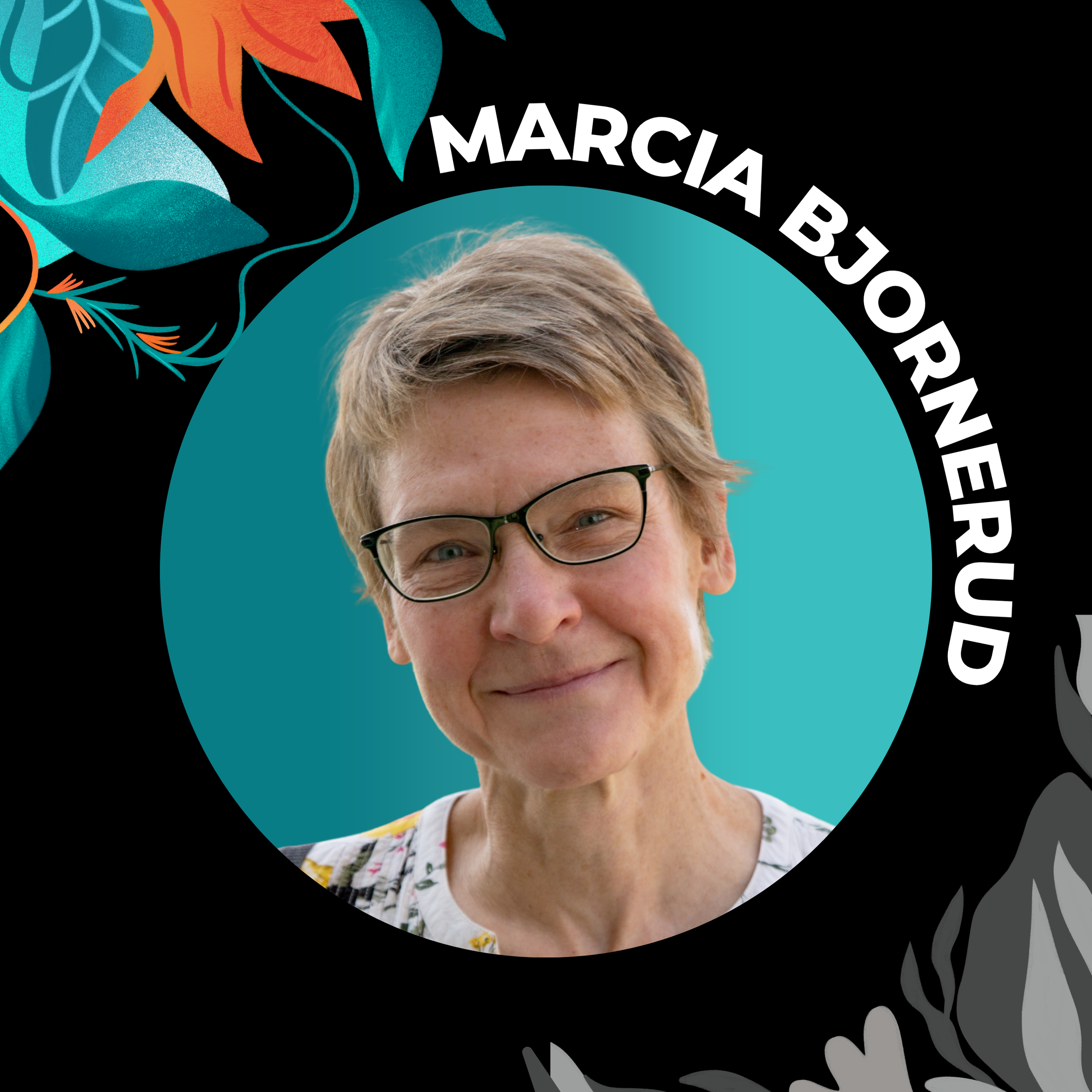



Every age is the Stone Age. Geologist and author Marcia Bjornerud discusses how thinking like a geologist can cultivate the grounded humility of a deep time perspective. We explore Earth's turbulent history, humanity's emergence as a geologic force, and why humanity and all of life - past, present, and future - is utterly dependent on the rocky planet beneath our feet. Highlights include:
Why geology is not just the study of rocks but the habit of seeing in four dimensions - including time;
Why rocks should be seen as 'verbs' and not just 'nouns', preserving the memory of long ago ecosystems and Earth processes that created them;
The geologic history of Earth in about 5 minutes;
Why humanity's massive impact on the planet is affecting Earth and its atmosphere faster than any known geologic force in Earth history;
Why the process of evolution is not inherently 'progressive' and how Earth's long history teaches us that change is the only constant - and that 'bad things do happen to good planets';
Why geology is in a 'golden age' of discovery and has made incredible advancement in both the understanding of Earth processes and the tools to measure and analyze those processes;
Why we're still in the 'stone age' - utterly dependent on the rocky Earth for biological life and all of the products of humanity's modern techno-industrial civilization;
How 'timefulness' - thinking like a geologist - can help us develop a deeper sense of both the past and the future, cultivating humility and countering the narcissistic focus on the perpetual 'now'.
MENTIONED IN THIS EPISODE:
-
Marcia Bjornerud (00:00):
To me, geology is above all a way of seeing things in four dimensions, including time. It's not just about rock and mineral identification or the pragmatic applications of geologic understanding. It's really a worldview. It's this weird mashup of both the practical and the philosophical, even spiritual. And so I think both from a practical standpoint, from environmental issues that are increasingly urgent and then also from a psychic/spiritual standpoint, this deep time perspective can heal us. It can chasten us to be better Earthlings and it can also comfort us that we live on an old, durable, reliable Earth that has seen upheaval and crisis and life too is resilient and persistent and we should revere and respect it.
Alan Ware (00:50):
That was geologist Marcia Bjornerud. In this episode of OVERSHOOT, we talk with Marcia about the deep time perspective of Earth's rich geological history and how this understanding can guide us away from being a destructive geological force to becoming a wiser and humbler humanity.
Nandita Bajaj (01:17):
Welcome to OVERSHOOT, where we tackle today's interlocking social and ecological crises driven by humanity's excessive population and consumption. On this podcast, we explore needed narrative behavioral and system shifts for recreating human life and balance with all life on Earth. I'm Nandita Bajaj, co-host of the podcast and executive director of Population Balance.
Alan Ware (01:42):
I'm Alan Ware, co-host of the podcast and researcher with Population Balance. With expert guests covering a range of topics, we examine the forces underlying overshoot - the patriarchal pronatalism that fuels overpopulation, the growth-obsessed economic systems that drive consumerism and social injustice, and the dominant worldview of human supremacy that subjugates animals and nature. Our vision of shrinking toward abundance inspires us to seek pathways of transformation that go beyond technological fixes toward a new humanity that honors our interconnectedness with all of life. And now on to today's guest.
(02:22):
Marcia Bjornerud is a professor of geosciences and environmental studies at Lawrence University in Wisconsin. Her research focuses on the physics of earthquakes and mountain building and she combines field-based studies of bedrock geology with quantitative models of rock mechanics. She has done research in high arctic Norway of Svalbard and Canada on Ellesmere Island, as well as mainland Norway, Italy, New Zealand, and the Lake Superior region. A contributing writer to the New Yorker, Wired, The Wall Street Journal, and the Los Angeles Times, she is also the author of several books for popular audiences: Reading the Rocks, Geopedia, Timefulness, and Turning to Stone: Discovering the Subtle Wisdom of Rocks. Timefulness was long listed for the 2019 Pen/E.O. Wilson Prize for literary science writing and was a finalist for the LA Times Book Prize in Science and Technology. Turning to Stone received the 2025 John Burroughs Medal for natural history writing and now on today's interview.
Nandita Bajaj (03:30):
Hi, and welcome to the OVERSHOOT Podcast, Marcia. Thanks very much for joining us. It's wonderful to have you here.
Marcia Bjornerud (03:37):
It's good to be with you.
Nandita Bajaj (03:38):
And Marcia, though so much of our work is grounded in our status as Earthlings and our understanding of humanity's brief existence from a deep time perspective, you are the first guest on our podcast who is deeply immersed in Earth's history in timescales that span across millions and billions of years. As a geologist and an excellent science communicator, you're helping bring to life the exciting and dramatic stories of Earth's history that go far beyond the hubristic human-centered narratives of our planet. And we're excited to delve into some of the writing that you've done. You've got a few books and you've written powerfully and eloquently about the wonders of Earth's deep time and its geological processes, while also showing that a scientific mind is attached to a feeling person with both memories and imagination. And you talk about your own experience in your most recent book, Turning to Stone: Discovering the Subtle Wisdom of Rocks, where you weave your personal history in with your description of your professional life as a geologist, including your childhood in rural Wisconsin.
(04:55):
Could you share with us how your childhood in rural Wisconsin helped shape your love of the natural sciences and ultimately your love of rocks and the study of geology?
Marcia Bjornerud (05:07):
Yes. I think I was fortunate to have a free range childhood, being able to wander in the woods and the fields around our house in rural Wisconsin. I had no inkling that I was doing science at the time, but I think I did have an early sense of being immersed in a kind of natural intelligence early on, that there was some kind of order and logic in which I and my childhood companions were immersed that was accessible to us if we would listen. And so I think in retrospect, we were little scientists. We were making observations of the behavior of the creek that ran below our house and of the icicles that emerged from the creek bank, this was groundwater, but with no sense that this is research or science. And like most people, I had no exposure to the geosciences in school of any rigorous sort.
(06:06):
Geology is just not represented in most school curricula in any sophisticated way, largely as an artifact of the relatively late maturation of the field compared with the other sciences. And also growing up when I did in the '70s, I had no female mentors in science. I had sort of just disqualified myself from the idea of being a scientist, but I happened to take an introductory course in geology as a first year student in college and from the very start I recognized its explanatory power. It just set my brain on fire because suddenly I could read the text of landscapes and rocks and it was a revelation. And I feel very lucky that somehow my 16-year-old self recognized that that would be a passion that would stay with me all my life.
Nandita Bajaj (06:58):
Beautiful. Yeah. I love what you're saying about being a young scientist without really having any training in science, learning to observe and appreciate and question the processes around you and how often school will ground that kind of curiosity out of you. And also what you're saying about your experience in geology, often when I think of in my mind of geological sciences, I think it's becoming more and more synonymous with mining and oil and gas industry. And so I just find it to be admirable to see how you're helping to reclaim the wonders of this field without its attachment to this capital value that we place on nature.
Marcia Bjornerud (07:47):
I think geology needs to grapple with the fact that from its beginnings really it's been entangled with the extractive industries - coal in the 19th century and minerals and oil and gas in the 20th and sadly still with us now. It's always been that. And we have to acknowledge also that much of what we know about the Earth and its history has come almost as a byproduct of exploration for these resources. But in a beautiful irony in the process, we have begun to understand this long story of the Earth coming into maturation and also understanding how it has worked over time. So this is a tension in geology that I feel. I felt it as a graduate student. Most of the people who were in my cohort ended up going into the oil industry and again, much of what we know, the money that flows into research is coming from industries and yet, and yet, what that has revealed to us is this remarkable tapestry over time.
(08:48):
I think the field has actually become more enlightened. I think these days it's not the norm actually for geologists to go into extractive industries. There are many other career paths and my argument to my students is that geosciences are such a broad scientific preparation and so relevant to so many aspects of society that they're excellent preparation for many kinds of jobs in policy and planning and law. I think in a way, the field is actually moving in a more enlightened direction. To me, geology is above all a way of seeing and thinking. It's a set of cognitive practices, the habit of seeing things in four dimensions, including time and that takes practice. It's not just about rock and mineral identification or the pragmatic applications of geologic understanding. It's really a worldview.
Alan Ware (09:40):
Yeah. Speaking of that, seeing in time, many of us did take a geology class like I did in college, remember much of the class being about naming classifying rocks, giving them as you've written a noun. And you've also written that rocks should be seen as verbs shaped by these processes over time. Could you explain that idea of rocks as verbs by giving an overview of what I remember from introductory geology class, the three major rock types of sedimentary, igneous, and metamorphic, as they're found and as you talk eloquently about in your general area there where you live in Wisconsin.
Marcia Bjornerud (10:18):
Yeah. So that idea of rocks as verbs is really the way geologists would interpret rocks. They aren't just there. They came into being by some process. So all rocks have a life story and often they've changed over the course of their biography too. So here in Wisconsin, people don't appreciate perhaps, that we actually have a lot of geodiversity. We have a longer range of time represented in our rocks than the Grand Canyon. Not all exposed in one place, but north to south, east to west, actually there are rocks of a wide range of ages and much, much older even than the oldest rocks in the Grand Canyon. So to start with the simplest ones, the sedimentary rocks, these are rocks deposited at the surface of the Earth and they would be recording in Wisconsin a time when sea level was much higher, the continent was much smaller, and we were in a marine setting.
(11:09):
We have coral reefs in Wisconsin, ancient ones. So memories of a beautiful sunlit sea with biodiverse organisms thriving so that in that case, the limestone and the dolostone is not just inert rock. It's a memory of this beautiful ecosystem that existed. Then igneous rocks, of course, are magmatic. They record the dynamic roiling of the Earth and the melting of rocks and volcanism. We have several generations of volcanoes represented in the bedrock of Wisconsin, including the Lake Superior Basin, which is one of my favorite places to visit. The lake itself is an ice age feature, but the rocks beneath the lake are about a billion years old and record a time when North America was very, very nearly split in half along a great rift system. It's a bit like the modern day East African rift and huge volumes of basaltic black lava poured out of fissures in what is now the Lake Superior region.
(12:11):
And then delving back even further in time we have rocks that remember times as long ago as about 3.5 billion years ago. That's only a billion years after the planet formed, probably before plate tectonics was even a practice, certainly before any macroscopic life was around, close to the time when life forms were beginning. But these are rocks that were formed in one setting as igneous rocks and then became kind of kneaded and folded deep in the subsurface into beautiful metamorphic rocks that then have been exhumed by erosion so that we can admire them and ask them what they saw in these deep subsurface environments so long ago. So all of these different rocks have very different experiences, very different origin stories. I like to say that they're a bit like different dialects, that each one is speaking a slightly different rock language and they have different insights to share about different environments and times. So when you start seeing rocks through that lens, they're not just inert insensate things. They have memory, they have experiences. Then they become these vivid companions almost.
Alan Ware (13:22):
Yeah, you're writing helped me appreciate living here in Minnesota, very close to a lot of the same geology, you have the mid-continent rift, which I learned about a couple of years ago, but then you deepen my knowledge of it, running from Lake Superior to Kansas that almost ripped this continent apart. I would have been here in Minnesota on a different continent than the two of you and human history would have been very different. I appreciate how in your first chapter in the book on sandstone that you lived within that area of sandstone, that that greatly shaped the human history, that the white pines grew in the sandy soil that brought, as you call it, the ignorance and the avarice of human activity to that area and then that helped erode the farmland that the farmers moved in after the forest. And then as you mentioned, that sand is so nicely spherical from being sorted over eons that it was used as frac sand in the fracking boom.
(14:20):
And now you mentioned that it's in some Marcellus shale in Pennsylvania and Texas and all these different fracking sites and these strange layers of strata of rock. So how that intersects with human history, geology has such an impact on the surface and our lives.
Marcia Bjornerud (14:37):
Absolutely. You could even say, who's in charge here? The rocks seem to be dictating our behavior. I use my own small corner of Wisconsin as just this sort of exemplar of the way that all of human history, of course, is shaped by geologic processes.
Alan Ware (14:55):
And you mentioned metamorphic are your favorite. They're very complicated so they've been very difficult for me to ever identify accurately. Why are they your favorite?
Marcia Bjornerud (15:04):
Well, because they're a bit cryptic, I suppose. They require sustained attention. They have always at least two distinct stories to tell. So a metamorphic rock means a rock that was formed in one environment, maybe as a sedimentary rock or as an igneous rock, but then usually through tectonics has found itself perhaps deep inside the guts of a mountain belt or heated by proximity to some magnetic source and changed, recrystallized. And so often they are partly but not entirely transformed. So you can read kind of elements of both of those environments still preserved in them. And as I suggested before, some of these rocks have been at depths that are inaccessible to us even by drilling. I mean the deepest drill hole humans have ever made is only about 12 kilometers depth, which is about seven and a half miles. That's just a pinprick in the crust.
(15:59):
So even by drilling, we can't get access to some of the depths that metamorphic rocks that now have been brought back up to the surface thanks to erosion have been at. And so they can give us insights into processes and places that we just otherwise wouldn't know what are the conditions that exist in those depths. So they're the travel writers of the rock world.
Nandita Bajaj (16:21):
Yeah. We love your worldview of rocks as storytellers and like you, we view our most important identity to be that of Earthlings. And while many of us know a fair amount of human history, our understanding of Earth's history is often very limited. And you teach a course that compresses the planet's four and a half billion year history into a single term and you've described that as a challenge and now we'd like to present you with an even bigger challenge. Could you give us and our listeners a five minute tour of the major chapters of the four and a half billion year history story of our planet?
Marcia Bjornerud (17:00):
So wow, the four and a half billion years we start with the recycled guts of ancient stars. And so that is an important theme that's going to be repeated over and over is this idea of deep recycling. So all of the constituents of the Earth have come from precursor stars that lived their lives and then blew themselves up in great supernovae. And so we think the very beginning of our Earth and solar system together as part of the family began when some nearby star blew itself up and then that material began to swirl and condense into what would become the planets. Then we fast forward into the time where we have a solid planet, it melts and then separates into a metallic core, a rocky mantle, and the very earliest crispy crust. That would have been probably by a few million years after that supernova event.
(17:56):
So surprisingly quickly going from one star system to the beginnings of rocky planets. And then by four billion years ago, we start actually having a rock record on Earth. The Earth itself does not preserve a memory of its first 500 million years, rather like humans can't remember their infancy. We can look to the moon and to the surfaces of Venus and Mars and Mercury for some clues to what might have been happening in those earliest days, but Earth itself does not have rocks older than about four billion years. And those oldest rocks do tell us of an Earth that was already dynamic. It has some kind of tectonic system, maybe not plate tectonics as we know it today because it was hotter and the crust would not have been as rigid and strong, but some sort of active surface with melting and volcanism going on.
(18:45):
By 3.8 billion years we have the beginning of a possible record of life on Earth that's somewhat controversial. Some rocks that were formed at the surface of the Earth that are today preserved in Western Greenland have hints that maybe there were photosynthesizing organisms already and that was a very sophisticated practice so they can't possibly have been the very first ones. By 3.5 billion, we know that there were definitely photosynthetic organisms and we have good microfossils preserved in several places around the globe. And then by 2.5 billion years ago, big changes were happening in both the atmosphere and the tectonic system. We have good evidence that by then the practice of plate tectonics had begun, this crispy crust with rigid plates that were moving and jostling with good evidence that that was happening and that those photosynthesizing organisms had transformed the atmosphere from one that was just volcano breath into one that had some oxygen.
(19:45):
That was a huge revolution in the geochemistry of the oceans and the atmosphere. Having some free oxygen made it possible for all kinds of new biological innovations as well as new kinds of minerals that couldn't have existed before there was free oxygen. We have just an explosion in both the biosphere and actually in the mineral kingdom around 2.5 billion years ago. All this time, life is still microbial from 3.5 or 3.8 billion years right up until a crisis at the end of what we call proterozoic time, snowball Earth, a deep ice age during which the planet was perhaps frozen from pole to pole, nearly a death experience for the biosphere, but happily the practice of photosynthesis was not forgotten because when things warmed up then rather suddenly we have the emergence of a whole bunch of macroscopic life forms, animals for the first time, plants that move on to the continents for the first time and that was about 540 million years ago.
(20:47):
So three billion years of microbial life, snowball Earth, and then this incredible flowering of diversity in the plant and animal kingdoms. And then we go into a time where we have more and more elaborate ecosystems and arms races, evolutionarily, and macroscopic organisms, but these become a little bit more fragile because they have elaborate food chains. So when things change in the environment, there can be kind of a domino effect of many, many different parts of the ecosystem collapsing. So we get the five great mass extinction events for different reasons in the last 500 million years. And then fast forwarding up to today, of course, we may be approaching a sixth great mass extinction event with humans being the meteorite that is destabilizing so many Earth systems simultaneously. And for me, having taught this course, the history of Earth and life so many times and talking about these great mass extinction events, actually the more sobering extinction events to study are not the dinosaur extinction event, which is probably caused by a rogue space rock, but the ones that are internally caused where for some reason multiple systems that were internal to the Earth simultaneously went awry and the destabilization of so many environmental niches was too much for the biosphere and those are the ones that are eerily similar in some cases to what is happening today. So is that five minutes?
Nandita Bajaj (22:17):
Brilliant. Wow. You can hear in just that short amount of time, the drama and intensity of changes that you've described in Earth's history and the sheer appreciation of the microbial life I would say that has been around the longest, right? They're still our oldest kin in terms of Earth's history and the sheer lack of respect that we have for these tiny little beings who are really at the heart of life on Earth and are making all of the different processes possible.
Marcia Bjornerud (22:52):
It's absolutely true. They are the old ones. There's huge genetic diversity in the microbial realm, huge amounts of information and ancestral memory in a sense and I predict they will outlive all other life forms. They'll be around. If I could go back to school, I would study microbiology. I really wish I knew microbes better because they really are in control of everything.
Nandita Bajaj (23:19):
Clearly, yes. And then I also really appreciate what you said about the mass extinction events is there's so much kind of a disproportionate level of focus that goes onto the asteroid event, the dinosaur one and the somewhat similar events in the past of the mass extinctions that were caused from within the Earth's processes to what's happening now. You've talked about the acceleration in the rate of change that we are creating as a geologic force is unlike any of the previous events. Can you briefly say something about that?
Marcia Bjornerud (23:56):
Yeah, that's a very important point. So even when we look at the worst mass extinction event in the last 500 million years, the end Permian extinction event, this was one before the dinosaurs. It was about 250 million years ago. There were land plants and animals driving ecosystem and we were coming out of a modest ice age, sort of like the ice age just the other day that happened here on Earth. So the world was warming up a bit, coming out of an ice age. And then there was this time of just effusive volcanism in what is now Siberia, just huge amounts of basaltic lavas spewed out in a geologically short period of time, i.e. about a million years, putting very large amounts of CO2 into the atmosphere, carbon dioxide, quite suddenly, again geologically speaking, spiking those values, warming the Earth dramatically again. It had been a cold, kind of ice house Earth.
(24:51):
We're now warming the Earth quickly and this seems to have set in motion a whole knock-on series of events, ocean acidification from all that new carbon dioxide in the atmosphere being absorbed into the ocean, big die-offs in the ocean that caused ocean anoxia, very similar to the big dead zones in today's oceans. Then that led to the proliferation of sulfur-spewing microbes, certain types of bacteria that exude sulfur dioxide and other compounds that led to more acidification and destruction of the ozone layer too, sounds familiar. And then just as various ecosystems were compromised, just kind of a worse and worse, a positive feedback runaway effect until 95% of the known marine fossil species that had been thriving in the Permian when extinct. And this seems the really severe period of this extinction event elapsed over tens of thousands of years. The magnitude is shockingly close to what we've managed to do in about a century and that to me is very sobering.
(26:00):
No, what we are doing is not normal and the consequences were extreme in the Permian and the recovery time was far beyond anything that humans could tolerate. It was on the order of millions of years. There seems to have been persistent ocean anoxia for at least a couple of million years before things slowly, slowly, slowly corrected themselves. So to me, that is sobering and much more terrifying in a way than the asteroid event because it was an internal combination and it's a combination that is all too familiar to those of us in the Anthropocene.
Alan Ware (26:39):
And that gets to some of the concepts you talk about of chronos and kairos, Greek concepts, but you apply them within the context of the history of geology that also kind of is similar to the ideas of uniformitarianism and catastrophism. If you could unpack some of that and explain the connection of those ideas with geology.
Marcia Bjornerud (26:59):
Yeah. So I know from experience that a lot of people just don't like thinking about geologic time because it's just off-putting, just billions and billions of years. It's hard to grasp. I can't say even I can honestly understand what a billion years is. That's the chronos part, just the numbers. But to me, I can begin to grasp what that means when I see what happened in those billions of years - the narrative, the events, the protagonists, the plot lines, that's kairos, that's the story. And when you begin to have some sense of how long does it take for a supercontinent to assemble and to break up, how long does it take for a mass extinction to happen and then the world's ecosystem to recover, when you fill in these billions of years with these actual narratives, then you begin to be able to actually have empathy for them or some visceral understanding and understand that we are on a continuum with them.
(28:00):
It's not that suddenly humans arrived. This is our story too. We have deep evolutionary roots and we are entirely shaped by all of those events that happened in the past. So that's how I'm using that chronos, kairos. Chronos is just the sterile billions and billions of years. The kairos is the narrative part.
Alan Ware (28:20):
And how would you relate that to uniformitarianism and catastrophism within geology?
Marcia Bjornerud (28:26):
Yeah. So those are fundamental concepts that people may have encountered in any introductory course. The uniformitarianism is kind of the mantra that we use, the idea that the present is the key to the past - that we can read the stories of rocks and landscapes by just using what we understand of the Earth today as a lens through which to understand what happened in the past. That has been applied with too much orthodoxy I think sometimes in the past. It was really not until the 1980s when the dinosaur extinction event was attributed to the meteorite impact that geologists allowed ourselves to sometimes invoke catastrophic explanations for things. I mean, sometimes bad things do happen to a good planet, but that had been sort of a taboo that started in the very early years of geology because the prevailing paradigm prior to a scientific understanding of the Earth, at least in the West, had been the biblical story of the Earth, perhaps being only six or 7,000 years old.
(29:25):
And so if you accept that view from the Bible, everything has to be catastrophic. You don't have a lot of time to create all the things on Earth. So things like the Grand Canyon or mountains must have come into being in these catastrophic events. And so early geologists strongly rejected the idea of catastrophe as explanation for geologic phenomena and it was such an orthodoxy. It really was taboo. People were not allowed. You would not get published prior to the 1980 meteorite impact story for the dinosaurs if you invoked catastrophe. And in fact, when the scientists who did propose the impact theory, first suggested it, they had very anti-evidence and it was not well accepted in the geological and certainly in the paleontological community. It was so anathema to scientific norms at that time. Now we do accept sometimes big, bad things happen suddenly even by human standards, but our default setting is always uniformitarianism and incremental change. That's the first thing we would try to invoke in explaining something like the Grand Canyon. No, it did not form in one deluge. It formed over millions of years by raindrops.
Alan Ware (30:38):
Yeah. We study overshoot, which feels like often a catastrophic or kairos type event, especially with climate change, how quickly we're changing natural processes. And the progress narrative of the past 200 years of modernity has been very much a kind of chronos onward and upward linear progression of social and material advance. And yeah, we try to open up the concept of the catastrophic in that way, that we are building up the potential for greater and greater catastrophes.
Marcia Bjornerud (31:13):
Well, that idea of progress is so Victorian, isn't it? It was really baked into early thinking even. I respect Darwin as a thinker, but he was very much a person of his time and thinking that there was this kind of great trajectory of evolution. And one thing that I think I actually put it on the exam for my history of Earth and Life class last term was, Can you say based on what you now understand about life on Earth that evolution is in any sense progressive? Given these mass extinction events that completely reset everything, clearly organisms become very well adapted to their environments so there's kind of local progress. But then if the rules completely change and the ecosystem that you are so well adapted to no longer exists, then is that progress? So I think that's one of the world views that geology can offer to this question.
(32:06):
No, we are not on some kind of inevitable march toward better and better. We need to be aware of the constraints of the natural world and not take for granted the seemingly inert Earth around us. It is dynamic and changing and sensate in a sense too and can easily foil any progress we're trying to make.
Alan Ware (32:28):
Yeah, that's a great question for the geology final. It reminded me in the Earth history when you talk about the great oxygenation event that the cyanobacteria were emitting a waste product for them, which was oxygen and that eventually kills them. So life can kill itself through its own dominance in different times through its waste product.
Marcia Bjornerud (32:52):
Right. It didn't kill the cyanobacteria, which are actually still with us. It's blue-green algae. But yeah, other organisms that had done quite nicely at the surface of the Earth had to find low oxygen environments to hang out in. So there was certainly a radical revolution in how organisms could make a living, new opportunities for some, thwarted ones for others.
Nandita Bajaj (33:14):
And you've also talked about how so much of what we know about Earth's history has really entered our own understanding in terms of the records in the last 50 to 70 years and you've described geology as being in a golden age. What discoveries or developments make this such an exciting time for geosciences?
Marcia Bjornerud (33:37):
Yeah. And I think this is something that many people don't appreciate. If they think of geology, they may think of the oil and gas industry, or they may just think of dusty museum collections. But as I said, geology is a set of cognitive habits. And what is unique now is that we have a convergence of kind of whole Earth paradigms. Plate tectonics is the way the solid Earth works. Climate science has become so much more sophisticated even than when I was a student in the '80s. We have this concept of biogeochemical cycles - the way that carbon and nitrogen, phosphorus, water of course, sulfur, all of these elements and compounds are in constant motion over a wide range of timescales being exchanged between the biosphere, the solid Earth, the atmosphere, the hydrosphere. We have this sense of the physiology of the Earth in a way we never did before.
(34:27):
And we have the analytical tools to investigate that, good geochemistry instrumentation, real-time satellite monitoring, and importantly, the computational capacity to be able to make sense of these gigantic data sets and do modeling that can allow us to kind of both post-dict and predict things like plate motions, climate over geologic kinds of timescales that we can't witness as humans. So this is such an exciting time to be in this field. We got all of the parts that we need and yet there's so much more to explore and I feel lucky to come through this time. I mean, I look back and I'm just kind of stunned at how little we knew when I was an undergraduate.
Alan Ware (35:15):
And in your 2018 book, Timefulness, you argue thinking like a geologist can help us adopt longer term perspectives in an age that's dominated by quarterly profits for business, election cycles for politicians, shortening attention spans as we're seeing with digital information. We wholeheartedly agree with that and we do explore all of that on this podcast. And it's also true that all of the human civilizations have run on mining of the Earth and we've named entire human ages of history based on rock - iron age, stone age, bronze age. And our modern techno-industrial civilization often seems to assume that it runs on just information and markets and the material substrate can be largely ignored until something like the Strait of Hormuz happens, then it becomes quite real. But this modern techno-industrial civilization requires this rapid and relentless mining of metals, minerals, fossil carbon, depleting that geological inheritance that formed over geologic time and then polluting the ecosystems. And the renewable energies that are often seen as clean, or given that misnomer, involve a huge amount of mining of all kinds of elements and bringing up other toxic substances in the process of that mining.
(36:38):
So there's a deep and growing need for humanity in general to become more timeful in our relationship to the Earth and its processes, but we still continue to mine and that it's the source of our non-renewable resources that props up the civilization. So if humanity adopted a worldview of timefulness, how do you think that would change our relationship to rocks and their extraction?
Marcia Bjornerud (37:01):
Well, I would say first of all, we're still in the Stone Age because we are utterly dependent on the rocky Earth for everything. And like all organisms, we need to use Earth's materials to survive, but it's how we use those things and whether we have any understanding of the intrinsic timescales over which they were created. And first of all, the delusion that we have somehow outgrown the Earth in this digital age is, as you say, completely ridiculous. We actually are going to have more intensive needs for rarer and rarer things like rare Earth elements, lithium for batteries. And I have conflicted feelings about the messaging of the green energy industry. We urgently need to wean ourselves away from fossil fuels. That is clear. The looming reality of extreme climate change is so great we do need to change. But I think in the narrative that it's been advanced, at least prior to the current administration in the last year or so, there has not been an acknowledgement that we can't continue to have the consumptive lifestyle that we do and just switch to green energy and everything will be fine.
(38:05):
We need to downsize, to economize, conserve, and it's really a cultural change that needs to happen at the same time as a technological change. But the cultural change is so hard. We don't like to have to acknowledge that we're living in this completely, I would say, immoral way on the planet. We just want a quick techno fix. We don't want mining in our own backyard, but we want our devices. So that's the hard reality. The hardest change is the cultural change, but the Earth has wisdom to share with us. If we have a deep understanding of how these entities have come to us, we would see that they are part of a long-term recycling system and deep recycling, not the shallow kind of recycling that we're talking about putting the recycling bin out, but deep modularity, reparability, true recovery of materials in the industrial cycles - that has to be baked into any kind of truly sustainable industrial economy.
(39:08):
And we have templates from nature we could look to. I have a computer and a smartphone, but people need to have some sense of proportion, I guess, of the amount of rock that needs to be moved to produce the things that they take for granted and easily dispose of and upgrade. And I guess I naively believe that if there was a deeper geologic literacy among the public, maybe people would be motivated to think and to change their behavior. But in the meantime, we need to set in motion every kind of cultural lever that we can deploy, starting with how children are brought up and right through continuing education at all levels, because it's culture that has to change. It's not technology that's going to save us.
Alan Ware (39:54):
Yeah. As you write in the book that their copper was being traded from the surface by indigenous people, quartzite around Lake Huron, obsidian, far back in human history. So we've always used rocks for one reason or another, but now we are digging them up from such depths that we're bringing up arsenic, lead, mercury - elements that the biosphere has not adapted, evolved to live with. So that I would hope that we at least have the sense to regulate the ore, the tailings that we're bringing up, all the pollutants that mining can add.
Marcia Bjornerud (40:31):
Yeah. And it's the scale, it's the volume. This is one of the arguments for the Anthropocene. We, some geologists two years ago voted not to adopt it formally as a division of the geologic timescale, but that's not because they didn't think that humans are geologic agents anyway, but that's one of the arguments that was launched for the Anthropocene is that we move through mining, through agriculture, industrial activities of different kinds, more sediment and rock than all the world's rivers combined. That's gigantic. And I often say to students, what we're doing often in mining is we're taking rock that of course it had arsenic. It may have had lead in it, but it wasn't interacting in a dynamic way with the surface environment or with water until we grind up this rock and pulverize it and greatly increase its surface area and we're in a sense making this rock more aggressive than it used to be.
(41:23):
We're unleashing sort of latent powers that it had by blowing it up and grinding it. And so to me, one of the ironies of the Anthropocene, this time we're naming for ourselves, is that actually we're really unleashing nature to fully take charge again. I mean, we've never truly been in charge, but there'll be no doubt once the Anthropocene really gets going, we really aren't in charge of our own destiny anymore.
Alan Ware (41:49):
And how do you think timefulness and thinking more like a geologist could reshape not just our relationship to rocks, but to each other, our cultural relationship to time and how we make decisions as a culture?
Marcia Bjornerud (42:03):
It certainly affects the way I feel as a human being. I don't know if this would be as potent of a worldview for other people, but if people could develop a better sense of temporal proportion, our place in time, have to think that we would be humbler, we would be less narcissistic both in time, I sometimes say we live in this narcissistic now, especially with digital devices constantly chiming at us, social media, constantly distracting us. We are just blinkered both to the past and to the future. And I think we know that this is bad, but we don't know how to extricate ourselves. So for me, this sense of continuity across geologic time is always an existential comfort. I can come back to it and sort of relax into deep time in my understanding that I'm part of this too. Geology is this weird mashup of both the practical and the philosophical, even spiritual.
(43:03):
And so I think both from a practical standpoint, from environmental issues that are increasingly urgent and then also from a psychic/spiritual standpoint, this deep time perspective can heal us. It can chasten us to be better Earthlings and it can also comfort us that we live on an old, durable, reliable Earth that has seen upheaval and crisis and life too is resilient and persistent and we should revere and respect it.
Nandita Bajaj (43:33):
I really appreciate it also that your coining of the term timefulness was a play on mindfulness, which was this obsession, especially within Western reading of mindfulness to be present in the now and this real lack of being in touch with the continuum that we are all part of. And you have a beautiful quote in the book where you say kind of just that where talking about geology points to quote a middle way between the sins of pride in our importance and despair at our insignificance. I wonder if you could say a few words about that quote.
Marcia Bjornerud (44:12):
Yeah. I think one thing that I thought of as you were mentioning that is there's an irony to me in our modern time where we enjoy long lives, thanks to modern medicine, that our attention spans are shrinking. I think in a time when people could not expect to live as long, they actually were more aware of both ancestors and descendants. There was this sense that we did need to preserve this continuity across time. Now we have the illusion that we're going to live forever and what came before us and what comes after us isn't really real. So for me, this geologic worldview is a reminder of that continuity and it's not my own idea. I quote in Timefulness, this beautiful sort of aphorism of a Polish rabbi, I think from the 18th century who said, You should always carry in your pockets two slips of paper. On one in the left pocket it says, I am ashes and dust and in the other in your right pocket, the world was made for me.
(45:12):
And both of those things are true. Yes, we are ephemeral and yet we are also eternal. We are part of this wonderful, vibrant, resilient, creative system of systems and we have to just make peace with that, that those are contradictory in some way and yet they're beautifully resonant in other ways and that's very antithetical to most of Western thinking.
Nandita Bajaj (45:36):
Very much so. It's a beautiful quote, both of them. And I do presentations for university classes often and we're talking mostly about our relationship to the Earth and where the worldview of human supremacy really came in and how did it get kind of reified over the last many thousands of years, but also the beginning of patriarchy, the beginning of the agricultural revolution. So we only go back to the last 10 to 12,000 years since the last ice age and most people are so surprised by it and say how the sense of our short human history kind of makes them feel more grounded and understand where a lot of these ideologies which we've come to internalize as real have come from and that we can unlearn just as quickly as we have learned these behaviors, whether it's through education or media or cultural narratives. And I know you've spoken about geology or just a basic Earth sciences course in high school as a capstone course, how helpful that could be both a geology and I would argue just also a human historical course and neither of which is being taught in school.
(46:56):
So the short-term cycles that you were talking about with elections and business and markets is what we are teaching our students to participate in. So how could we really be timeful when our own education system is not grounded in timefulness?
Marcia Bjornerud (47:15):
Yeah. Well, we need to start with the education system then and work incessantly to add that in. And I think your experience with people really responding when they hear these deep stories, these deep truths, people recognize when something is real and true and it resonates with their deep intuitive sense. I think that's where we can reach people and we absolutely somehow need to change school curricula, but again, those are cultural changes that can be very hard to implement. I think on the personal level, if people are receptive, it can be so simple. It's just getting to know your neighborhood, the names of plants and birds and rocks and their geological resources. There are so many things out there. Almost every state and province has public geologic maps or information that's readily available online. And I think starting with a place you know well from your everyday life and understanding how the contours of the land or what the rocks signify can be the beginning and then you kind of build outward from there a sense of how to read again, landscapes and what the language of rocks is telling you.
(48:24):
But it takes practice. I think people have to appreciate that it is a habit of mind. There is a vocabulary that kind of needs to be developed. For me, whenever I go into a new place, I kind of don't feel like I'm really properly there until I understand the geological backstory and then I feel like, okay, I'm here now. I kind of understand what the land is saying now. And there's great comfort and satisfaction in that. It's not arbitrary. I sometimes have said that sadly the average person, because they haven't had opportunity to learn about geoscience in school, is kind of like a bad tourist on Earth enjoying all the amenities without any understanding of the language or the cultural or the deep practices of the place. And it's so much richer if you do understand the language and the culture.
Alan Ware (49:08):
Yeah. I've learned a little bit over the past few years of the area around here, but it is so shaped by glaciation. So you've got to understand glaciation, the bedrock at some points is down 300 feet below all this glacial till. So the hills, the moraines, it's all very recent and looking for outcrops is a cleaner record, right? And geologists love those. And your writing is so wonderfully descriptive and evocative and you've done a great service to geology and all of us by sharing the wonder of the Earth and your enthusiasm for it. And we'd love for you to read one of your favorite passages from your work if you could.
Marcia Bjornerud (49:50):
Well, thank you. I thought I'd read a little bit from the prologue to Turning to Stone where I lay out the kind of beginnings of my spiritual relationship, I guess, with studying the Earth. And it takes us to fieldwork that I did in Svalbard as a graduate student in high arctic Norway. So I'll just read a couple of pages from that. So this is the prologue to Turning to Stone.
(50:12):
Viewed from the rails of a heaving ship, Svalbard conveys monumental stillness. When I first glimpsed the ice-draped islands, they seemed like a scene from the past, frozen in time, insensible to the din of civilization. Initial explorations on foot confirmed this interpretation. No motion could be detected in the landscape. The wind was relentless, but on the tundra, no swaying trees or rippling grasslands made its power visible. We peered anxiously through binoculars at a patch of white in the middle distance, fearing it was a polar bear, only to realize it was a huge cream-colored boulder that had been sitting in the same spot while the whole of human history elapsed.
(50:50):
On occasion, we'd hear strange noises, rumbling, crashing, roaring, and would scan the terrain to see what had produced them, but the land betrayed no hint of unrest. Days later, we'd find newly scoured channels on the mountainsides with levies of large rocks, testaments to avalanches that must have been the source of the thunderous sounds. My companions and I were geologists in training, graduate students, charged with deciphering the tectonic evolution of the northern end of the Appalachian Caledonian mountain chain - the hemisphere scale of crumpled rocks formed by continental collisions during the assembly of Pangea. This remote Norwegian archipelago, now alone in the Arctic Ocean, had once been attached to a sprawling supercontinent. While mapping the rocks as we found them in the present, we had to hold in our minds the geographies of the past. Intellectually, we all understood that landscapes are impermanent, but the modern topography of Svalbard is a legacy of the ice age - that long before Pangea existed, the contorted rocks we were studying had been flat layers of sediment on an ancient sea floor.
(51:54):
But as flesh and blood mortals laboring up slopes toward the formidable peaks, we found it difficult to imagine that they had not been there forever. Too often as we struggled to understand the mountain's interior architecture, they seemed not only unyielding but also hermetic, closed to interpretation. Glacial ice, equally mute, conspired with them to conceal their secrets. Events that had shaped the landscape more recently were easier to read from the topography. The broad strand plain, which slopes gently from the base of the mountains to the sea was once clearly a beach beveled off by waves. The old shoreline is now covered by a layer of springy moss and peat, but as we walked across it on our daily commute into the mountains, we could feel the old wave-rounded cobbles rolling beneath our feet.
(52:42):
The present elevation of this surface, a few tens of feet above sea level, reflects the rebound of the land since the late Pleistocene when all of Svalbard was under a thick blanket of ice. As the ice age glaciers melted, sea level rose dramatically, but in the last 10,000 years, the duration of human history, the land has bounced back even more, lifting the former beach beyond reach of the raging surf. Perhaps Svalbard was not as still as it seemed. Although glaciers obscured some rocks we wanted to study, they also modeled for us in miniature how strata become wrinkled in mountain building. Glacial ice built up over millennia when summer warmth does not melt winter snow is technically a kind of metamorphic rock, a crystalline substance altered by burial and pressure. Fine layers of dust in the ice formed swirling patterns reminiscent of marble and we could see that these convolutions had formed as the glaciers flowed languidly down their valleys.
(53:37):
This made it easier to believe that the contorted strata visible on the mountainsides had formed in a similar manner. Solid rock too could flow given enough time. During that first arctic summer, I began to understand that the apparent stillness of the Svalbard landscape was completely illusory. Everything was in motion. Slopes were slipping, the land was rebounding, the mountains were flowing, the geography of the world was changing.
Nandita Bajaj (54:03):
Those are really powerful passages and it truly captures the action-oriented evolution of our planet, the fluidity, the stories and the drama that it has experienced and lived through. Marcia, thank you so much for being such an exceptional science communicator of geologic knowledge, for doing the work you're doing and for being with us today.
Alan Ware (54:29):
Thank you, Marcia.
Marcia Bjornerud (54:30):
Wonderful conversation. Thank you both.
Alan Ware (54:33):
That's all for this edition of OVERSHOOT. Visit populationbalance.org to learn more. To share feedback or guest recommendations write to us using the contact form on our site or by emailing us at podcast@populationbalance.org. If you enjoyed this podcast, please rate us on your favorite podcast platform and share it widely. We couldn't do this work without the support of listeners like you and hope that you will consider a one-time or a recurring donation.
Nandita Bajaj (55:01):
Until next time, I'm Nandita Bajaj thanking you for your interest in our work and for helping to advance our vision of shrinking toward abundance.