
Pro-Nuclear Propaganda and Our Future
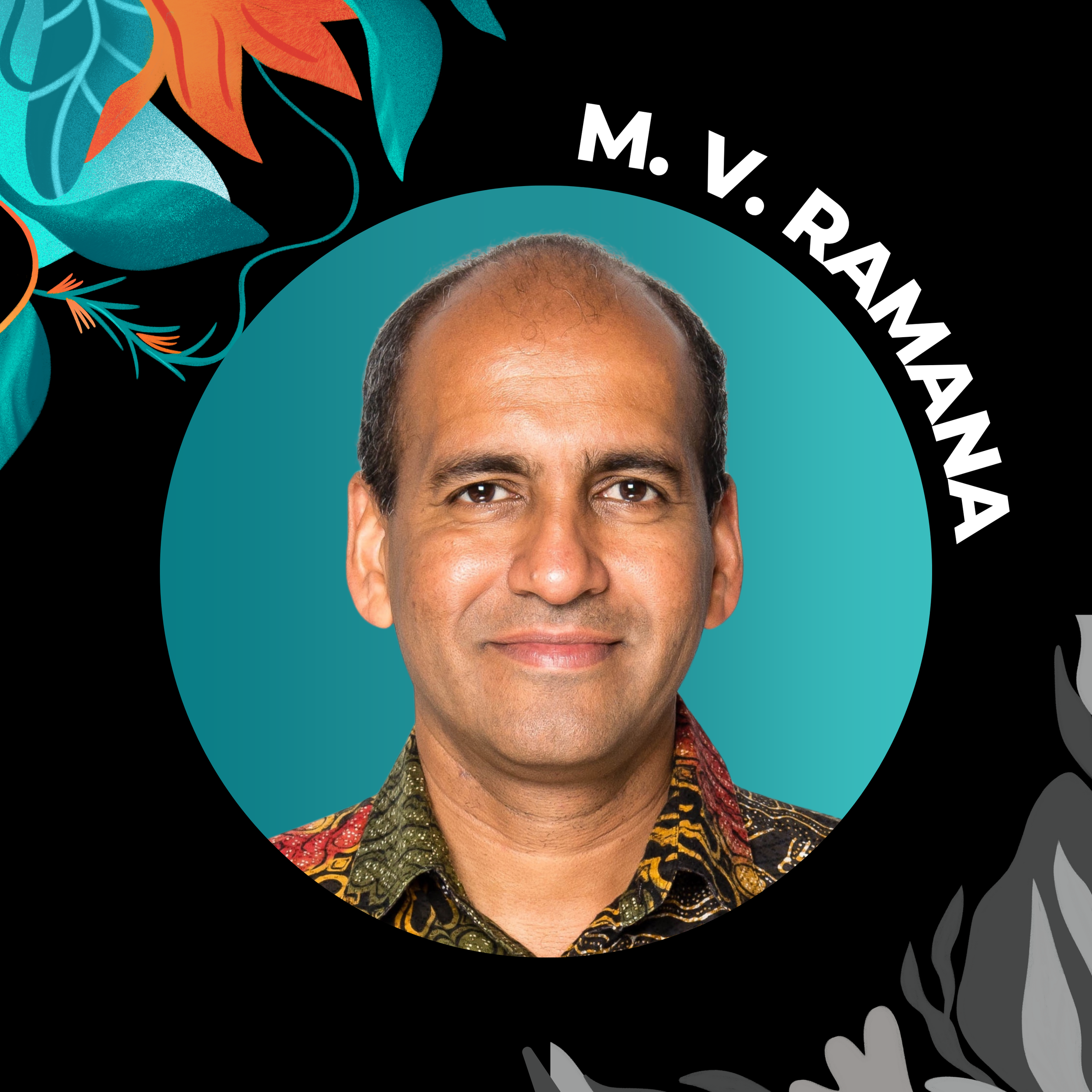



The nuclear industry and its boosters promise clean, abundant energy, but nuclear power delivers expensive electricity while posing catastrophic radiation risks and a constant threat of nuclear war. M. V. Ramana, physicist and author of Nuclear is Not the Solution, explains why respecting the limits of the biosphere means reducing our energy use and rejecting elites’ push for endless growth. Highlights include:
Why nuclear energy is inherently risky due to its complex, tightly coupled systems that are prone to catastrophic failures that can't be predicted or prevented;
Why nuclear waste poses long-term threats to all life by remaining dangerously radioactive for thousands of years, with no safe, permanent disposal solution and frequent storage failures;
Why nuclear energy is expensive, with projects routinely running over budget and behind schedule;
Why the expansion of nuclear energy increases the likelihood of devastating nuclear war;
How climate change and war-time accidents or direct targeting increase the risks of nuclear catastrophe;
Why nuclear Uranium mining and its wastes often require ‘sacrifice zones’ that are disproportionately found in indigenous land and less powerful communities;
How the nuclear industry shapes nuclear policy and debate by capturing regulators and creating an energy ‘panic’ based on one-sided narratives that block democratic discussion and scrutiny;
Why, despite the hype from the nuclear industry, new nuclear plant designs like small modular reactors are subject to the same cost and safety concerns as the old designs;
Why the best answer to dealing with renewable energy's variability is not nuclear or fossil fuels but reducing demand;
Why renewable energy is no panacea for planetary overshoot and why we need to have a broadly democratic conversation about living within the limits of the planet.
MENTIONED IN THIS EPISODE:
-
M. V. Ramana (00:00:00):
How often do common people think about the energy system in general, let alone nuclear power. So their opinions get formed by what they read in mainstream media, in social media. And so there's a huge amount of propaganda that the nuclear industry puts out and also various sections of the government who serve as cheerleaders for the nuclear industry - that there is some serious problem and nuclear energy is needed to solve that. Climate change was one thing. In recent years it has been, oh, we need a lot more power because of AI and data centers. And if you don't build nuclear plants, then the only other option is to have natural gas plants or coal plants, and that's so bad for the environment. And more important, we won't have enough energy and you create moral panic about electricity blackouts. That is supposed to match the fear of accidents and meltdowns. For a lot of people, that is very effective because they're told there's no other option. There is no space for any kind of reasoned debate over what these options are. And also there is no space to question the larger prerogatives of the system. We have to get out of the growth mindset. We have to think about how we shrink and use less ecological resource, but that interjection is never possible.
Alan Ware (00:01:16):
That was M.V. Ramana who is a physicist, a prominent critic of nuclear energy and author of Nuclear is Not the Solution. We'll talk with Professor Ramana about why expanding nuclear power is neither practical nor wise, and why reducing energy demand is the most realistic and responsible path forward.
Nandita Bajaj (00:01:44):
Welcome to OVERSHOOT, where we tackle today's interlocking social and ecological crises driven by humanity's excessive population and consumption. On this podcast, we explore needed narrative, behavioral, and system shifts for recreating human life in balance with all life on earth. I'm Nandita Bajaj, co-host of the podcast and executive director of Population Balance.
Alan Ware (00:02:09):
I'm Alan Ware, co-host of the podcast and researcher with Population Balance. With expert guests covering a range of topics, we examine the forces underlying overshoot, the patriarchal pronatalism that fuels overpopulation, the growth-obsessed economic systems that drive consumerism and social injustice, and the dominant worldview of human supremacy that subjugates animals and nature. Our vision of shrinking toward abundance inspires us to seek pathways of transformation that go beyond technological fixes toward a new humanity that honors our interconnectedness with all of life. And now on today's guest.
Dr. M.V. Ramana is the Simons Chair in Disarmament, Global and Human Security and professor at the School of Public Policy and Global Affairs, University of British Columbia, Vancouver, Canada. He's the author of the 2024 book, Nuclear is Not the Solution: The Folly of Atomic Power in the Age of Climate Change, co-editor of Prisoners of the Nuclear Dream, and the author of The Power of Promise: Examining Nuclear Energy in India. He's a member of the International Panel on Fissile Materials, the International Nuclear Risk Assessment Group, the Canadian Pugwash Group, and the team that produces the annual World Nuclear Industry Status Report. He's the recipient of a Guggenheim Fellowship and a Leo Szilard Award from the American Physical Society. And now on to today's interview.
Nandita Bajaj (00:03:38):
Professor Ramana, welcome to our podcast. It is really great to have you here.
M. V. Ramana (00:03:43):
Thank you very much. I've listened to so many of your episodes that it's a great honor for me to be part of that very elite group of people you have been inviting.
Nandita Bajaj (00:03:51):
That is a really kind remark. Thank you so much for saying that. It is an equal honor for us to have you, an expert in nuclear energy. And you've spent decades weighing the costs and benefits of nuclear energy. And as our ecological crisis becomes more dire, we're seeing an upsurge of interest in nuclear power as a supposedly clean and green form of energy that can be used to support the so-called green growth. And in fact, being in Ontario, this is an issue that is front and center in our current political and climate debates, which I'm sure we'll get into later today. But you've been deeply skeptical of nuclear power for several reasons, and we are really looking forward to exploring these reasons with you today.
M. V. Ramana (00:04:38):
Thank you. Yeah, it's one of those unfortunate things like the locusts come back every couple of decades to plague us.
Nandita Bajaj (00:04:46):
Yes. Good analogy.
M. V. Ramana (00:04:48):
Yeah, I always say, I mean people say, oh, nuclear is having a revival. And I usually say it's the talk of nuclear that is having a revival.
Nandita Bajaj (00:04:58):
Yes. Kind of like growth and kind of like pronatalism, it’s always there in the background. And we are today going to focus on your latest book, which is called, very appropriately, Nuclear is Not the Solution. And the book offers a quote, ‘technical, economic, and environmental critique of nuclear energy while also locating it within the larger political economy of energy and society’. And as I just said, we've seen the promotion of nuclear power increase in recent years as many powerful renewable energy advocates, from climate scientists like James Hansen to many tech company leaders, push for nuclear power as an essential source of energy that will supplement renewable energy like solar and wind - for when the sun doesn't shine and the wind doesn't blow. And in your book, you provide three reasons for why nuclear power is undesirable and those reasons are the risk of catastrophic accidents, the accumulation of hazardous waste, and the potential for the creation of nuclear weapons. And then you also provide two reasons why you think nuclear power is not a feasible solution to climate change. And those two reasons are the high expense and the long timelines for building up nuclear power. So we'd like to delve into each of these primary reasons in turn, and we can begin with the first one, the risk of catastrophic accidents. What do we know about the risk of nuclear accidents?
M. V. Ramana (00:06:40):
Thank you. That's a great place to start this discussion. But I'd like to preamble that by saying one of the reasons why we hear this propaganda about nuclear power being clean and green is that the energy debate today is seen primarily through a carbon tunnel, if you like. The only metric that they look for whether something is clean or not is whether it image carbon dioxide or not. And that is I think a challenge because the main pollutant from nuclear energy is radioactive products that are produced. These are an inherent part of the nuclear fission process. So let me first start by saying what a nuclear reactor ultimately is, and it is basically a very complicated way to boil water using a hazardous process, namely nuclear fission, which can quickly spin out of control. And when it is uncontrolled, we see a nuclear weapon.
(00:07:43):
That's what happens in a nuclear weapon, but any fission process automatically produces some radioactive materials, so-called fission products, and a whole bunch of other materials which are not otherwise radioactive become radioactive because they absorb neutrons inside a nuclear reactor. And so the inside of a nuclear reactor has a lot of radioactive materials. These are often at high temperatures, sometimes at high pressures, and as I said, intensely radioactive. And the entire challenge with designing a nuclear reactor is to ensure or at least lower the probability that these materials cannot escape out into the biosphere. And the reason why you don't want that to happen is because these radioactive materials are hazardous to human health. Exposure to radiation is harmful to health even at very, very low doses. There is no known threshold below which nuclear radiation exposure is safe. The challenge with any kind of nuclear reactor is to try and prevent this from escaping, but there's no way to actually ensure that can never happen.
(00:08:57):
One way to think about it is that because a nuclear reactor is so complex, there are so many parts, these complex technologies, and then especially if these parts interact with each other, they have the property that you cannot envision how the system will behave under all kinds of circumstances. So when we look at actual accidents that have happened, for example in Fukushima or Chernobyl or other things, in retrospect, when designers and nuclear engineers look at it, they would say, we had never imagined that this particular scenario would occur. So in the case of Fukushima, it was the fact that there was what's called a station blackout. There was no external source of power. A nuclear reactor generates power, but it also always requires electricity to be fed in because one of the properties of these radioactive materials is that not only are they radioactive, but they also produce a lot of heat.
(00:09:52):
And that heat has to be constantly removed from inside the core of the nuclear reactor. And so water or some other coolant is continuously circulated inside the reactor. And that circulation typically needs some source of power, which is electricity usually. And so nuclear power plants have backup systems and so on and so forth. But in Fukushima, all of them failed. And this was not a scenario that anybody before the accident had envisioned. Of course, after the accident you can always look back and say, aha, that's the mistake we did. We should have done this. But that's always in hindsight. So the first thing to remember is it's very complex. The other thing to remember about a nuclear power plant is that these events happen in very quick succession. So one term that sociologists use is called tight coupling, engineers as well. So these are people who typically study safety.
(00:10:43):
And tight coupling is basically a system where things happen in very quick succession. So imagine for example, we are flying and let's say I'm flying from Vancouver where I live to let's say Japan or to Delhi, and that involves me changing flights in let's say Frankfurt. Now if I have six hours between my flights in Frankfurt, that's fine. If there's a problem, I can usually address it. But if I have only half an hour between flights and I have to rush from one flight to the other, any even small mistake, for example if I forget to zip up my backpack and as I'm walking out of the plane, everything falls out. So I have to stop to pick up everything. That little accident can lead me to miss the flight. And so it has major consequences. And so this is the kind of system that a nuclear reactor is, and the reason why nuclear reactors are designed that way is precisely also the reason why we sometimes take flights with very short gaps between them, because you don't want to spend six hours in an airport.
(00:11:42):
And so if your choices are between six hours and one hour, you probably will say, I'll just take a chance and take the one hour break because you don't want to waste the time. Likewise, in a nuclear power plant, there are many design constraints including the fact that you want it to be as efficient as possible and as cheap as possible. And so you make design choices which involve this kind of tight coupling. So this combination of both this interactive complexity and tight coupling, a famous sociologist called Charles Perrow argued in the 1980s after studying the Three Mile Island accident of 1979, that these features make certain kinds of technologies inherently prone to accidents. And he called them normal accidents. These are accidents that happen in the normal course of operations. It's hard to envision them in advance. And he did this not just for nuclear reactors but a whole range of other systems that he studied, which have these properties.
(00:12:35):
And since his studies many, many people who have looked at used normal accident theory to understand accidents in different systems, and it works pretty well. So that is one element why you cannot actually rule out the possibility of accidents. So the nuclear industry, what it does is basically say, oh, we have looked at all possible things and we have put in safety systems and we can calculate that the probability of an accident is one in a million years, one in a billion years or something of that sort. But in our own lifetimes, we have seen multiple accidents, so this can't clearly be true. So there is a mismatch between these kind of theoretical predictions by engineers whose job it is to design nuclear power plants and the empirical reality. So nuclear accidents in that sense are almost inevitable. They're not frequent, but that doesn't mean that they cannot happen.
(00:13:27):
And of course, if you were to expand nuclear power and build many more nuclear power plants, you increase the chances of accidents like this. And so the results of these kinds of accidents is that a huge amount of radioactive materials are thrown out into the atmosphere and the wind disperses it across various places. And when it settles down, the land there gets contaminated. The people who are walking around are breathing this in and are exposed to external radiation. And so it becomes extremely difficult to live in those places. So there are areas near the Chernobyl power plant that were evacuated back in 1986 when the accident occurred, which still cannot be inhabited because the background levels of radiation are very high. Also, the radiation is something that spreads quite far and wide. Again, in the case of Chernobyl, it's reported that just about every country in the northern hemisphere received at least some amount of radiation from this. So the impacts of an accident can be long lived and it can be quite distant. And so this makes it a very different kind of accident from other kinds of accidents which are happening in multiple energy systems. And so this is kind of a unique thing about nuclear power.
Alan Ware (00:14:38):
I think you make a good point in the book too, that future accidents will be compounded by climate change. And you mentioned from 2010 to 2019, the frequency of climate-related nuclear plant outages was eight times higher than the 1990s. So between flood, drought, fire, the droughts in France, a country that's very dependent on nuclear power affected them. And I also found in researching for this, that the US General Accounting Office in April, 2024 found that the nuclear regulatory commission in the US is not considering future climate change scenarios. It's only looking at the history of climate change, which seemed amazing to me that they wouldn't be planning in the effect of drought, flood, fire, hurricane on all of these nuclear plants that have to be located near major bodies of water, right, oceans, rivers. And now just wondering what Trump will do with the nuclear regulatory commission and how climate change will be even more downplayed, the risk will be increased even further. And I also thought another accident that we saw in Ukraine, that's not an accident, or it could be an accident of a missile accidentally flying over there, but I think nuclear power also greatly underestimates the accidents, intentional or truly accidental, of war in the future, right?
M. V. Ramana (00:15:57):
Yeah, I think both are excellent points that you bring up. On the risk of war, the simple fact is that nuclear power plants are not designed to operate under wartime conditions. And the challenge with ensuring the safety of a nuclear power plant in those conditions is twofold. One is that you require very trained operators to be there. And in Zaporizhzhia a lot of the operators who could escape when the Russians occupied the plant, they escaped, right? And so they are operating with a skeletal staff, and of course Russia can bring in some of its own nuclear operators and so on, but it's a new reactor for them. They're not familiar with this place. So there's all kinds of complications there. The second challenge is that the systems of safety that are designed are designed to try and prevent processes that are inherent to the nuclear reactor from leading to an accident. So you think of scenarios where there's a fuel defect or somebody makes a mistake, it is not designed usually for when a missile directly tries to attack it.
(00:17:09):
If a missile flies in, you cannot put a shield there that kind of stops it. That's a problem. And the reason why this is a special problem with nuclear power plants, apart from the fact that they have all this radioactive material, is the issue that I mentioned earlier, which is that they're always producing heat, these radioactive materials inside the core of a reactor. Even if you shut down the nuclear power plant so that it stops producing electricity, the uncontrolled chain reaction stops. But the materials that are there inside that are radioactive keep decaying. And that's the challenge with all radioactive materials because they stay radioactive for however long they stay radioactive. Some of them have half lives in the milliseconds, some of them have half lives in the millions of years. And so for that millions of years, those particular radioactive nucleotides will be decaying and producing heat.
(00:18:01):
And so even if you shut down a nuclear plant, you have to figure out a way to keep it cool. And that requires external source of power, external water. And those things were all challenged. In the case of Zaporizhzhia. The lucky thing was that, I mean, they shut down the plant and then eventually the very hot radioactive materials cool down. And then at some point it becomes sufficient to cool it with just air being circulated as opposed to water. And so if you're going to have a war and if an attack is going to happen, the best thing you can hope for is that the attack doesn't happen so soon that even if I shut down the plant, it's so hot. If that attack happens three years after the war starts and you've shut down the reactor, then maybe you're okay.
(00:18:44):
Coming to the climate change issue, some of the problems are very similar. The nuclear reactors require cooling water, and they require trained personnel to be on site, and both of them can be challenged in the event of a severe weather event. So imagine there's a big hurricane, there's a trained group of people who are sitting in the nuclear power plant, but at some point they would like to go home and a new crew typically comes every eight hours or 10 hours. Those people, if they cannot come into the plant because all the roads are damaged and because of the severe weather, what are we going to do? So those kinds of scenarios are very difficult to deal with. And the last thing I'd say is that coming back to the larger question of nuclear reactor safety and so on, it's easy to imagine a theoretical design where if everything operated perfectly, then maybe the nuclear reactor will not have an accident.
(00:19:36):
The question is whether that translates into the real world where the organizations that are operating these nuclear plants are operating under multiple constraints, including the fact that they all have to make profit. And so they are always trying to cut costs. And one of the challenges with climate change is that when these severe weather events happen, if you want to ensure safety, your best bet is to shut down the nuclear plant. And that's what was happening in France. That's good operating procedure, but that's coming at a financial cost to the company that is owning those nuclear plants. So they are going to be finding their profit margins coming down, and in the future they have to start thinking of how they're going to cut costs. And usually when you start cutting costs, safety does get compromised, right? And that's true whether it is the Boeing factories in the US or it is nuclear power plants. So it's very ironic that the solution that is being proposed for climate change can become even more of a threat in case climate change becomes worse.
Alan Ware (00:20:39):
Yeah, and you've talked about, I'm not sure if it was Three Mile Island where Perrow mentioned that the safety culture had been compromised. The nuclear plant employees need to probably build in a lot of routinized protocol and redundancy to make sure that they're always checking a checklist of safe behaviors. And that can often erode over time, right?
M. V. Ramana (00:20:59):
Absolutely. But there's a special challenge also with the idea of safety culture and I also see that quite often when you have accidents, the tendency is to blame some low level operator, find a scapegoat and say, that person made a mistake and it's that person's fault. But in reality, it's just the design of the plant. And the challenge with that idea of a checklist is based on the assumption that we know exactly what can go wrong. So in the event this switch trips, you have to do this. In the event that this happens, you have to do this. What if it's a scenario that we don't know about, that designers have not thought about? So how do you plan for that? And in actual accidents, and this is not just true for nuclear plants, it's also for certain chemical factories, other complex technologies, and the times of near accidents or when accident scenarios start unfolding, sometimes operators act by gut instinct, and that often saves the day. If they'd gone by what the rule book says, it may have actually led to a much worse conclusion precisely because the rule books are not necessarily envisioning all possible circumstances. And so there's this contradiction between wanting the freedom of action and the trust in the operators to be able to use their intuition and their experience to design some particular way of dealing with the situation and trying to design a thick rule book that sort of tells you all contingencies and training people to be like robots, just doing whatever is being told.
Alan Ware (00:22:27):
And a famous example of that that I think maybe you mentioned was the Soviet who didn't launch the missiles at the US in the 1960s.
M. V. Ramana (00:22:35):
Yeah, there are many cases where we have been saved by individuals not following instructions.
Nandita Bajaj (00:22:42):
And one often hears that the nuclear industry is tightly regulated. Is that really true? What is the relationship between the nuclear industry and the regulatory agencies?
M. V. Ramana (00:22:55):
The regulators also have this hard job of trying to ensure that accidents don't happen, but the regulation happens in all sectors - in electricity, in finance, and so on and so forth. The difference between the nuclear industry and many of these other industries, let's say the airline industry and so on, is that there is a group of people, there's a movement that would say, we should shut down all the nuclear power plants and we have other ways of generating electricity - whereas there is no such move in the case of airplanes or the financial system. There is no widespread call for that. And that puts the nuclear industry in a very special position in that if the regulators do their job really well and they keep pointing out all the things that are wrong with how a nuclear plant is operating, there will be a call for the nuclear plant to be shut down.
(00:23:46):
And that then eventually will put them out of a job. Because if they don't have any nuclear plants out there, there's nothing for them to regulate. And so there's a way in which the regulatory system in the nuclear case is inherently going to be constrained by the call for the shutting down the system. But of course like in many, many industries we are seeing two things. One is there's a phenomenon of what's called regulatory capture where for one reason or the other, the regulators start working in the interest of the industry that they are overseeing rather than in the interest of the public. This happens because there is sort of personnel who move in and out. It happens because of certain kind of epistemological biases that these regulators have and so on and so forth. And then most importantly, in recent years, what we have been seeing is a very strong political push to constrain regulators.
(00:24:39):
And this is the second trend that we have. You mentioned the Trump administration. The Trump administration would ideally just like to gut completely the nuclear regulatory commission and every other regulatory body out there, and they just want the wild west to be sort of resurrected where the only law is the law of power and might. And we've seen this in all kinds of industries, and the nuclear industry is no exception. Even liberal policymakers and politicians, whether it's the United States or elsewhere, they have looked upon the nuclear industry’s problems - the fact that the nuclear industry is not growing, the fact that there are not very many nuclear plants being built - they lay the blame of that phenomenon on the feet of the regulators. And so there've been multiple calls for regulators to try and ease their regulating, use a light regulatory touch, and all that basically means is that they're going to give more and more of a pass to the industry, and they take industry's word for it.
(00:25:38):
They'll say, okay, if you say this is safe, then we think it's safe. If you say that you are doing all the safety procedures carefully, then we are okay with it. And we also see that here in Canada, for example, where the Canadian Nuclear Safety Commission recently approved a small modular reactor design in Darlington near Toronto where you live Nandita, and that particular design is incomplete. Even the proponents and the Canadian Nuclear Safety Commission admitted there are several things that are problematic with the design, and yet they have given a construction license, right, with the assumption that, okay, you will make those changes and we will be there to look at it, but not looking out for the public and also allowing the public to look at any changes and intervene at that point. And so that's the other area, which is a general phenomenon around the world, which is the right of the public to intervene in any policy debate is getting curtailed more and more, especially in these high tech sectors, whether it is AI or whether it is nuclear power.
Nandita Bajaj (00:26:41):
Right. As you're saying, it's a lot more undemocratic and more centralized than some of the other industries that are a little more tightly controlled by government authorities.
Alan Ware (00:26:52):
And I wondered the insurance for accidents, they don't have to carry some kind of private nuclear accident. It's the national government that picks up the tab.
M. V. Ramana (00:27:03):
Exactly. So there is a kind of cap on what the companies that are operating have to pay. So they have to take out insurance for a certain level, and then if the damages from an accident exceeds that, essentially it falls upon the national government. But there's also another unique thing about the insurance and the liability procedures in the nuclear industry, which is unique, which is that in the event when nuclear power plants are exported to other countries, the United States is the leading exporter historically of nuclear power plants, they insisted way back in the 1960s, these conventions which basically exempt or indemnify the suppliers from any potential accident. So in case the United States exports a nuclear reactor to let's say India or to Saudi Arabia, which they're sort of talking about, and 15 years down the line that reactor has an accident, if that accident is because of a defect in the design, the operators in those countries cannot come back to the designer of the plant and say, it was your fault, so you need to pay for this accident, or you need to pay something for this accident.
(00:28:17):
So this is very different from, let's say a few years ago, there was a problem with Toyota cars where there was something called a stuck pedal problem, that the gas pedal sometimes stays in the bottom and the person who's driving is not able to control the speed of the car. And GM had a problem with its key sort of suddenly switching off if there is a weight attached to the key or Boeing, all kinds of these companies, they usually have to take back the cars, fix it and pay the people for whatever expenses they have, et cetera. None of that liability holds in the nuclear industry. All the liability’s placed on the operator, and these are all sort of special carve-outs for the nuclear industry, precisely because of what I started with, which is that the impacts of an accident can be so catastrophic that the costs tend to be in the billions and hundreds of billions of dollars, and that'll wipe out any private company. So private companies always insist that they have to be indemnified or liability has to be capped.
Nandita Bajaj (00:29:18):
And why do you think there is so much public naivete around nuclear energy where there's still large scale or widespread acceptance of nuclear power as a potential solution, not just among say, climate scientists and tech entrepreneurs, but just the general public when as you've said, costs are socialized and profits are privatized, so they are bearing much of the cost. Is it just because the regulatory capture with the government and the industry, they've been so successful at hiding or covering up the accidents and hiding the negative effects of these to the public?
M. V. Ramana (00:29:59):
There are multiple strands of reasoning here, right? One is if you think about common people, how often do they think about the energy system in general, let alone nuclear power? So their opinions get formed by what they read in mainstream media, in social media and so on. And so there's a huge amount of propaganda that the nuclear industry puts out all the time, and also various sections of the government who serve as cheerleaders for the nuclear industry. And so when these people say that we need nuclear power, nuclear power is safe, and so on and so forth, at some point if you keep repeating the same thing and they see it from multiple sources, and the argument of course to some extent relies on the idea that there are regulators who are overseeing everything. They have said that this reactor is safe and therefore you don't have to worry about it.
(00:30:52):
So that plays a little bit of a part. But in general, it is this constant dinning into them. And the only time that particular propaganda stream is interrupted is when there's a severe accident, like what happened at Fukushima. And every time that happens, we see a decline in public support. And then eventually the propaganda catches up because the nuclear industry never goes away. They keep saying the same thing, and they find ways of absolving each of these or excusing these kind of accidents. And so they explain away Fukushima. There's a tsunami there. In Darlington in Toronto, there is no chance of a tsunami, so why are you worried about it? And then if it was Chernobyl, they'll say, oh, it is a Soviet system. It is that. We don't have that problem. So they find ways of excusing each of these things. And last but not least, I think we have to think about the main thrust behind nuclear power, the meta narrative, which is that there is some serious problem that is out there, and nuclear energy is needed to solve that.
(00:31:54):
So climate change was one thing that was running. In recent years, in the last year or so, it has been, oh, we need a lot more power because of AI and data centers. And if you don't build nuclear plants, then the only other option is to have natural gas plants or coal plants, and that's so bad for the environment and more important, we won't have enough energy. And so the idea is basically the famous cultural theorist, Stuart Hall, used to talk about something called moral panic. You create moral panic in the public, and in this case it's panic about electricity blackouts. So that is supposed to match the fear of accidents and meltdowns. That is the effort that the PR industry does. And for a lot of people, that is very effective because they're told there's no other option. And of course, there are two other things there, which is that there is no space for any kind of reasoned debate over what these options are.
(00:32:48):
And also there is no space to question the larger prerogatives of the system. So in the case of climate change, I mean, you and your listeners will probably say, this is a systemic problem. We have to get out of the growth mindset. We have to think about how we shrink and use less ecological resource, but that interjection is never possible. This moral panic about the need for energy for AI and data centers, nobody asks, do we really need this? And what are these data centers doing? Most of the time they're collecting all kinds of information. They're not actually even doing the kind of stupid Chat GPT, please give me a recipe for making lemon cake. That kind of query, of course, uses a lot of energy and resources, but that's not what most of these data centers are doing. A lot of the time what they're doing is capturing data on all kinds of things, including this conversation that we are having. Some data center somewhere is storing all this data, and we have to be asking the question, do we really need those data centers and what are they doing? And that is never part of the discussion. And so it's quite natural that people kind of assume that, okay, we need, and the experts, experts, and that's a term that I find extremely problematic, but the quote experts tell us we need nuclear energy and therefore I'm going to buy into that.
Nandita Bajaj (00:34:03):
Right. Well, I like the moral panic reference there because that seems like the playbook for a lot of industries. You mentioned AI, the very people who are behind proliferating all of this panic around the existential risk that AI poses are those same people who are pushing for AI, this open AI organization. They are trying to get all of the regulation under their control. They want to be the regulators of AI, and that's why they keep posing this notion that it poses some kind of an existential risk
M. V. Ramana (00:34:41):
So they can create the regulations in a way that is suitable for them.
Nandita Bajaj (00:34:44):
Yes, yes.
M. V. Ramana (00:34:46):
Yeah. But also you must be familiar with the whole idea of the panic that we see about falling birth rates and the fact that, oh my God, economic growth is going to come to an end because people aren't having enough babies. That tactic is extremely common.
Alan Ware (00:35:00):
We've been talking about accidents and the regulation and the regulatory capture. And another reason to avoid nuclear energy that you talk about is the stored nuclear waste. And I found out in the US that one in three Americans lives within 50 miles of a nuclear plant. And those wastes that at one time were supposed to all go to Yucca Mountain and all be taken care of, none of them are there. They're all piling up around the plants in the cooling ponds and the dry cask storage. What do we know about the risk of stored nuclear waste?
M. V. Ramana (00:35:33):
So the first thing is this kind of localized storage opens up the possibility that in case the control of this facilities breaks down for one reason or the other, by control, I just mean that we need trained people there making sure that the cooling ponds and the dry casks and so on are safe and there's no leak, there is no loss of water, things of that sort, and this requires people. Now in the event that a nuclear plant is shut down, the company that is operating a nuclear plant has no incentive to keep paying money for these kinds of security guards and operators. So in the long run, they think that we should be able to figure out a way to take something out because they would like to get rid of their economic financial liability for dealing with this kind of stuff. So that is one thing to sort of remember.
(00:36:21):
And the second thing to remember is that we are talking about narratives and the nuclear industry has long had a narrative that says waste is not a problem. We know how to deal with it. And the idea is was propounded in the 1950s, which is basically we can take all this waste, we find a suitable place, dig a deep hole, and just bury it there and hope and pray that it never comes out. They, of course, will not use that kind of terminology. They will say, we are building a deep geological repository. It'll be engineered safety features. The fuel will be stored in special kind of containers. All that is true, but the challenge is the long radioactive half-lifes of these things, right? So you have to ensure that this particular structure inside which you are going to be storing these wastes stays that way.
(00:37:12):
And there's no escape of radionuclide into the biosphere, into the water or into the soil for those hundreds of thousands of years or the millions of years that these things are radioactive. There is no way we can do that with any kind of confidence because we don't know all of the contingencies, all of the scenarios that are going to happen in the future. Of course, you can make plans and you can make scenarios and you can model it, but all those models will have uncertainties, because we don't know how parameters are going to evolve over this very long periods of time. So there's always going to be some inherent uncertainty there. And so there's going to be some amount of radiation that you can expect will escape out of these things and make its way back to the soil, back to the water. There's a second problem with this of being confident that these facilities will be safe, which is that we have had a little bit of experience around the world with trying to bury some radioactive materials.
(00:38:04):
So in particular in the United States, there is something called the waste isolation pilot plant in New Mexico, which was supposed to store some special category of waste from the nuclear weapons program. So there is some plutonium in those wastes and the other materials in those wastes. Those things were buried in this facility, which started about 25 years ago. And in 2014, there was an explosion underground involving one of these casks, and plutonium came out from there up to the ground, got released, and it was because they had changed some procedure about what these casks were packed inside, basically it is sort of the challenge with these casks that there are all kinds of gases being emitted. And so they used to use some version of kitty litter that absorbs these gases, and somebody apparently thought this material that we are using, it's inorganic. Let's use an organic kitty litter material because that's environmentally better.
(00:39:04):
Unfortunately, then the organic material had a chemical reaction with these gases, and then that led to an explosion underground and of course this all seems so stupid and this person should not have done that, and so on and so forth. But that brings us back to the point, how do you envision all possible scenarios under which these things can go wrong? And if something can have an explosion like 15 years roughly after you start the facility, how are you confident that it's going to be safe for 10,000 years, a hundred thousand years? There's no way you can be confident. So that's the fundamental challenge with dealing with nuclear waste. And the industry will say this thing and they persuade regulators that we have a safe method and regulators say everything is okay. The only thing that is coming in the way often is public opposition. And in Yucca Mountain that has been extremely successful because the state of Nevada basically pointed out, look, we have no nuclear plants here.
(00:40:01):
Why should we be the sacrifice zone in which you're going to bury your nuclear waste? And Nevada was able to do various things in Congress that allowed that particular project to be stalled. It keeps resurfacing itself. I mean, Trump will say, yeah, we need to start Yucca Mountain, et cetera. The democratic governments when they come, Obama for example, had a blue ribbon commission that was to do a fresh start and try to figure out how to deal with this, and they will probably talk a much more conciliatory language. We have to involve the people. They have to have participation, and they have to get buy-in and so on and so forth. But that's exactly what they do in Canada. So in Canada, there was a similar process that was set up. There's something called the Nuclear Waste Management Organization. And in the first decade of the century, they did a bunch of reports and they went all over the place talking to people and saying, okay, we have to get rid of this.
(00:40:56):
We have produced this waste. We use electricity, therefore it's our generation's responsibility to deal with this waste. And so what do you guys think? And of course everybody says, yeah, if you've used electricity, we should do something about it. And that's a kind of decent response from most people. And then they go ahead and say, okay, we've thought about all the values of the Canadian people and we've come up with a scheme that involves finding a repository of people who are willing to host it, a willing host model as they call it. But when they go to actually do the hosting and talking to communities, they basically underestimate or under report any of the risks associated with this. So they go and say, this is completely safe. You'll never have any problem. Nobody's going to have a problem. And simultaneously also basically throw a billion dollar carrot at them.
(00:41:41):
And this is usually sort of remote communities which don't have a lot of economic activity often where there was, for example, huge amount of logging or some other industry that has closed down. And the local mayors and the municipal councils are faced with the problem that they're not able to have budgets. All the young people are leaving and going to big cities. And so when this organization comes and says, Hey, we are going to set up a multi-billion dollar facility, you are going to get a hundred million dollars every year in tax revenues. How would you like it? And of course these people are going to say, yeah, right. This is the exact way by which the whole pipeline debate happens here, where you go to communities where, and you say, this is money for you. Do you want it or not? And if these communities are sufficiently immiserated, then they're going to say yes to that. And that's the strategy that is happening with nuclear waste disposal as well.
Alan Ware (00:42:32):
Yeah. And another element of the waste is the uranium mining itself, right? It's often been on indigenous lands of the Navajo in New Mexico, and I'm not sure about the rest of the world, but that's another form.
M. V. Ramana (00:42:45):
Yeah, it's true. In much of the world, uranium mining happens in indigenous people's territories. In India, for example, it happens in this place called Jaduguda in Jharkhand state, which is primarily tribals like the Santhal and the Ho who live there. In Australia, it's the Australian aboriginal territory where it is being mined. And in Canada too, it's the Dine people. It seems to be happening everywhere. One doesn't know whether inside boardrooms, they kind of look at these territories and go only there, or is it just because that's where the uranium is? And this is true, I think in general with mining projects in many, many places, there's a lot of overlap between where indigenous people live and where the mines are and the forests are and so on and so forth.
Nandita Bajaj (00:43:28):
Along the lines of that comment too is not only are the dangers surrounding nuclear radiation, whether it's waste or plants are being downplayed for human communities, they are overwhelmingly absent in terms of nonhuman animal communities, right? Like the effect it's having on ecosystems and the biospheric integrity, that is completely absent from this. And I think it brings me back also to what you said earlier, the carbon tunnel vision of this issue. Like, oh, climate change is the only issue we're trying to solve, and nuclear is the answer, when we fail to look at some of the other issues like species extinction and biodiversity loss, which nuclear then only actually exacerbates. And then on the heels of that conversation, what are the risks associated with nuclear power plants facilitating the development of nuclear weapons?
M. V. Ramana (00:44:28):
There's a very deep connection there, and it’s one connection that usually the nuclear industry underplays. There are some exceptions, and I'll come back to that, but there are five kinds of connections. First, the most obvious one is historical - that in most countries the first nuclear plants were built to produce material for nuclear weapons. So that's an easy connection. And related to that is the sort of technical connection. Why is it nuclear power plants useful? Because one, all nuclear reactors produce plutonium, and this plutonium can be used to make nuclear weapons. And the only thing that stops the effective use of this is the fact that inside a nuclear reactor, the plutonium comes mixed with a lot of other radioactive materials that are hot and very radioactive. And so you have to go through a fairly expensive and dirty chemical process called reprocessing to separate out from this.
(00:45:27):
And this was also done in the United States and other countries, and it's a costly and dirty thing, which can be relatively easily seen iIf it's on a large enough scale. In a small scale, it's harder to detect it from the outside. Anyway, so that's one connection, the technical connection. The other connection is that most of the nuclear reactors around the world do not use uranium as it is found in nature because that has too small a fraction of one of the components of uranium. The lighter component of the uranium 235 is the one that is preferable for both for making nuclear weapons and for operating a nuclear reactor. But the process that is used to enrich the uranium can be used again and again to enrich it further, to make the uranium usable in nuclear weapons. So any country that has uranium enrichment facilities can in principle try to modify it and make weapons usable material.
(00:46:23):
And so that's a second connection. A third connection is the sort of people that are required. So if you want to set up a nuclear power program, you have to train engineers and scientists and so on to do various things, learn nuclear physics, try to do certain kinds of engineering operations, all of this training. Some of it can be used to develop nuclear weapons as well. And historically, the best case that we have seen of that is Pakistan. Pakistan, when it was set up, had relatively low amounts of technically trained people, and it was the US Atoms for Peace program set up under President Eisenhower that brought over many Pakistani scientists and engineers to the US and trained them. And those are the people who enabled the creation of the Pakistani nuclear weapons program. The same story is true for Iran as well, because Iran sent a whole bunch of people under the Shah of Iran before the Islamic Revolution, and the US was only too happy to train all those people because they were thinking they're going to sell billions of dollars worth of nuclear reactors to Iran.
(00:47:29):
1979 happens, and suddenly Iran becomes on the other side of a political divide. And so the US stops doing all of these things, but the people who have been trained are still there, and so they can go ahead and do that. So that's the third connection. A fourth connection is that of sort of institutions, which is that if you were to set up a nuclear power program, you have to set up institutions that operate these programs. And around the world, what you see is that many of these institutions are also the ones that operate nuclear weapons programs in those countries that have both nuclear power and nuclear weapons. So in the United States, it's the Department of Energy that oversees nuclear weapons materials and also promotes nuclear energy. The industry itself is privatized, but the state institution that promotes it is the US Department of Energy.
(00:48:17):
Likewise, in India, the Department of Atomic Energy was set up originally to only promote atomic energy for peaceful purposes. But somewhere along the way they realize that there's a lot of political power and financial power to be had by developing nuclear weapons. So there's the institutional connection. And the last thing, which I want to say is there's also a kind of geographical connection, which is that if you think about which of the countries that have nuclear power plants and which are the countries which have nuclear weapons, there's a huge overlap in that the majority of nuclear power plants around the world are in countries that have nuclear weapons. United States, Russia, China, France, the UK, India, and Pakistan. The only two countries which have nuclear weapons, which don't have nuclear power plants are Israel and North Korea. And the numbers are just overwhelming. There are a few 400 odd reactors operating, and probably around 300 of them will be in these countries.
(00:49:15):
And if you include countries like Canada and Japan and so on, which are in military alliances with these nuclear weapons states, that is even more overwhelming. So there are all these connections. Now, the nuclear industry typically doesn't want to admit to these. They will usually say, oh, you are confusing things. And of course, because the public may not know anything, they can caricature the public and say, oh, nuclear pipelines are not going to explode like nuclear weapons. You guys are confused, et cetera. You can't drop a nuclear power plant on a different country. Nobody's saying that, right? But they would like to caricature that because they know that one of the sources of public opposition is this connection, right? People don't like nuclear weapons, have been longstanding movements, opposing nuclear weapons, peace movements around the world have mobilized millions and millions of people over the decades to go against it.
(00:50:03):
Some of those millions and millions of people see the connection, and so they oppose nuclear power as well. So the nuclear industry is very cautious and wants to emphasize it, except when they are in financial trouble. When they're in financial trouble, they will go to the governments and say, the reason you need to subsidize us, the reason you need to give us political support of different kinds is because we have a national security use for you. This is what happened in the United States. For example, when Trump first came to power in 2017, there was a series of reports written by all kinds of think tanks basically saying, oh, you should be supporting nuclear power because it's a national security imperative. It helps our nuclear submarines, et cetera. So it's one of those arguments which when they want to, they will deploy it and with the public, they will try to underplay it.
Nandita Bajaj (00:50:54):
I didn't realize the overlap between the nuclear industry and the weapons and the countries that have both was that overwhelmingly strong. That says it all in terms of the relationship and the collusion that's going on between the two.
M. V. Ramana (00:51:11):
You'll also see that many of the corporations that are involved in the nuclear energy industry are also involved in the nuclear weapons industry and more generally the military industrial complex.
Nandita Bajaj (00:51:23):
And you've done a little bit of work of looking at nuclear energy in India, and you just talked about Pakistan as kind of the rising power. With the recent and rising conflict between India and Pakistan, how concerned are you about it escalating at some point into a nuclear war or is that just more of a speculative thing?
M. V. Ramana (00:51:42):
I worked on these kinds of issues for many years, and one of the ways you try to be able to go to sleep every night and wake up and have breakfast is by distancing yourself from these concerns. But at an intellectual level, I'm absolutely concerned. If countries develop nuclear weapons, they will say it's for deterrence. But deterrence actually means that you have to develop operational strategies for use under certain circumstances. And those circumstances can happen either by design or by accident. And so these procedures that militaries develop to say under, when this happens, we have to do this, and when this happens, we have to do that. Some of those things can happen because the fighting keeps escalating in India and Pakistan. Thankfully, we now have a ceasefire of sorts, but it is not a stable ceasefire. In India, Pakistan, there's a special concern, which is that the two countries are unequally matched in terms of conventional military resources.
(00:52:38):
India has much more military equipment, people, much more budgets, fancy equipment, et cetera. And Pakistan is a smaller country. So they're always much more concerned about the possibility that India, at some point, the Indian tanks will start rolling across the border. And so they've come up with a set of what they call red lines under which they will use nuclear weapons. And the Indian military, when it sees those red lines, the message it is getting is okay, those red lines we will avoid, but we want to be able to act and do other things. So early conflicts between India and Pakistan, after they developed nuclear weapons, was exactly at the border. Essentially the Indian planes didn't really cross into Pakistan. That has changed in recent years, and this time it has been much more. They have attacked some of Pakistan's military facilities, so this is escalating. So the two are sort of having very different purposes with their nuclear weapons, and it can escalate.
Nandita Bajaj (00:53:35):
And like you're saying, governments have to sometimes in order to gain their citizens' trust, they have to act to pretend like they are doing this for their safety. You mentioned that nuclear weapon related accidents can happen either by design or disaster, and I hadn't realized that since 1950 there have been 32 nuclear weapon accidents, and whether it was from unexpected events involving accidental launching, firing, detonating, theft, loss of weapon, and that is, I guess not even part of the accident conversation in terms of the risks associated with the weapons, even if the governments aren't actively striking.
M. V. Ramana (00:54:21):
And the 32 that you mentioned is just the official figure. We don't know what we don't know.
Alan Ware (00:54:26):
Yeah, this existential threat from nuclear weapons proliferating, and then I learned from the World Nuclear Association website, they said there are 30 countries considering planning or starting nuclear power programs. So it's concerning to the extent you were talking about the overlap between countries with the nuclear industry and the countries with nuclear weapons, and if we're expanding countries with nuclear energy.
M. V. Ramana (00:54:50):
Conversely, that's also a reason why nuclear energy is not going to be a feasible way to deal with climate change because we are talking, if we really have to deal with climate change by expanding nuclear energy, what needs to happen is more and more countries use nuclear reactors to generate electricity in place of fossil fuels. Now, the countries that are most rapidly expanding their energy and electricity use are often what we would call developing countries. These are the countries with higher populations, which are at this point don't have enough material resources and material comforts and use very little energy compared to the global north. So these countries are the ones where these nuclear plants ought to be set up if nuclear power has to be expanding in a way as to take a bite out of emission increases and deal with climate change. But these are the countries which a) do not have experience with nuclear power plants.
(00:55:48):
So it's going to take a long time for them to learn how to use, set up the regulatory systems, train the people, and so on and so forth. If many of these countries get it, there are going to be concerns in western circles, in the United States in particular, about them getting nuclear power plants because of the overlap between nuclear energy and nuclear weapons. So unless that country is allied with the United States in diplomatic and military ways, the United States typically refuses or tries to oppose. So Iran is a classic example. Iran was all along saying, we are just doing this for peaceful purposes, and the US just wouldn't believe it. And so their motto for these kind of countries is, you should have zero nuclear technology. Now, Iran is just one country. But imagine that all the countries that we are thinking about as large developing nations with large numbers of populations, Nigeria and Indonesia and all of these countries where to develop nuclear power, how many of them are going to provoke proliferation concerns? How many of them are going to be blocked by the United States and other western countries from acquiring this? So there's also a geopolitical dimension of trying to think about using nuclear power, and I mean it's a more broadly speaking, is it going to be feasible, precisely because these developing countries, they're poor. They don't have financial resources, and nuclear energy is such an expensive way to generate power that if they spend money on this, then they will have even less power than they would've had if they had developed some other set of resources.
Alan Ware (00:57:16):
That gets to the other weakness. You mentioned, the critique of nuclear power, the high cost and the long construction timelines that make it quite economically infeasible, and that usually those higher costs are passed on to the many consumers or taxpayers to help kind of subsidize the creation of it. So what are some of the factors behind the high cost and the delays of nuclear power?
M. V. Ramana (00:57:41):
The high cost result from the fact that nuclear reactors are ultimately just a complicated way to boil water using a hazardous process. So they have to necessarily have a lot of concrete and steel and all kinds of materials. They have to have a very highly trained set of people operating them. So that drives up the operational costs. And so that's the ultimate reason why these are expensive. But in terms of quantitatively, what does that mean, is that a nuclear power plant is necessarily running in the billions of dollars, if not tens of billions of dollars. So the latest set of nuclear reactors that have been built around the world were in the United States from the state of Georgia, the so-called Vogtle plants, those were initially estimated at $14 billion when construction started, and that was already increased from what the vendors were saying a decade before that when they were canvassing in Washington DC for the government to give subsidies or incentives.
(00:58:44):
This was during the George Bush administration and in 2005, the Bush administration passed something called the Energy Policy Act, and the Energy Policy Act put in incentives for an expansion of nuclear power. And at that time, Westinghouse, the company that designed the AP 1000 reactors that were built in Georgia, they were going around saying, this is going to cost five to 6 billion for a couple of reactors. And that jumped to 14 billion and then that 14 billion eventually ran to 36 or 37 billion. So it's a huge expense. And that cost increase, by the way, is also, I should say, was what came in the way of the first nuclear renaissance of this century. At that time when the Bush administration announced the Energy Policy Act, by the end of the decade, there were plans to build about 30 reactors in the United States of which 15 were supposed to come online by 2021.
(00:59:38):
And none of that happened. Only four of those reactors actually moved from the planning stage to construction stage. Two of them were in the state of South Carolina and they were abandoned after about $9 billion was spent. And the people of South Carolina are still paying for that. Same kind of stories we can see in the UK with the Hinkley Point C with Olkiluoto in Finland and from Flamanville in France and so on and so forth. There are countries like China and Russia, which seem to be doing better, but we have very little transparency, nor are we sure about what kind of working conditions they have, what kind of regulatory systems they have. But even there, the nuclear reactors in China are more expensive than solar and wind plants there. So that's about the cost. Now, the timeline is also something which is very interesting because the average nuclear reactor takes about 10 years to go between when construction starts to the point where it starts supplying power to the electricity grid.
(01:00:39):
But then if we are really thinking about nuclear as a solution to climate change, a lot of new places will have to start building nuclear reactors. And I usually point out that a) there's this 10 year period that you have to take, but more important they can't start overnight. So they would first have to go find a community that is willing to live near a nuclear plant. For all the reasons that I've mentioned that's not going to be easy. They're going to have to go through some environmental impact assessment process, which involves public comment and so on and so forth. This is something which politicians don't like. They would like to abbreviate, but they still have to go through that process, and they have to go through necessary safety checks. For example, if you choose a particular site, you have to make sure that seismically it is stable or figure out what is the level of earthquakes that are likely and design the nuclear reactor to be able to withstand that, right?
(01:01:32):
So those are sort of necessary prerequisites. And last but not least, they have to raise the tens of billions of dollars it requires to build a plant. All of that takes time so it can take another five to 10 years. And if you look at the experiences in all the countries that I mentioned, Finland, for example, the parliament passed a ruling saying they're going to build a new nuclear plant. It took roughly 20 years before the first unit of electricity flowed. So that is the kind of timeline we are thinking about, and that's completely incompatible with the kind of timelines that climate scientists are telling us we need to cut our emissions within. But the other challenges, if you think about how much money you have to spend on the nuclear power plant, the emission reductions that you might get because you build a nuclear power plant and that is going to replace some fossil fuel source of power, then you are spending much more than you would if you were to spend that same amount of money on solar or wind farms.
(01:02:27):
And those things can be put online much more quickly than nuclear power. So you'll get your emission reductions more cheaply and more quickly if you go the renewable route rather than the nuclear route. But of course, they'll also say that the nuclear plant is going to replace a fossil fuel source. And as you know from the experiences around the world, actually this is not a transition that we are seeing. What you're seeing is actually addition. So the fossil fuel sources are still going to be there and the nuclear power is going to add onto that rather than subtracting. And if you look at globally, the fraction of power supplied by nuclear power plants around the world to electricity grids, that fraction has been declining consistently since the mid 1990s. It used to be about 17.5%. It’s come down to about 9% in 2023. And so that tells you also that it's not doing the job of replacing fossil fuels and actually sort of a declining source of power. So on so many ways, trying to think about nuclear power as a solution to climate change, it's just infeasible. You cannot do what it's supposed to be doing.
Alan Ware (01:03:34):
And you had mentioned a lot of times, I think you phrased it, a deliberate misrepresentation by the power companies, estimating that they can get it done timely under budget or within budget.
M. V. Ramana (01:03:45):
Yeah, it's absolutely deliberate because if you start by saying, okay, the nuclear plant is going to cost 40 billion dollars, the taxpayers are going to say, no thank you very much. And so they will always start by saying, don't worry, we've learned our lessons. It's only going to cost X billion dollars. We'll do it in three years. And if you want to treat it more sophisticatedly, they will even come up with a nice computer simulation that shows everything happening in three years. But in reality, none of that works.
Nandita Bajaj (01:04:13):
You also talked about the propaganda machine of who's proliferating these ideas. And you talked briefly about big tech, Amazon and Meta and Google and Microsoft are all very interested in nuclear and increasing their investments to serve the need for data centers for the AI boom. And so in terms of where all of this deliberate misinformation is coming from, social media and media narratives, we are all completely intertwined in them. So in some ways it's really difficult to extricate ourselves even as educated citizens because larger media organizations are being funded by some of these tech giants.
M. V. Ramana (01:04:57):
That's absolutely right. But also we have to understand why they're doing this because not everybody is identical. They all have different set of interests. Every utility in the United States that owns nuclear power plants also has large natural gas plants or coal plants or both. So they're not in any rush to shut all those things down. So there are material interests that basically add the nuclear. It's a great propaganda point for them because of the way that the debate has been seen through the carbon tunnel that it's only carbon. So they can kind of say, oh, we are addressing climate change by building nuclear power plants, but they don't say, we are addressing climate change by shutting down all our fossil fuel plants. But this is not necessarily the same kind of material interest in the leaders of Amazon or Google or something like that. They don't necessarily have huge fossil fuel interests necessarily, but what they are, I think in my opinion, interested in is controlling the narrative about the direction of society and where it should be going.
(01:06:02):
The current setup is extremely favorable to them economically and financially. They don't want anybody coming along the way and saying, we need to have deep systemic changes. But at the same time, there is widespread concern about climate change and that is leading some members of the public to ask difficult questions, including the ones you discussed on this podcast. Should we be doing economic growth in this fashion? We are exceeding the Earth carrying capacity or planetary limits and we need to be rethinking all of that. That's a conversation they really dislike. They really want to shut it down. And so their answer is, oh, don't worry about it. We have the technologies, it includes nuclear power, but it's not only nuclear power. So they will say, oh, renewables and batteries and hydrogen, nuclear fusion, carbon capture storage. Name your technology. There is some stupid venture capitalist who's putting money into that.
(01:06:52):
And this is a different problem as well, which is that there is so much stupid money, as somebody called it, floating out there that they can afford to give all this money out for all kinds of things. They don't need to do the due diligence. I'll just share a personal anecdote, which is that I was at an environmental meeting and there was a woman who advises many of these venture capitalists about what kind of carbon friendly technologies they should be funding in. And she mentioned somewhat proudly that she had got investment of about $5 million for something called a nuclear fusion battery. And I was like, can you tell me more about it? And of course she couldn't. The point was that, I mean, nuclear fusion doesn't even work on a large scale. You can never make a battery out of it, but somebody had so much money that they could afford to throw 5 million dollars at this.
(01:07:45):
And so I was always very puzzled by that. And so it happened that once I was visiting an old friend of mine in Palo Alto and we were out in the farmer's market and she ran into a friend of hers who operates one of these venture capitalist firms. And so we had a coffee and I said, look, I had this question and you're the first person I'm meeting who's in that circle. Why is it that me or any of my friends who are writing critical things about small modular reactors and other reactors, never get a phone call from any of you guys to say whether what they're hearing is right or wrong, what is the concerns? And he says, you don't understand. I have no incentive to call you. Because he runs a firm where basically people come to him and say, look, I have 40 million dollars or a hundred million dollars or whatever it is, and I want you to invest it for me.
(01:08:34):
I'm too busy making more money, and I don't have time to do all this research. So you go do the research and you find a bunch of things to invest it in. This guy charges them some percentage, 1%, as his fees for holding the money basically and managing the stuff. So he says, the more money I get, the better it is, and there's so much money that I'm out of projects. I cannot find what projects I think are good. So anybody who comes to me and says, I have a nuclear reactor idea, he says, I'll just call two professors in Berkeley or Stanford who do nuclear engineering and then say, what do you think? And that person is going to say, this is a great idea. And so they go ahead and fund it. And so the kind of incentives that exist in the presence of so much surplus money is also quite bizarre.
(01:09:20):
And though people who have all that money have every incentive to keep that operation running. And so they are involved in indulging in all kinds of propaganda, whether it's nuclear or renewables or any kind of tech solution and AI. We have now been told by some of these leaders of AI that AI is going to come and solve climate change for us. And of course, they all believe in this kind of innovation and there's an inexhaustible source of innovation that can basically somehow make our finite planet support infinite capacity. That's also why they want to have lots of children. So one of the children are going to come along and create this magic solution. But in the meanwhile, they basically told us, don't bother us about carbon dioxide emissions from our AI facilities because we want to do it now. And why do they want to do it now?
(01:10:08):
Because I mean, I strongly suspect that this is a bubble. The AI is not something that is economically a viable business model, and so they have to make their money as quickly as possible. There's a lot of venture capitalist money sort of floating around. And so they want to do this. And so the only concern they have is basically a public relations one. So the public relations concern for them comes from the earlier round of what happened with the cryptocurrency industry. So you might remember that a few years ago there was a lot of newspaper headlines that said, oh, cryptocurrency, Bitcoin in particular, is using so much power, its emissions exceed that of Uruguay or some country to the point that the Biden administration actually talked about the environmental impacts of cryptocurrency mining in one of its executive orders. China actually banned data mining for cryptocurrency.
(01:11:02):
So these people would've seen that play out and say, we don't want the same thing happening to us. So they immediately get onto the point and saying, we are addressing this right away by investing in nuclear power. So the announcements usually talk about they're investing a few hundred million dollars into these things, but a few hundred million dollars is peanuts compared to what you need to build a nuclear power plant. And it's also peanuts compared to how much money those companies have. So this is just investment for them in managing the PR propaganda machine. So they are seen as somehow being responsible for dealing with climate change while keeping their businesses afloat.
Nandita Bajaj (01:11:39):
The examples that you just gave, I think one of the newest examples of that that we also talked about in a recent episode is the abundance agenda that is being pushed by the New York Times, Ezra Klein and a lot of his friends and colleagues. And you're talking about throwaway money just for the PR and this organization, Open Philanthropy Foundation, which I think one of the directors is the co-founders of Meta. They just threw 120 million dollars to promote the abundance and growth agenda. And then we know that hundreds of more millions are coming to then support these book projects and these podcast projects, which then make their way into the New York Times headlines as the next best thing. So when you look at the chain of how this propaganda machine works and how one of the most respected media outlets is directly or indirectly being bought by these tech billionaires, there's very little left to have faith other than having conversations like this with people like you.
M. V. Ramana (01:12:54):
Yeah, I mean it's true. It's a thankless job nowadays, but what can we do? So I'll just say two things. One is the kind of standard slogan is we need to speak truth to power. But my friend P. Sainath, who's a well-known journalist in India, he has a phrase. He says, it's not about speaking truth to power, it's speaking truth about power. That is what we need. We need to expose what these people are doing. That's the best thing we can do. And the second of course is what choice do we have in this matter? Noam Chomsky once in an interview, he said, look, there are basically two options. One is if you don't do anything, we are going to go to hell in a handbasket. Now if you do something, there's a very small chance that maybe you might be able to make a difference. So a rational response in this situation is to do something.
(01:13:43):
And I think it's especially true for people like me who are very privileged, right? I am paid to be a professor at university to teach, to do research, to write. And so it's my responsibility to talk about these things, especially some of these truths or some of these things which are very uncomfortable to people in power. They don't want to hear any of these things. Ideally, what they would like us to say is don't worry some technology is there, some set of policy solutions are there, some economic things are there which will resolve all of these things. But that's not possible. There's not necessarily a solution to every problem that is out there. In mathematics we say if you want to solve a set of equations, you have to specify what are called the boundary conditions. And only when you specify what the boundary conditions are, can you find the solution to that?
(01:14:31):
If you start with a boundary condition saying you have to grow all the time, the boundary condition will impose a certain set of solutions, which will be absurd. And this is what happens with a lot of the climate models that are there, right? The IPCC and all these people sort of ask people to do modeling and they all say, you have to find a way to come within 1.5 degrees Celsius or whatever target you want to be setting. And so all these models will spit out all kinds of numbers about how many nuclear plants have to be built, how many hydrogen powered vehicles have to be done, even though it's all completely absurd. But the reason they're doing it is because the constraint that has been imposed on them is economic growth has to continue this way and you have to come to within 1.5 degrees or whatever constraint you want to do. And so they make absurd assumptions about the cost. The cost will decline in the future, et cetera, none of which has any semblance of what's happening in reality. But because they have been tasked with this impossible condition, they come up with these answers and then the policymakers and the tech giants will come and say, yeah, and the experts have told us that this can happen, and so we are going to go ahead and do that.
Nandita Bajaj (01:15:35):
I know. We've had so many conversations about the growing irrelevance of organizations and groups like the IPCC and the UN. Regardless of how noble their intentions were to begin with, if they're not able to disengage from this mantra of economic growth, they really are just rehearsing the voices of those in power. And then to go on further, you mentioned briefly small modular reactors in this conversation of things that are being promised by these tech billionaires. And Bill Gates is one of the promoters among many others of these SMR, small modular reactors. And you've also already talked about how media outlets often amplify the claims of this new nuclear technology uncritically, which feeds into the hype. Can you offer briefly a perspective on these new technologies or so-called new technologies and their proponents and any other nuclear booster narratives you think deserve greater skepticism?
M. V. Ramana (01:16:41):
Great question, and I liked the way you call them, so-called new technologies. And so most of these, and I explained what small modular reactor is, but before that, I'll just say that most of these designs actually date back to the 1950s in the first big nuclear age when there was all these dreams of atomic-powered future. Everything was supposed to be powered by atomic reactors including cars and cruise ships and everything, right? And of course at that time, a lot of engineers and physicists came up with a whole range of designs. Many of them proved unworkable at that point or some of them were tried out. Some of them were theoretically shown to be unworkable, et cetera. What constitutes a lot of new nuclear reactor design is basically pulling out one of those older designs and doing some few modifications, right? Of course, we are not going to use the same kind of alloys that were around in the 1950s.
(01:17:37):
You have new alloys or you have some new kind of steam generator or whatever it is. And so then you can quickly package those things together to come up with a so-called new reactor design. That is the sense in which they're new, in that yes, nothing exactly like that has happened in the past because there will always be some change, but the underlying idea is essentially the same. And so this has been the standard way by which the nuclear industry has responded to all of its problems. And this is a historical feature going back to the 1980s at least when the first questions about the nuclear narratives emerged right after the Three Mile Island accident, after all the cost increases that happened in the 1970s with nuclear construction in the United States. People became much more aware of the waste challenge and all of the other challenges.
(01:18:23):
And so the 1980s was when the first questions about nuclear industry started. And from that point onwards, we have every so often we will hear them about these new reactor designs that are going to solve all the old problems, and that's the mantra they go with. So the small modular reactors is the latest iteration. There's been also advanced reactors. These are just jargon terms that doesn't really mean very much ultimately. So the small modular reactors is there are two terms there, small and modular. So small makes it sound very cute. You can put it in your garage or something else. In fact, there's nothing of that sort. There's no relationship between the small there and the physical size of these reactors. What it means is it produces less than 300 megawatts of electricity in comparison with most of the reactors that are operating around the world, which have an average capacity of somewhere around 1000 megawatts.
(01:19:13):
So it's about a third or less of the size typically of the current generation of nuclear power plants. That's all the small means. And the other term, modular, is basically a construction term. Modular basically means there are parts coming to the site from a factory and those are basically assembled on the site wherever your construction is happening. And this is the way that all construction today happens. If you think about a shopping mall that is being built near your house or an office building, nobody brings bricks and wood and carpenters and starts from scratch. Everything comes from factories and they're basically slapped together on the site. And so this is a industry practice that is applicable to both large reactors and small reactors. So the latest generation of the AP one thousands I talked about in the United States in Georgia, they were modularly built. So the parts came from a factory to Georgia and they were put on site.
(01:20:07):
So the modular part goes to the idea that the reason why nuclear plants are so expensive is because there are challenges to building it onsite that we can avoid by making stuff in factories. But in fact, the experience in Georgia, what it showed was that there were these cost increases and time increases just like in the other older plants. But the only difference was that the problems occurred both at the construction site and at the factory. So you produce a series of some particular gizmo which is used inside a nuclear reactor, and then you find that there is a flaw in that. You have to go back and change everything and reproduce everything again. So that's the kind of problem that you would see. So modular has not been a way to actually reduce costs from the larger reactor experience. The small part is even more interesting in that around the world when countries started building nuclear power plants, they all built small plants.
(01:21:04):
The first nuclear reactors in Canada or the United States were all small reactors under the definition of under 300 megawatts. And the industry moved from that to larger plants because most of these first generation plants proved to be uneconomical. They couldn't compete in the electricity marketplace. So they were shut down. And eventually the industry moved to building larger reactors because they gain what are called economies of scale. So a reactor that produces five times as much power will produce five times as much revenue for the company that owns it, but does not need five times as much concrete or five times as many workers as a plant that produces a much smaller amount of power. And so there is a gain that you have. It's sort of like if a hundred people have to go from Toronto to Montreal, you can go in 20 or 25 cars or you can have one large bus.
(01:21:54):
It's a little bit like that. So trying to talk about going to small reactors today is just bizarre because you are going backwards in time in a way and with the claim that you're going to make it more economical. Whereas actually the experience shows that when you go to smaller reactors on a per unit of capacity basis or per unit of electricity production basis, it's going to be more expensive. So it is just completely a propaganda battle. And we've seen the cases where there was a proposal to build a small modular reactor in the state of Idaho, and this involved a design called NuScale. And that project initially was they were expecting it's going to cost 4 billion for 600 megawatts, and then eventually it ended up being about 9.3 billion for 462 megawatts. And if you do the math, that is actually more expensive per unit of electricity than the final cost of the Vogtle project, the project in Georgia.
(01:22:52):
And if you look at what is the correct thing to correspond with, which will be the estimate when construction started, which is 14 billion for the Georgia plant, and that went up to 36 billion, if you do that math, it's around 250% of that cost. And so if this project had gone forward, those costing fees would've driven it so expensive that it is not going to solve the fundamental problem for the nuclear industry, which is cost. We are more concerned about the safety and the accidents and so on. But the industry is mostly concerned about cost, and that is a major challenge, and SMRs are just not going to fill. The only reason why they can hope to do anything of that sort is because the cost had become so high that if you want to build a nuclear plant, then if you say you have to spend 35 billion dollars Wall Street will basically say, You can't do that. We are going to cut your credit ratings because you are taking on so much debt. And so for a company that wants to build a nuclear plant, it's better to build a smaller plant than a larger plant, but the electricity to produce will be more expensive and the cost of that is going to be paid by consumers.
Nandita Bajaj (01:23:55):
And it's probably the same that's happening with Ontario's, the SMR, the Darlington one, where the news last week said the estimated initial cost was 7 billion and now it's 21 billion and construction hasn't even begun yet, has it?
M. V. Ramana (01:24:12):
It's not begun. It's also not a design that's actually complete. It's just going to have changes. So even this 20 billion, like a preliminary estimate, it is going to increase even before construction starts. And of course if you do the math, you'll find that it's much more expensive than everything. And I think this is a serious underestimate at this point. And what is strange here is that there's been no public process through which the cost has been justified. What are the alternatives? How much do they cost? They of course have some official number that says this is going to be comparable with wind and solar, but they have not shown us what the assumptions are, and they on face value, it seems quite absurd. I'm actually hoping to have a student sort of look at this and do the math for this and we'll, hopefully by the end of the summer we'll have a better number.
Alan Ware (01:24:58):
So there are many nuclear power advocates of course, emphasizing we need nuclear power to provide continuous reliable base load power instead of natural gas, which has often been used and been increasing, that we need that base load power to make up for the variability of sources like solar and wind. What do you make of that argument? Is nuclear power still a good way to deal with the variability? And what are the economics of scaling up nuclear power within the context of building out a larger renewable energy system?
M. V. Ramana (01:25:30):
So are nuclear power plants suitable for doing this, right? So in order for that to happen, what you would have to do is to operate the nuclear power plant in a mode where it produces power, not at a constant level, but at a variable level. And the variation has to kind of be complementary to the variation in the output of the solar and wind plants. So if the sun is shining and the solar plants are producing a lot of power, then the nuclear plant has to reduce its output maybe to zero even. And that's been, for example, in California, which has a lot of solar power, there are days on which the solar panels generate more than a hundred percent of the electricity demand. So some of it goes into batteries at this point, but if you had a nuclear reactor operating in a rational, economically rational world, you would shut down that.
(01:26:18):
So the fact that you are not operating at that same constant level means that all of the costs that you spent in building the nuclear plant and operating it have to be recouped over a fewer units of electricity that are sold. So per unit cost is going to be higher. So nuclear power is already expensive. It's going to become even more expensive when you operate it in this kind of complimentary mode. So that's the first thing to say. The second is I think the whole term base load and so on. It's a term that comes from an earlier paradigm of how people manage energy, how grid operators used to deal with energy, which is they looked at the demand pattern for electricity. And as you might imagine, that varies all the time. It varies between day and night. It varies between summer and winter, but there's usually a minimum value below which it doesn't go down.
(01:27:09):
And so they call that the base load. So that's the minimum amount of load, electricity load that is there all the time. And they said, okay, we can try to operate these large plants whether they are coal or nuclear, used to be coal in those days, and in some cases, hydro dams. All of these have the same properties. They're expensive to build, and so you want to operate them as much as possible so that you can recoup as much of your costs. And then there are the ups and downs of the demand that are not about the base load. So those are called peak demand periods. And for those periods, the economically sensible way of dealing with that is to operate plants that are cheaper to build, but cost more to fuel. More recently, what you might call open cycle natural gas plants. So they are typically cheaper, but they use the gas more inefficiently, and so you have to pay more for the gas per unit of electricity.
(01:28:01):
But the point is you'll use those only when the demand is so high and for very short periods of time relatively. So that's the way it works out. Now, renewables change this picture in a fundamental way in that renewables are neither base load nor peak. They generate when they generate. And as I said, it's economically rational to use it whenever they generate. So this whole paradigm of thinking about dealing with the electricity demand using this base load plus peak load formalism completely goes out of the window the moment your renewables become sufficiently large. And even in the most mainstream models of climate change and integrated assessment models, which are completely technology agnostic as they would like to call it - they will have some nuclear, they will have some fossil fuels with carbon capture and storage and so on. They will typically say, maybe you can have a third of the electricity coming from nuclear, third of the electricity coming from carbon capture storage, and a third of the electricity coming from renewables.
(01:28:58):
The challenge with that kind of scenario is that because renewables don't generate power all the time, you have to build much more capacity compared to fossil fuels or nuclear power. And if you build that capacity, there are going to be times of the day or night or the year when they are generating so much power because the wind is blowing really strong and the demand is low or the sun is shining really high. And so there's so much renewable power that's coming into the system that the economically sensible thing is to shut down everything else. And so there's nothing that is going to be operating in a baseload fashion, the smallest amount of capacity in baseload fashion, in future iterations of the grid. So then the question really becomes how do we try to balance the variability of these renewables? And there are broadly speaking, three buckets of solutions.
(01:29:47):
One is thinking about diversity. So when we say renewables, people think about solar and wind, but really there's a lot of other things as well. And even solar and wind are not just one thing. You can have solar voltaics, you can have solar thermal, you can have wind onshore, offshore, and then there's geothermal. Those are all more expensive, but small amounts of it can come into play and even small hydro dams, et cetera. So once you have a more diverse group of technologies and also technologies that are spread out across the country - so when the wind is not blowing in California, maybe it is blowing in Colorado and some of the electricity can flow into California. So there are ways by which you can compliment the availability by using diversity. So that's one bucket of solution. The second and more obvious one, in a way the one that we should use the least, is storage through batteries, through all kinds of other technologies that people have talked about that's been getting a lot of attention in the recent years.
(01:30:45):
And the third is what can be done on the demand side. If we change our demand patterns in ways that are more in line with the availability of energy from these renewables, then you can obviate the need for any kind of backup or shortages. And this seems very strange we couldn't be doing this stuff like that. But in reality, lots of people do this all the time. Think of all the people who are in let's say Canada or the United States who are in more remote parts. Some people go and build cabins in Vermont or someplace like that where they know that two weeks in the year during the big snowstorms, the power lines will come down. And so they back themselves up with firewood and other batteries and they store up various things. They anticipate this and they plan. And on a completely much more practical level, when I used to live in India, we used to have frequent blackouts.
(01:31:37):
They're not random. They would actually be announced. And so every morning I will look at my newspaper. It used to be a physical newspaper in those days, and the newspaper would say, in your area, the power will go on between 10 and 11:00 AM. So actually exactly at 10:00 AM the power will shut down, and at 11:00 AM usually it'll come back on. So what do I do? I do all my blending or cooking before that, and then I don't plan to do anything during that period. So this is something which we can actually do if we plan about it. The entities that cannot deal with this are the big corporations. They want all of their computer servers and all this machinery operating 24 hours a day because they want to keep the production as high as possible to maintain their profit levels. So they're the ones who are creating this panic about electricity shortage and the variability of electricity. And so that's I think, the problem. And we need to get over this whole paradigm of saying we need to have base load power because that's something which we should just get out of, and we need to think about how we try to live our lives in ways that are more in tune with what renewables can supply to us.
Alan Ware (01:32:48):
Right? Yeah, we would like to see more demand reduction and more of that approach. As you mentioned, the amount of extra capacity we would have to build in of renewables could mean a lot of land taken for solar panels and wind turbines, and if we want to maintain this kind of techno-industrial civilization.
M. V. Ramana (01:33:09):
And also huge amounts of materials being mined all over the world.
Nandita Bajaj (01:33:14):
Yeah, and on that note, you also have rightly mentioned that renewable energy, as much as we are talking about it, is in itself is no panacea to our energy issues. And yeah, we really do need a much broader political transformation that involves relying entirely on renewables and more generally living within ecological boundaries and constraints. Could you elaborate on that? You kind of mentioned it briefly earlier.
M. V. Ramana (01:33:40):
Yeah, I mean, I think this is the big challenge for our generation in a way. It's not really for our generation. I mean the idea of limits to growth dates back to 1972, at least, if not earlier. In fact, you can go back to lots of ecological thinkers or even political thinkers who have thought about environmental problems like Mahatma Gandhi or somebody like that. You can find these kinds of talk about how we need to constrain how our needs are. And this is also true with many of the spiritual systems that we might all individually subscribe to or think about, that we can't have unregulated desire and demand for all kinds of things. There are things, of course, we can make individual choices, but there are also limits to how much we can change. And as I said, even with the challenge for all these large tech people as they want to control the narrative to say that we can continue with life as usual, we just have a technical fix.
(01:34:35):
Now renewables can also play that role, but if you keep saying, no, I'm going to use more and more and more, you are going to at some point run into land constraints creating all these sacrifice zones around the world. And capitalism is very good at hiding those realities, at trying to keep your focus on the point of consumption, rather than anything else along the chain. And the longer the chain, the better for them for our current system. And so I think renewables also fall exactly into that same trap. So we are in this difficult bind in that if you start talking too much about the challenge of renewables, they'll say, oh, that's why we need nuclear power. Nuclear power needs less land. Or they will say, that's why we need fossil fuels. We can't get out of fossil fuels because renewables are going to be a huge disaster as well.
(01:35:25):
That's one reason why I think we need to broaden the conversation rather than narrow it down into a technical thing about can renewables meet or not, how many renewables do you need. For technical experts, it's very easy to play in that region where they can use all their mathematical and computational expertise to kind of come up with these scenarios. But that has a effect of obfuscating all the larger questions and also it falls into exactly the same carbon tunnel trap. So you're only thinking about carbon, not thinking about all the other environmental impacts, all the other social impacts, all the impacts on the biota and so on and so forth.
Alan Ware (01:36:01):
Right, which reminds me in your book in the conclusion, you state that nuclear power provides insight into the ideologies of those who dominate how today's world operates and how those elites deal with challenges to the current system that you were just mentioning. And based on your study of nuclear power and the political and economic power that's behind the nuclear industry, what do you think advocacy organizations like ours and concerned citizens can do to stand up to these prevailing elite ideologies and enormous amounts of capital that are driving us more deeply into ecological overshoot?
M. V. Ramana (01:36:38):
I think the right emotional reaction to seeing what we are seeing is anxiety and anguish and pain and depression. All those things are the right things, but of course we have to act and acting has this way of trying to forestall some of these emotional reactions. That's one thing. One thing which I often say when students often come to me when I give one of these talks and they all get completely depressed, and they come to me and say, what can I do? And I'll say the first thing, and this I learned from David Barsamian, my friend, who says, the first thing you have to do is to change the pronoun there. It's not I. It has to be we. You have to be part of some collective, and being part of a collective makes a difference. The fact that we are having this conversation makes all of us feel a little bit better.
(01:37:26):
I want to know that there are people like you who are thinking a little bit like me who are concerned about the same kinds of things, and the more we know of that, that actually makes a difference. And the thing of course we should remember is that the system works for the few, not for the many. And so the many are naturally going to be dissatisfied with the system, and this is what I'm mostly involved in. Explain how the elite in the system are trying to assuage the fears and the legitimate fears and the concerns of people by telling them that they have a solution so that they can control the narrative. They can control what is happening and ask these people to go and watch Netflix or something like that. So that is one part of it. The second, and this is a harder thing, is that in order for us to be able to get change into the system, we need to start thinking about what an alternative pathway could be.
(01:38:16):
And that's a hard challenge, both because we have not seen that world before. We might go back to some long time back thing about saying people could live in this fashion, but whatever that was cannot work in a world with 8 billion plus people. And so there is no experience we can look to, and so trying to come up with pathways is going to be always fraught with this danger that you might be coming up with something unrealistic. That is one thing. The second is also that exercise has to be done democratically. Just as people in Silicon Valley or Washington DC should not be telling us how we should live our lives, it can't be some professor in some university who goes on and say, this is exactly the way everything is going to happen. It has to be something which is democratically done. And I think the only thing which people like us can do is to bring up all these conversations.
(01:39:05):
Of course, that's one role. I mean, change requires multiple things happening at the same time. It requires actual experiments being done in various places. How do you set up cooperatives and some people running certain kinds of things, communes, et cetera. It requires organizing on the workplace, the unions, and so on and so forth. So all kinds of things have to be happening. And of course, none of us can do all of it, but we have to be aware that all of these things have to be done. And unless all of these things happen at the same time or at least roughly at the same time and in sync with each other, we are never going to have the kind of systemic change that we might want to achieve at some future date.
Nandita Bajaj (01:39:44):
Well, this seems like a really great place to end this conversation. Professor Ramana, thank you so much for joining us today, for enlightening us with so much deep knowledge about an issue that we personally know very little about. And I know our listeners will really appreciate the deep dive that you've done into it, into what nuclear energy is, but also why we should be skeptical about it being promised as some kind of a solution to our crises and why we need to look deeply into the root causes of these crises. Thank you so much for doing what you do and for giving us a lot of your time today. We really appreciate it.
M. V. Ramana (01:40:27):
In turn, I should say thank you for providing me this opportunity to talk about these kinds of things at the kind of depth and detail and also trying to draw all these connections, because quite often when I'm asked to comment on mainstream platforms, the only things I can mention are the most narrowest of critiques, the high cost or the risk of an accident or something of that sort. But it's hard to tie these to these larger questions, and that's in part because of the nature of mainstream media, which narrowly constrains what you can say without you looking like a crazy person because they don't have the context for this. Whereas in your case and your audience, I know they will sort of understand where we are coming from, even if they may not know the intricacies of nuclear power or something. I also say that my own experience and my reason for writing this book was primarily to speak to environmental activists and people like that, rather than, I'm not interested in writing for policymakers or academics.
(01:41:29):
I mean, if they read it, that's great and that's fine. And because I think what I find is a lot of people have a gut reaction saying nuclear power is probably a bad idea, but they're being told again and again that this is a solution. And so they need a set of talking points. And you've sort of allowed me to explain those things to your audience. So I really appreciate that, and I also appreciate the fact that you've been doing this conversation with so many interesting people, which I have learned a lot from, and I've at least got inspiration from. So thank you for doing this.
Nandita Bajaj (01:42:05):
Yeah, thank you very much. It was an honor having you.
Alan Ware (01:42:08):
That's all for this edition of OVERSHOOT. Visit population dot org to learn more. To share feedback or guest recommendations, write to us using the contact form on our site or by emailing us at podcast@populationbalance.org. If you enjoyed this podcast, please rate us on your favorite podcast platform and share it widely. We couldn't do this work without the support of listeners like you, and we hope that you'll consider a one-time or a recurring donation.
Nandita Bajaj (01:42:35):
Until next time, I'm Nandita Bajaj, thanking you for your interest in our work and for helping to advance our vision of shrinking toward abundance.