
Data Grab: The New Colonialism
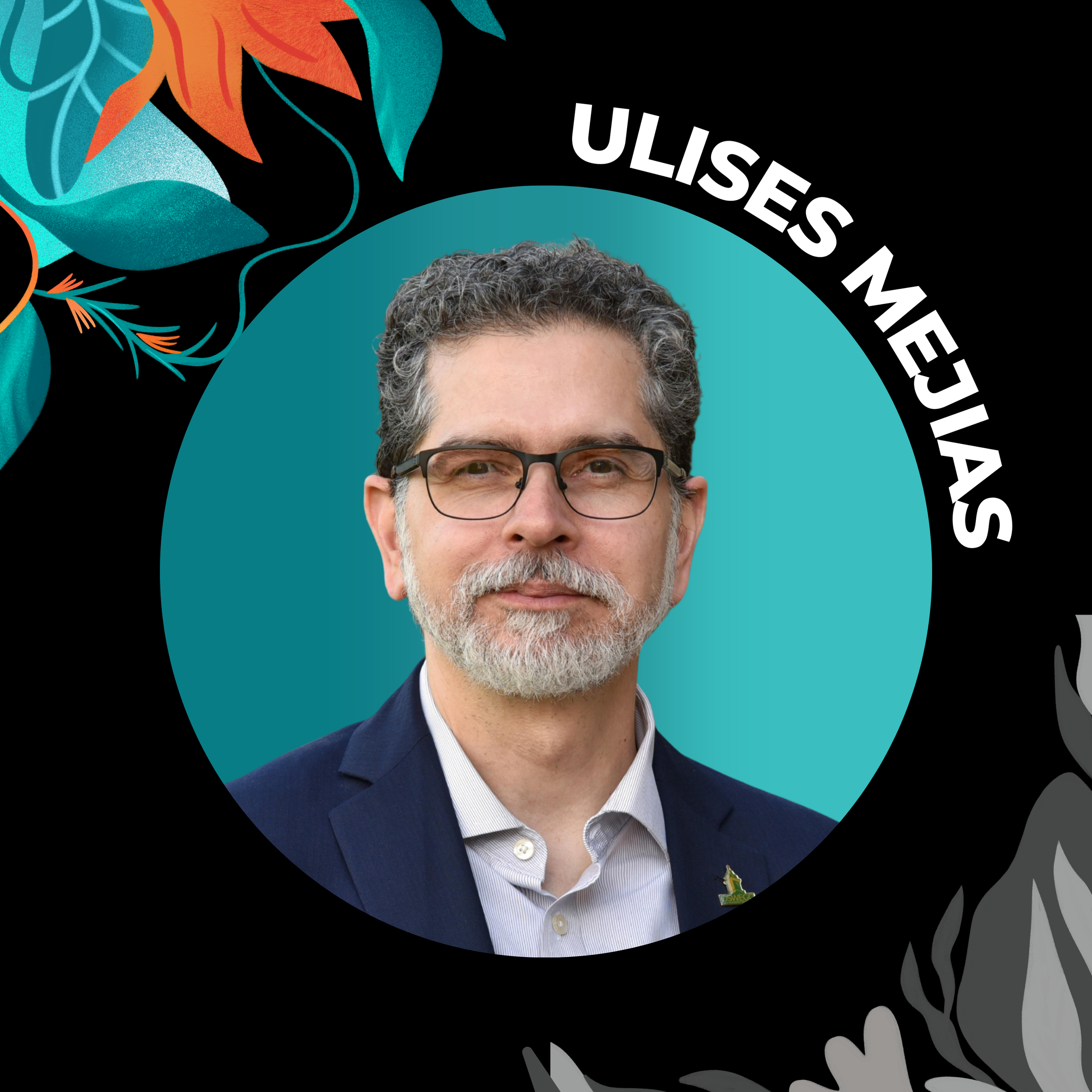



Data is the resource, and our lives are the territory. Ulises Mejias, co-author of Data Grab: The New Colonialism of Big Tech and How to Fight Back, reflects on data colonialism as a new social order that extends the extractive logic of historical colonialism into our everyday lives. Highlights include:
How terms of digital service agreements, written in dense legalese, resemble past colonial proclamations to indigenous people intended to dispossess;
How data colonialism, a system of continuous data extraction from our everyday lives, mirrors traditional colonialism in that both generate wealth for the few and enable new forms of social and behavioral control;
Why colonialism was essential for the development of capitalism and remains central in understanding today's data-driven capitalism;
How data colonialism uses the 4 X's of traditional colonialism - explore, expand, exploit, and exterminate - to move into new 'data territories' like education, health, agriculture, policing, and war;
How both traditional and data colonialism use 'civilizing narratives' to justify their extraction and colonize peoples' minds;
How AI amplifies the worst of bureaucratic proceduralism and the costs fall on the least powerful in society;
What resistance to data colonialism can learn from resistance to traditional colonialism: working within the system, against the system, and beyond the system.
MENTIONED IN THIS EPISODE:
-
Ulises Mejias (00:00:00):
What does the history of colonialism tell us about what is happening today with our data? The historical function of all forms of colonialism has always been to extract and to dispossess. Today, the colony is not a particular territory. The colony is our social lives. All of this data is being continuously extracted from our lives to generate wealth for the benefit of an elite and to facilitate new forms of social control. So that's why we have an alignment between some of these companies in Silicon Valley and far right political agendas of the current government.
Alan Ware (00:00:41):
That was Professor of Communication Studies, Ulises Mejias. In this episode of OVERSHOOT, we'll talk with Ulises about his co-authored book, Data Grab: The New Colonialism of Big Tech and How to Fight Back.
Nandita Bajaj (00:01:04):
Welcome to OVERSHOOT, where we tackle today's interlocking social and ecological crises driven by humanity's excessive population and consumption. On this podcast, we explore needed narrative, behavioral, and system shifts for recreating human life in balance with all life on Earth. I'm Nandita Bajaj, co-host of the podcast and executive director of Population Balance.
Alan Ware (00:01:28):
I'm Alan Ware, co-host of the podcast and researcher with Population Balance. With expert guests covering a range of topics we examine the forces underlying overshoot -the patriarchal pronatalism that fuels overpopulation, the growth-obsessed economic systems that drive consumerism and social injustice, and the dominant worldview of human supremacy that subjugates animals and nature. Our vision of shrinking toward abundance inspires us to seek pathways of transformation that go beyond technological fixes toward a new humanity that honors our interconnectedness with all of life. And now on to today's guest.
(00:02:07):
Ulises Mejias is Professor of Communication studies at the State University of New York at Oswego and recipient of the 2023 SUNY Chancellor's Award for Excellence in Scholarship. He is the author of Off the Network: Disrupting the Digital World, and with Nick Couldry, The Cost of Connection: How Data is Colonizing Human Life and Appropriating it for Capitalism. His latest book, also co-authored with Couldry is Data Grab: The New Colonialism of Big Tech and How to Fight Back. Dr. Mejias is co-founder of the Tierra Común, and the Non-Aligned Technologies Movement - two innovation and support networks of activists, educators and scholars working towards the decolonization of data. And now on to today's interview.
Nandita Bajaj (00:02:56):
Hi Ulises, welcome to It's wonderful to have you. Thank you so much for joining us today.
Ulises Mejias (00:03:02):
Thank you for the invitation. Happy to be here.
Nandita Bajaj (00:03:05):
And you may have seen that our podcast looks at the many drivers of our social and ecological crises, two of which, namely our growth-obsessed economies and a blind faith in technology in the name of so-called progress, are explored in depth in your work. Your latest book that you co-authored with Nick Couldry Data Grab The New Colonialism of Big Tech and How to Fight Back introduces the concept of data colonialism and how this modern form of colonialism connects to the broader patterns of historical colonialism and the capitalism it gave birth to. We're excited to have you help us understand the increasingly extractive and exploitative nature of big tech in our digital lives and the enormous and growing power imbalances that it is enabling. So we can start with how you open your book. You've talked about your interpretation of our current relationship to data as a new form of colonialism and how it began when you noticed a similarity between actions of the Spanish colonizers and contemporary terms of service agreements for various digital services agreements that probably everyone listening to this podcast no doubt reads and full with their training in contract law. Could you speak to that similarity that you found?
Ulises Mejias (00:04:34):
Yes, of course. I guess I can start by saying that I'm originally from Mexico. That's where I was born and where I grew up. And I don't mean to suggest that just by virtue of that it gives me some sort of privileged access to colonialism. I actually started to think more about the history of colonialism once I moved to the United States and I had a bit of distance, so to speak, to kind of reflect on what it meant to grow up in Mexico. But all of this to say that since then I've been very interested in the history of colonialism and especially in Latin America, but other parts of the world as well, India for instance, my wife being from Southeast Asia. So I've always found that history fascinating. And yeah, Mexico is a very interesting place to think about all of these things because if you go to downtown Mexico City, you literally see the layers, the historic layers of pre-Columbian architecture and archaeology.
(00:05:39):
And then on top of that, the building of our colonial structures including churches and the government palaces. And so, I was actually very interested in this early history and at some point, I run across this document called The Requerimiento, and this document is quite interesting because it's a document that was used by Spanish conquistadors just as they were about to colonize or enter into a village or a city. And it's framed in very legalistic terms, but what's most interesting about it is that of course it was being read in Spanish to a population that did not speak Spanish, a population who could not understand what was being said to them quite literally. This document, The Requerimiento, basically starts by saying, here we are, we representatives of the Pope and of the Catholic Church and of the king and queen of Spain, and guess what? We're here to stay.
(00:06:41):
And basically everything that belongs to you now belongs to us. We're going to take possession of it. We're going to turn you into slaves, not just you but your wife and your children, and we are going to engage in acts of war and create all the mischief and terror that we can. It's all sanctioned by the church, but basically the gist of it is that your property now belongs to us. Now when I read that, I was quite struck because of course my other field of education and research is media studies and in particular internet studies, critical data studies, the political economy of digital media. So I was quite struck by this similarity between this document that, The Requerimiento, and as you just mentioned Nandita documents like these terms of services. Terms of service when we install any particular software or an app on our phone, email client or browser or a game, we are asked to agree to these terms of service, which as you pointed out, basically nobody reads.
(00:07:47):
Nobody reads them because the language of them is quite abstract. But if we actually go through them carefully, basically the language is very similar to The Requerimiento, not in the sense that Google or Meta are going to enslave us and take away all of our property, but in the sense that yes, we're going to engage in this process of extraction and the data that you generate through the services now belongs to these companies. And furthermore, they're sort of counting on the fact that we don't understand this language, that we are in a rush to install Google Chrome, which I actually just had to do in order to conduct this interview. I usually don't use Google Chrome, and so I didn't even look at the terms of service. But when we start to compare historically what those terms of service have looked like specifically in Google Chrome in 2007, for instance, the language is very clear.
(00:08:44):
Everything that you do on Google Chrome is now the property of Google the corporation. So the content that you upload, the websites that you, and let's remember that we use Google Chrome not just to browse the web, but to access our email, to create Google Docs, which include text and spreadsheets and PowerPoints with images. So those terms of service are very specific. Google now has the right to use any and all of that content for whatever purpose they deem necessary. So all of this is happening sort of behind the scenes and in a language that we don't quite understand. So once I had this idea, I had the good fortune of collaborating with Nick Couldry and start to develop these ideas about the similarities between the past and the present. We wanted to highlight this use of abstract language that nobody understands to begin this process of historical comparison. What does the history of colonialism tell us about what is happening today with our data?
Nandita Bajaj (00:09:50):
That's very, very helpful and I like how you started with your own historical experience of growing up in Mexico and seeing the remnants of colonialism all around you. I mean, I can relate to that experience. India had been colonized for a hundred years before I was born, long before I was born, and I grew up in a post-colonial India never really questioning what the pre-colonial or post-colonial differences were in India. For me, that was the norm. Everything that colonialism has brought, and we'll talk later about civilizing narratives that you discuss, but I even recall in some cases we were told that it was good for the country because it helped develop it into a much kind of better way. And you talk in the same way about data colonialism and the different ways, as you said, it's very similar to traditional colonialism. Can you define data colonialism and also share some of the specific examples of how we experience that in our lives?
Ulises Mejias (00:11:00):
I think what Nick and I have noticed is that when we present our work, many times our audience sort of assumes that we are going to say that we are against data, that we think data is bad, that we are some form of like neo-luddite that's trying to do away with all of these new digital technologies, and that's not necessarily the case. We are not against data. We're not saying data is bad. If you use something like the weather report, you're using data. So as a category, there's nothing inherently bad about data. We are very specifically defining data colonialism as follows. We're saying that it's an emerging social order. So just like colonialism arrived 500 years ago and significantly transformed humanity and transformed the planet. Sure there had been instances of imperialism before and what have you, but colonialism was really the first time that all of these changes happened at a global scale.
(00:12:04):
So it's a new social order. We don't know exactly what it's going to look like in 20 years, a hundred years, but we know that something significant is happening. So it's an emerging social order for the appropriation of data from our lives or our lives have become completely defied from the moment we wake up, if not even before that because our devices might even be tracking what we are doing while we sleep. Obviously it means data about our activities, about our exchanges is being collected. Now we are also saying that data colonialism means all of this data is being continuously extracted from our lives for basically two purposes to generate wealth and to facilitate new forms of social control. We don't live in a world with capitalism where wealth is evenly distributed and everybody benefits. Quite the contrary, we're seeing that the generation of wealth accumulates and benefits certain parties more than others, and it also enables new forms of social control, which we see governments, but also corporations, sort of exercising over us.
(00:13:17):
They're taking advantage of this information that they're gathering from us in order to perhaps manipulate us, maybe in 'innocent' ways in the sense that we might see an advertisement for a product that we might enjoy and maybe not so innocent ways in the sense that for instance, politically, we might be manipulated to believe that a candidate has our interests in mind more than another candidate. So that's kind of how we define data colonialism.
(00:13:51):
You also asked for maybe a couple of quick examples to sort of illustrate how all of this is working. Nick and I sort of work with this concept of data territories. This new form of colonialism is not interested in acquiring land. It's interested obviously in acquiring data, but the relationships that we develop to data is very similar to the relationships that corporations in the past developed to colonial territories. A colony is a bounded space where certain rules apply and if you happen to live or occupy that colony by choice or by birth or whatever, you have to abide by some of these rules.
(00:14:32):
So let's think for instance of these different data territories, go back to the example of Google and all of the Google products that many of us use on a daily basis. That would constitute a data territory, right? I use Gmail, I have to in some ways, even if I wanted to use another provider, my school has chosen Google as its official IT infrastructure, so I have to use it to communicate with students and with colleagues, and we all use Google Docs and we all use all sorts of different Google services and we upload our videos to YouTube and so on and so forth. Now, what does this control over this data territory facilitate or enable? It's recently been reported that Google is going to use, for instance, all of the stuff that we do on Gmail and everything that we do on Google Docs. It's going to take all of that data to train its AI models. So that is presented us as a favor to us.
(00:15:32):
It's presented as something good for us because when we do searches on Google, now those searches are going to be personalized by an AI trained on our data from our emails and our Google docs. So that kind of gives a very concrete example of what a data territory is, but it's not just that. I mean, I'm thinking in my community, there's a lot of discussion these days about Flock cameras. Basically, Flock is a company and they produce these surveillance cameras, license plate readers. So in the town where I live, we have started to see a lot of these cameras crop up, and now every time you drive by, they take a picture of your license plate and of course they store that data and analyze it and can build very extensive profile of who is driving what car, where the car is going, at what time of the day, lots of important information about our activities.
(00:16:30):
Now, of course, this data is then licensed or rented to police departments or to housing communities, to neighborhoods if they want to buy it. I think the idea is that we can perhaps control crime because when a crime happens, we'll be able to very quickly identify a particular car going in a particular direction. But people are concerned in some states in the southern United States, there's evidence that some police departments have used data from these cameras to, for instance, track women who have had abortions, who have visited abortion clinics. So you can sort of get a sense of how this data might be used. The other big use that's being reported in news is this data can also be used in ICE operations, the Immigration and Customs Enforcement Agency, which as I'm sure many of your audience know these days, we're experiencing mass incarceration and deportation of immigrants.
(00:17:32):
So ICE can also use this data from vehicles to try to locate supposedly criminals who have violated immigration contracts. The last quick example I'll give is data centers. Data centers are also very clear data territories. They embody physically the spaces where these corporations need to have a bunch of computers to analyze and store and disseminate all of this data. These data centers are in some parts of the world, earning quite a bad reputation in terms of environmental impact. They use up a lot of energy, use up a lot of water. So again, these data territories have very specific and concrete impacts on our social lives and our political lives, on the environment, on surveillance, et cetera.
Alan Ware (00:18:26):
And you've discussed the differences between data colonialism and traditional colonialism. Traditional colonialism definitely being much more violent appropriation of people and property land, whereas data colonialism is often done for convenience or connection. Wondering if you could drill down a little further into the similarities between data colonialism and traditional colonialism. This one form that has 500 year history and this other that is just a few decades old.
Ulises Mejias (00:18:58):
Exactly. Yeah, that's a very important distinction because that's another aspect of our work where Nick and I have many times encountered a little bit of resistance because people tell us, okay, you're talking about colonialism and I understand what that means and we have a 500 year history of colonialism, but if what you are describing for us is a new form of colonialism, where is the violence? Are you making a one-to-one comparison between what happened in Mexico, what happened in India, and what's happening today in these new data territories? And people, I think understandably, can get a little bit of uncomfortable about those comparisons because at the end of the day, yes, we're talking about entire genocides, for instance, in the Americas that resulted in as much as 95% of the indigenous population being obliterated as a result of colonialism, not just direct violence, but also disease, et cetera.
(00:19:55):
But yes, a result of this violent encounter between two cultures. So we do want to be very clear about this. We are not making a one-to-one comparison. Colonialism in Mexico looked very different than colonialism in India, which also look very different when compared to modern forms of colonialism. Depending on who you ask, places like Puerto Rico or Palestine might be examples of current forms of colonialism. And of course we have different kinds of colonialism, plantation colonialism versus settler colonialism, et cetera. So we want to be respectful of all of those differences. Differences in terms of the scales and the context and the location and the history at the same time. There is one clear similarity that all of these forms of share, and that is the function, the historical function of all forms of colonialism has always been to extract and to dispossess. And you're right.
(00:20:59):
The other point is that's important is the relationship between colonialism and capitalism, because I think many times we sort of think of those two histories as separate, colonialism happened first, then it ended. Colonies got their independence by and large, and then capitalism came along and it was a completely different system. Part of the argument that we're trying to make in our work is that those two histories are much more intertwined than we usually assume, and this is of course not our innovation in terms of this argument has been around for a long time, and especially post-colonial scholars have thought about this quite seriously, that you cannot have capitalism without colonialism. The extraction that happened during colonialism in the plantations, for instance, to simplify things a little bit, that accumulation of wealth financed the factories of early industrial capitalism. So that is why I think it's quite useful then to think about the colonial echoes and how they continue to shape emerging forms of capitalism.
(00:22:07):
People talk today about data capitalism, surveillance capitalism, et cetera. Those lenses or frameworks can be useful to understand what's going on. But what we are saying is that we need to also historically contextualize them. And in order to understand what capitalism looks like today, we need to understand the history of colonialism and treat it not just as the past, but see how it continues to shape the present. Because at the end of the day, if we're talking about this new phenomenon of data colonialism, yes, everybody's part of this global emerging social order, but some populations continue to pay a heavier cost in this new social order, and those people are the same victims of historic colonialism. So people of color have more to lose, women have more to lose, poor people have more to lose. So that's the way in which colonialism continues to reverberate even in this new digital economy.
Alan Ware (00:23:13):
I thought it was interesting in presentations you've mentioned that by 1945, 1 in three people around the world were living under colonialism, and that it was estimated to have increased the land per capita of Europeans by six times. So it was as if Europe were six times larger in terms of the food, sugar, cotton, everything that, like you said, was forming the basis for the industrial revolution where they could apply coal and steel to all of these raw materials, the cotton for the textile mills, sugar for various food stuffs. And as you mentioned, it was a corporate state alliance like with the East India company that you mentioned with just a few hundred in London then having what a quarter of a million Indian agents helping control and appropriate, I forget how many trillions of dollars out of India that were taken during the colonial period.
Ulises Mejias (00:24:05):
Yeah, exactly. Those comparisons are fascinating because yes, the acquisition of territory during colonialism, of course it was massive, but in our work we try to compare it to what's happening today with the generation and accumulation of data. We are generating so much data today, and that's why we need all of these data centers to store it and to process it. And we need all of this compute power to feed it to AI models so that supposedly that can make our life easier. The scales are quite interesting. So if around World War ii, one in three people were living under colonial rule, as you pointed out, Alan, now we have to think about how many people use TikTok in the world, one in eight, or how many people use Meta products? How many people are a part of this data territories, in other words. And so again, it's not a one-to-one comparison. We don't mean to suggest that. Yes, therefore everyone using TikTok is a slave, a modern day slave. Obviously it's a different kind of colonialism, but the function, the purpose is the same to extract and to dispossess.
Alan Ware (00:25:16):
And just as it was relatively few countries with land colonialism, now we've got the US Silicon Valley and China with Baidu and Tencent and Alibaba, you have these two large systems and everybody has to buy into one or the other system and have very few, I've read that a lot of European countries have very sensitive information that has to go through Silicon Valley corporations, right? There aren't other options, and I'm sure all of Africa and much of the world has to choose which of those systems, Chinese or US, really data systems to join. And that can marginalize so many people.
Ulises Mejias (00:25:54):
Yes, because again, the whole point of the system is not to distribute wealth and benefits equally, it's to concentrate power and to concentrate wealth. So that's why we have an alignment between some of these companies in Silicon Valley and far right political agendas of the current government because yes, what they want to do is concentrate all of this wealth and power for the benefit of an elite. We've seen this before. I think that's also why the framework of data colonialism resonates with many people because it's like, well, we don't need to make wild guesses about the future. We've seen this before. We know where the history is going, and so we know what's at stake.
Nandita Bajaj (00:26:38):
And I appreciate that one of the similarities that you make with traditional colonialism and data colonialism as brought up earlier, was this tool of civilizing narratives where traditional colonialism will use language of progress or civilization or colonizer knows best or racial narratives of superiority while data colonialism is using similar narratives of progress, convenience, connection, efficiency, productivity, et cetera. And yeah, I wonder if there's anything you want to say to that.
Ulises Mejias (00:27:17):
Again, we can learn a lot from history and we can see that colonialism wasn't just about acquiring land, it was also about colonizing the minds of the colonial subjects. If one in three people were under colonial rule at the height of colonialism, then obviously it's because in addition to the violence, there was also an epistemic dimension to all of this, right? People believed that the colonizer's model of the world, how they view the world was the right one and the only one in fact. And so the Eurocentric ideas of white males basically came to represent a universal standard that we should all follow under colonialism. And why should we agree to these terms and conditions of colonialism? Well, because the colonizer knows best. Colonialism was also founded on the idea that white western civilization was best and knew best. The rest of the world were basically savages, uncivilized savages, or perhaps just like innocent children that needed to be educated, that needed to be civilized.
(00:28:28):
And so the idea was to present colonialism as progress, as the spiritual salvation because heathens needed to be brought to the true and authentic religion. And perhaps later we can talk also about the alignment between what's happening today in Silicon Valley and certain ideas of Christianity and the antichrist, which suddenly some billionaires seem to be very interested in. So religion is not completely out of the picture, it's still around. But mostly today, yes, we're presented again with this narrative that, well, this is progress. This is what we must do in order to keep the human project advancing, and in economic terms it's going to bring wealth and abundance, and in social terms, it's going to bring democracy and the ability for all of us to be connected. And if people start asking questions, we are told well before the colonizer knew best. Today, the CEOs know best. They know what's good for us and the products that they're building know what's good for us, so we should just trust in all of this. And so there's definitely this epistemic dimension to colonizing our minds, not just acquiring territory or building up wealth. It's also about getting us all to believe that this is the right and only way to move forward.
Alan Ware (00:29:53):
Well, and as we look at on this podcast, the ecological devastation of traditional colonialism, the forest and the soils and the waters, and now new tech, big data growing at an enormous rate, where I saw in an article from MIT review by 2026, the electricity consumption of data centers would place it between Japan and Russia in terms of an entire nation's electricity demand. And Goldman Sachs estimating global energy, electricity demand growing 50% from 2023 to 2030. So this is enormous growth of natural resources, water energy, creating all kinds of pollution and backed up often with a view that even in areas like renewable energy, that we've got to have certain sacrifice zones, and we may see data centers being put in global south if the global north doesn't want them. So we've seen that more of that from an ecological perspective also.
Ulises Mejias (00:30:53):
And this idea that never-ending growth is sustainable, which is what drives capitalism, which is what drives data colonialism as well in terms of we need more data, we need better models, we need more data centers because those are going to power AI. And it's one thing to say we need 10% more energy, but apparently there's just no end. I was listening to another podcast where they were quoting Elon Musk. They asked him, it's like, okay, well how much more energy are we going to need? What's the end goal here so that at least we know what we're going to shoot for? And he said something ridiculous like, Well, eventually all of the energy that comes from the sun, and in fact all of the energy that comes from the galaxy will need to be dedicated to power data centers and AI and all of these conditions.
(00:31:41):
So I don't know what drugs these people are on, and why are people believing this, taking them seriously? I mean, we kind of know why in the sense that we are in an AI bubble. And so in order for this wealth machine to keep generating more and more, we need lots of people sort of not asking questions and just believing that all of the money spent on data centers is a good investment. But yes, I think the rest of us are kind of scratching our heads and thinking there's just no end that we can see. And so the narrative, the civilizing narrative is not just about civilizing savages, it's about taking over galaxies in terms of all of these resources should be at the command of a handful of people who are going to tell us what is good for humanity.
Nandita Bajaj (00:32:32):
And there's kind of this fascination and obsession with the concept of innovation that these are the people who are innovating new tech, new ideas. And you've also discussed how it's not unsurprising that data colonization follows traditional colonialism because the science and tech in a way emerged with and around the time of colonialism. So though they may not be totally hand in glove with colonialism narratives, they are heavily influenced by it. And I like that you said earlier technology is not neutral in the past, and it continues to be owned by the most privileged in society who then get to set the rules of what technology gets pushed out, how it's used, and how it continues to exploit and dispossess those who have always been on the margins of society. So I think that's very, very fascinating. And you've also argued like traditional colonialism, data colonialism has to constantly expand its territories of extraction, and you've used the four x model of territorial expansion. Can you explain that model and highlight some of the new territories data colonialism is moving into?
Ulises Mejias (00:33:56):
Yes. So this was another sort of moment when Nick and I were developing our argument that we ran across something that we thought it would be good to use it to sort of explain what's going on. And this time we actually borrowed something from the world of video games, in particular, strategy video games, for instance. There's actually Colonialism, the video game, part of Sid Meier's Civilization series, which I think many people are sort of familiar with those kinds of games. And so if you visualize this kind of game, you're usually in this particular game playing the role of a colonizer. You can be the Spanish Empire or the British Empire or the French or the Dutch, I think. And so your role is to go around this virtual world and establishing colonies, planning your resource management, pacifying rebellions if the natives get a bit troublesome.
(00:34:49):
And so in order to do this, you have to apply what is known in strategy video games as the four X model. And those four Xs are explore, expand, exploit, and exterminate. You have to go through this process again and again in order to win the game, succeed. And so when we encountered that, we thought that this is actually quite a useful summary of what the colonizer's playbook is because they did exactly these four things also - explore, expand, exploit, and exterminate. The whole idea of colonialism is that first you go out and explore new territories. The idea is then that you expand them by establishing new colonies and connecting them to each other, and also more importantly, connecting them to the center of empire so that resources can flow in very specific directions. So you expand your empire, you exploit the resources of that empire, so certain parts of the world can contribute silver and gold.
(00:35:50):
Other parts of the world can contribute cotton or sugar or coffee, et cetera. But the idea is, again, to build a machine that concentrates power and wealth. The idea is not to distribute it evenly. The idea is to capture it and accumulate it in very specific centers of empire. And then of course, because while doing this, you create a lot of animosity and Ill will, people are going to rise up and protest. And so then the last X is exterminate. Sometimes you will need to kill off indigenous populations, put dissenters in jail, or even if we think of extermination, not just in terms of violence, but in terms of, as we were just saying earlier, epistemic violence, you're going to exterminate alternative ways of thinking so that only one way of looking at the world survives and becomes prevalent. So again, this model of explore, expand, exploit, exterminate is quite useful to see what corporations in collaboration with states today engaged in this process of data colonialism are doing.
(00:36:57):
I talked a little bit already about what a data territory is and how the whole point of this system is to create these enclaves, these sacrifice zones where all you're going to do is extract these resources to the largest extent possible. Today, the colony is not a particular territory. The colony is our lives, our social lives, those are the zones of extraction. We generate all of this data when we post pictures or create documents for work or for school when we engage in financial transactions. So all of this data is being accumulated and put to the service of generating wealth. So these data territories, we're starting to see new ones. It's not just a social media, it's not just AI chatbots, for instance, ed tech, educational technology, something close near to my heart because I'm a professor, and so I see this very closely. In order for me to do my job and for students to learn, we have to rely increasingly on tools provided by some of the same companies that we have been mentioning.
(00:38:08):
And so education has become also a space where data generated through the learning process can be extracted and accumulated. Health tech, again, the datafication of healthcare, not just through, let's say, making sure the data systems of hospitals are now online, but also through all of these devices that monitor our health, Fitbits and Apple watches and all of this. And so that's also become quite a big important and rich data territory. Health data has become quite a lucrative resource that these companies want to accumulate. Similarly, we can talk about the ag tech, agricultural technology, the way we produce food. It's also becoming increasingly datafied with robots that can do the work that humans used to do, with the design of new seeds, even using AI to genetically modify seeds and create seeds that are owned by corporations so that local farmers can no longer just depend on what they used to grow, but now must buy basically tech products, genetically engineered seeds or fertilizers, et cetera, just to grow food.
(00:39:22):
We can talk about PropTech, property technology, the way in which properties are being managed by corporations and for instance, rent prices are being set algorithmically not to benefit tenants, but to increase the wealth of landlords. WarTech - war as we have been seeing in Palestine and in Ukraine has become increasingly technologized and increasingly dependent also on data that armies capture and extract from civilian populations and from territories. So all of these new data territories, they're basically set up to fulfill this essential function of taking the data that is generated in this territories and using it to generate wealth and to generate new forms of social control.
Nandita Bajaj (00:40:13):
What you said about EdTech, I'm also a long-term educator, both in high school and now in university, and I'm seeing the same adoption of data services, but also AI kind of in a very uncritical way where the foundation of these services is not being questioned, it's just seen as an inevitability. And with those progress narratives, the way it's being sold is you either adopt it or get left behind, and schools are so afraid of being seen as not being progressive, that some of them are really uncritically adopting a lot of these technologies. There was this great article recently in Current Affairs written by Ron Purser saying AI is destroying the university and learning itself, where they talk about how the California State University system, which is America's largest public university system with 23 campuses and half a million students, they went all in announcing a 70 million partnership with OpenAI. And interestingly, at the same time, they've proposed slashing 375 million from its budget, which basically means getting rid of faculty because so much of, as you said, our jobs and our purpose is being replaced by these machines, and if students are writing stuff using AI and professors and teachers are marking stuff using AI, you just start to wonder what is the purpose of education then if it's not creating these critical and systems thinking skills, including being able to critique this form of colonization.
Ulises Mejias (00:42:06):
Yes, I mean, I could spend the whole hour talking about what's happening on campuses with AI, and in some ways it is kind of like a battleground because you are right, just the way in which different parts of the campus think about AI is quite different, and I hope we can still have dialogues about this, but everything else in our societies, those discussions are becoming more polarized. The higher ed policy institute in the UK actually has done a lot of interesting data collection and analysis. And yeah, it's quite interesting to see that the parts of the campus that are pro-AI are those parts that are associated with STEM basically and business school, et cetera. And it's mostly white rich men, professors who are mostly in favor of AI, and this is not my opinion, this is actually the results of the surveys that they did at this institute.
(00:43:01):
And of course, you can expect that at the other end of the spectrum, the people who are against AI are mostly, the people in arts and humanities are mostly women, people of color from what are considered lower economic strata. But it is unfortunate, like you said, Nandita, that schools feel certain pressure to jump on the bandwagon, and if they don't adopt AI, they will be seen as outdated and not relevant. Having said that, I think it's quite interesting that my students are completely against AI, most of them, because again, we're talking about students in the creative fields - arts, humanities, writing, media, and so they see the writing on the wall. And so this narrative that, well, you need to learn how to use AI because in your job you will be expected to do that, well students are starting to ask, it's like, well, is there even going to be a job? So what's the point of training me for a job and telling me I need to learn how to use this tool if this very same tool is resulting in fewer and fewer jobs in my field? So yeah, the discussions happening around campuses are quite interesting these days.
Alan Ware (00:44:09):
And as you note, a lot of the territories, not just ed tech, but ag tech and health tech and transport tech and just every area of our lives in the past, the government had a critical role in computers and the internet and going to space, at least in a country like the US and there's at least some accountability we can exercise through the government. These new territories are being explored and exploited primarily at the behest of private capital, private corporations. So you have companies like Palantir that are deeply embedded in multiple sectors, policing, immigration, public health, military operations globally. And that's a scary new element that there doesn't seem to be as much public accountability of a lot of the advancement into these new data territories. And this state-corporate alliance can be used for a frightening level of social control. And as you've mentioned, a bit of the epistemic domination, the power to define what counts as knowledge and truth. And to the extent that that's coming out of more private capital wealth accumulation interest even more than in the past, how is that reshaping our sense of reality and agency?
Ulises Mejias (00:45:24):
Yeah, because you're right. I mean, as we sort of established earlier, colonialism has always been a partnership between the state and the private enterprises. With the East India company being a good example that we already mentioned, but even going back to the Spanish Empire and they have something called the Casa de la Contratación de las Indias, which was basically also kind of like a proto-corporation that did the dirty work of the state. You're also correct in pointing out that the relationship has sort of shifted. I think the state used to have more power and the authority to establish laws, to collect taxes, to put limits on certain kinds of colonial activities, whereas now it's very clear that with the disintegration of the state, the defunding of the state, corporations are playing a much more important role. So for instance, we're talking about data extraction, and the state used to have the authority to collect data from citizens through census, things like that.
(00:46:25):
Nowadays, to the extent that they don't have the resources to do that, they depend on private corporations to do that. And so what we have found is kind of like an interesting loophole where before the state could not collect certain kinds of data. It would be unconstitutional or illegal for the state to do that. Today they're getting around that because they're not collecting the data themselves, they're licensing the data from private corporations that collect it. And so some good lawyers are trying to challenge this because it's like, well, this is still illegal. This is not constitutional. Just because you're not collecting the data yourself but are getting it from somewhere else, doesn't give you permission to use that data. But at this moment, we've sort of just gone past that point very rapidly. And so not a lot of people are aware that this is happening or are trying to determine how to stop it.
(00:47:18):
But yes, we can see how it can be used to basically shape our realities and shape our understanding of the world. And we've just talked about AI and even just the way in which AI is being introduced into scientific research. And so I think we're going to see a crisis where more and more researchers are losing the abilities, the critical thinking and the skills that come with the ability to do science. And all of that is being sort of offloaded to AI. And perhaps even instead of having to do research and studies, let's let AI conduct experiments with synthetic data. It's like, why go and study a hundred human beings? That's expensive. AI is going to come up with a hundred synthetic profiles, and let's do the experiments on those profiles. So we're on a way for a serious crisis in scientific knowledge as well.
Nandita Bajaj (00:48:13):
And you've also written about the rise of artificial bureaucratic intelligence and use the term social quantification sector to describe the new social class that manages and profits from data extraction. Can you unpack what you mean by those ideas and how they help us understand where AI is heading and the kinds of power that's being concentrated through data colonialism?
Ulises Mejias (00:48:38):
Well, so I wrote an op-ed about this concept of artificial bureaucratic intelligence. It was a little bit tongue in cheek because of course, the broligarchy, the tech oligarchy, keeps talking about AGI, right? Sort of this constructing this all knowing deity AI machine that will tell us how to solve all of our problems. I don't think we're getting close to doing that, but in the meantime, we have all of this negative social impact that introducing AI to our lives is creating. But of course, when I say bureaucracy, it's sort of like this negative cliche of people who abuse state power to basically encircle us in meaningless procedures and hoops that we have to jump through. So if that's sort of the starting premise of bureaucracy, I thought, yeah, AI with its hallucinations and with its inaccuracies can actually be a very powerful bureaucratic tool because bureaucracy is one area where inaccuracy is not a bad thing.
(00:49:42):
What you want to create is confusion, and what you want to create is a lot of meaningless hoops that people have to jump through. And so if AI is not accurate and it's in fact creating hallucinations, that's actually not a bad thing from the perspective of a bureaucratic government. And a very clear example of this is the focused on and the persecution of immigrants that we're seeing in the United States. Now, I was just looking at some of the most recent figures. It seems that according to ICE records, there are about 65,000 people in detention currently in the United States since the beginning of the Trump administration, and 35,000 people who are GPS tagged. So they might not be in detention centers, but they're wearing some form of ankle bracelet so that their position can be tracked. And not surprisingly, the biggest growth in all of these detentions is among people with no criminal histories.
(00:50:41):
So not even people who have broken any kind of immigration rule, but people who have committed no crime. So according to the recent data, 70% of arrests have targeted immigrants deemed low risk by the government. So this idea that we're going after the criminals, we're going after the bad people from Latin America who are raping our women and dealing drugs on street corners, that's just a fantasy. I do want to point out that this has been a fantasy for a long time, even before Trump. I mean Obama, not for nothing he was known as the deporter-in-chief because a lot of deportations happened under his watch. But what's the change that's happening is that now I guess they've run out of criminals to try to catch and deport, so now they're going after innocent people. So again, this is an application of algorithms and AI where inaccuracy is quite valuable because if AI or an algorithm can say, this person is just flagged as someone that should be captured and deported or detained, then people are not asking questions about the validity of that data or how that algorithm or that AI came to that conclusion.
(00:51:57):
We now have a force in this country with a budget that is bigger than the armies of countries like Spain or Turkey who is going around detaining people and deporting them, and all sorts of tragic things are happening to these people. So these government agencies are seeing themselves as data organizations, and as Alan mentioned earlier, with the help of companies like Palantir, some of these government agencies have become just that, they're using data to carry out their functions, which in this particular case means going after immigrants, whether they have the right to be here or not, and regardless of whether they have committed any crimes or not.
(00:52:42):
So all of this brings us to what we in our work called the social quantification sector. So the idea is that we wanted to talk about big tech, Apple and Amazon and Meta and Alphabet slash Google, and of course we wanted to talk about their Chinese counterparts because a lot of these things are happening in a similar level in China as well. But we wanted to not just talk about these big players, we wanted to talk about everybody else because there are a lot of smaller companies like Palantir or even an independent programmer creating an app to track people or whatever. So it's not just the big companies, it's the smaller ones too. It's not just software, it's as well, it's not just data brokers, it's also the construction firms who build data centers. So we wanted to collect all of these players under one umbrella, which is what we call the social quantification sector, because at the end of the day, whether it's a big company or a small one, whether it is a phone manufacturer or AI chatbot company, all of them function on the premise, the essential function of data colonialism. All of them function by extracting data from our social lives, hence social quantification sector. So that's where those ideas came from.
Nandita Bajaj (00:54:03):
Yeah, this unholy alliance that you speak about between government and corporations, I want to also tie it back to another thing that you mentioned in terms of surveillance. It's not complete coincidence that this kind of new obsession with detaining and deporting immigrants and this obsession, especially in the United States with this low fertility alarmism that we're not producing enough American babies. And you talked about the surveillance of who's going to abortion clinics, there's now period trackers, and you mentioned also earlier this overlap with Christianity. And I think there is an overarching narrative around the great replacement theory, this fear of running out of the right kind of people within not just the United States, but this is happening in so many other countries, and at a time when human presence and activity and this kind of huge power imbalance has led us into this extreme state of ecological and social crises, this seems like the absolute worst possible obsession to be focused on. Yeah. I wonder if there's anything you wanted to add to that.
Ulises Mejias (00:55:24):
Well, in what world could we imagine a follower of the teachings of Jesus or many other Christian fears promoting incarceration of children? So it is just mind boggling. I think it's also a very shameless attempt to align themselves with far right, supposedly Christian values. I mean, you were mentioning the period tracking apps, and apparently one such app is backed by Peter Theil who plays a key role in Palantir. So again, I think it's very much this idea that women's bodies are data territories. We have to know what's going on with them and control them and put them at the service of the generation of the right kind of human beings, i.e. white Eurocentric males preferably. So yeah, it's scary.
Alan Ware (00:56:19):
And as we've talked about, the data territories, we're all enmeshed in them to some extent. This interview is taking place all through digital platforms and our lives are thoroughly enmeshed in it. Before we get to some of the resistance we might have to it, we were wondering if you could paint a picture of what the stakes might be, if we don't resist, what might data colonialism look like in a few decades?
Ulises Mejias (00:56:44):
Well, in some ways, with your help, we have been talking about many of those issues already throughout this interview. Just the idea that we are creating a world where there is increasing inequality because the wealth that's being created ends up in very few hands. We're creating a world that is very oppressive towards certain kinds of people, which traditionally have been the same victims of colonialism that we've seen for centuries. So when we talk, for instance, about the impacts of the gig economy, things like that, obviously we see that these things are impacting mostly people of color, migrant communities, women. So yeah, it's not a world that has direct violence in the way in which we're used to thinking about it, physical violence. But there's plenty of that too, especially when we think about the genocides that are going on in Palestine, for instance. And again, the role that technology and data plays in part of that too.
(00:57:48):
So physical violence is still very much with us, but we also have all of these new forms of symbolic violence, epistemic systemic violence. So yes, what's at stake is basically a world where only a few people get to live behind high walls because they have to protect themselves from the mess that they've left behind a world which benefits very few at the cost of the lives and the quality of living and the dignity of the majority of the world. We don't need a lot of imagination to paint that picture, that picture we have seen for 500 years. It's the picture that colonialism and then the combination of colonialism and capitalism have painted for us. So that's at stake.
Alan Ware (00:58:33):
Yeah, it reminds me of the debate that I've heard over the decades between are we headed towards Orwell's 1984 or Huxley's Brave New World? And it feels like it's a bit of both, the Big Brother surveillance, which AI and big data are enabling in the social control of a 1984 combined with kind of the dopamine, distraction, pleasure, convenience, algorithmic ease of life of kind of a Brave New World combined with designer drugs and who knows what else that might be equal to. So at some point, plenty of dystopian possibilities.
Ulises Mejias (00:59:09):
Yeah, I forget now the name of the author doing work on this subject, but since you mentioned dopamine, dopamine has also been a very instrumental colonial tool. So certain colonial crops, sugar and coffee, the growth of these substances that always give us a nice high. And so we can trace the colonial evolution of these substances compared now to social media and AI, which again gives us a very nice high, of course, followed by a crashing low, but it's the same cycle.
Alan Ware (00:59:45):
So to finish the conversation, what are some paths of resistance for both us as individuals and groups, communities? What do you see as some of the most promising contemporary approaches to resistance?
Ulises Mejias (00:59:59):
Yeah, this is important because when we present our work, it can get pretty dark and tends to come across as pessimistic. I know some people sort of feel that it's a privileged position to be this pessimistic, perhaps there's a little bit of truth to that, although I disagree by and large. As someone from the Global South, I am comfortable with pessimism at the service of critical thinking. And I do think that the naive optimism, that's actually where the privilege lies. I think when we present our work and people say to us, okay, this is all very depressing, please give me a list of five things I can do right now to fix this so I can feel better. And so, yeah, our message is not geared towards that. It's like, no, unfortunately, if we are right, and this is part of a 500 year problem, the solution is not going to come next week or next year or in the next decade even.
(01:00:53):
These are long historical processes. But we can intervene and we can do things to safeguard our rights and our dignity. And here in our work, Nick and I have actually borrowed a model from Latin American activists, from people who have had a long history of resisting colonialism. And what they tell us is that when fighting against colonialism, you need to operate simultaneously at three different levels. And those levels are you need to fight within colonialism, you need to fight against colonialism, and you need to fight by going beyond colonialism. And if you only focus on one of those things, it's not going to be enough. So we need to expand our horizons of opportunities for intervention across all these three different levels. So very briefly, what does that mean? Well, working within the colonial system, within the capitalist system means maybe mainstream politics, which this day and age seems quite pessimistic and dire, but we do, we have to continue to put pressure on governments to do what's right by us not to do what's right by corporations.
(01:02:10):
We need to elect the people who are going to defend those rights. So participating within the system, it means not giving up on the state and on government, unfortunately, yeah, we can sort of choose to look the other way and ignore it, but part of our struggle definitely needs to be change things from within. We can also see it very clearly in terms of corporate dissent. There are people within Amazon and within Google and within Meta who are increasingly saying, I'm not okay with what my company is doing, or at least they're asking questions. It's like, well, yeah, what about the environmental impact of all of these data centers that we are saying that we need? Some of these people, of course, are not at the management level, and many of them are losing their jobs as a result of speaking up, but we should applaud them and encourage them because it's still a very important function that they're playing.
(01:03:05):
Many of them are seeking to unionize to create unions within their industries and corporations so that they can advocate for their rights. So those are examples of working within the system that I think are important, but of course, the system is not going to fix itself, so we also need to work or fight against it. And so this means any kind of politics or protests, for instance, one example I frequently bring up is the group deliveries Unidos, which is a group mostly of immigrant workers in New York City who deliver food through the gig apps, Uber Eats and whatever. And so they've actually came together at great risk to themselves to try to organize and to try to demand certain labor protections with some success, at least on paper.
(01:03:53):
Another good one is all of the community organizing that is happening around protesting against data centers. So as all of these data centers are encroaching in our communities, there are neighborhoods, there are communities who are saying, hold on a second. You say this is going to bring jobs, but what does that mean? You say, this is going to bring tax income, but let's look at the record of some of these companies, or let's look at past histories and see if this has actually happened in the past. And at the end of the day, yes, we don't want data center in our neighborhood if it's going to mean increasing energy prices and if it's going to mean depleting water resources. So people are organizing against construction of more and more data centers. So that's the second level working against the system. Lastly, what does it mean to work beyond the system? Of course, that's where imagination becomes quite an important tool of colonial resistance, which is a tool that has always been deployed by anti-colonial, decolonial forces. Because when colonialism couldn't be resisted with the body, it could be resisted with the mind, as we have said by decolonizing the mind. So imagination, cultural responses to everything that is happening, developing alternative technologies so that we don't have to use Google Docs, we can use Next Cloud, which is an open source alternative that is free and available to the public. So that's where thinking beyond our current circumstances, thinking about other worlds, other realities, other possibilities, is going to be crucial and important, and we must engage in that as well.
Alan Ware (01:05:32):
Right. And moving beyond tech to more direct interaction with nature that's not mediated by tech or face-to-face communication would be two ways to kind of resist just being on any sort of digital element. And it did remind me that within the system, there's an interesting tension between people like Trump wanting to deregulate AI and various states, some of them conservative like Florida, Arkansas, and Texas, want states to be able to regulate AI. Bernie Sanders wants states to be able to regulate AI. So that would seem to be quite an important within the system element that we can all try to ensure that the states in the United States have the ability to push back.
Ulises Mejias (01:06:17):
Yes, that's a great example.
Nandita Bajaj (01:06:19):
And I also really appreciate what you said about our responsibility to be realistic about where we're headed and where history has brought us, and to not buy into this often delusional form of optimism that so much of our culture is obsessed with. And there is this fear that if we're not constantly subscribing to some form of optimism, that we automatically are subscribing to despair. And I think you and so many other people, including us, we are showing that that is not what it means. You can actually lean into the realism of the terrible nature of the reality that we're in and still be fighting. It doesn't mean we become paralyzed and destabilized if we're not optimistic. There's a lot of strength in being honest about the state of the world and still fighting to minimize suffering and injustice. So I really want to thank you for your incredible work in drawing such important distinctions and similarities between the traditional form of colonialism and data colonialism, and also helping to expand our knowledge about how we and our listeners can engage in different forms of resistance. Thank you so much also for your time today.
Alan Ware (01:07:45):
Thank you.
Ulises Mejias (01:07:46):
Thank you. This was a wonderful conversation.
Alan Ware (01:07:49):
That's all for this edition of OVERSHOOT. Visit population balance.org to learn more. To share feedback or guest recommendations, write to us using the contact form on our site or by emailing us at podcast@populationbalance.org. If you enjoyed this podcast, please rate us on your favorite podcast platform and share it widely. We couldn't do this work without the support of listeners like you and hope that you'll consider a one-time or a recurring donation.
Nandita Bajaj (01:08:18):
Until next time, I'm Nandita Bajaj, thanking you for your interest in our work and for helping to advance our vision of shrinking toward abundance.