

This article first appeared in Truthdig on November 26, 2025.
A new book by geographer Samuel Miller McDonald details the origins of technological development in humanity’s parasitic relationship to the natural world.
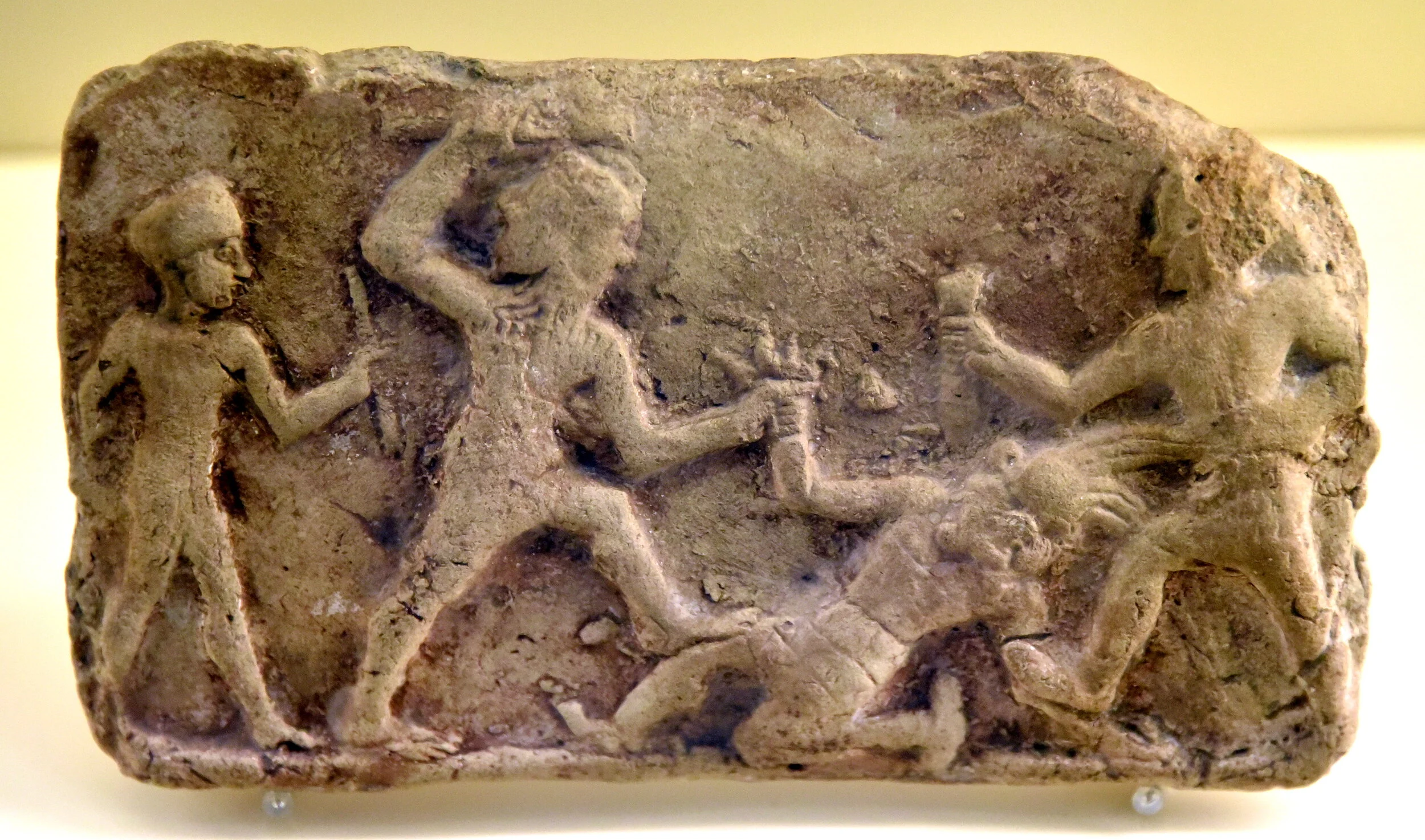
Gilgamesh and Enkidu slaying Humbaba at the Cedar Forest. Credit: Osama Shukir Muhammed Amin FRCP(Glasg), CC BY-SA 4.0, via Wikimedia Commons
The oldest surviving literary endeavor, “The Epic of Gilgamesh,” is also the first recorded progress narrative. In the story, the all-powerful, mountain-flattening demigod Gilgamesh, “awesome to perfection,” domesticates a hairy hominid named Enkidu, “a savage fellow from the depths of the wilderness,” plying him with bread and beer and offers of sex with a “voluptuous” woman. Once he becomes fully human, transformed into a tamer of lions and wolves, Enkidu joins with Gilgamesh to slay the guardian of the Cedar Forest, the terrible Humbaba, so that a city may be built from the felled timber.
The narrative glorifies an act of ecocide as necessary to cement Gilgamesh and Enkidu’s dominion over the natural world, leaving behind a metropolis as monument to their power. According to Samuel Miller McDonald, writing in his formidable first book “Progress: How One Idea Built Civilization and Now Threatens to Destroy It,” the story amounts to “a piece of propaganda” fashioned to justify a new relationship with the natural world, in which progress is equated with expansion of the “ecologically destructive” Sumerian city-states that arose in Mesopotamia 5,000 years ago.
McDonald, a geographer and human ecologist, travels nimbly across this well-trod terrain. Jared Diamond, Lewis Mumford, Derrick Jensen and many others have indicted civilization — literally “life in cities” — as the starting point for kingship, hierarchy, inequality, war, slavery, conquest and disease. (Diamond famously called agriculture, the sine qua non of life in cities, “the worst mistake in the history of the human race.”)
Listen to our podcast interview with Samuel Miller McDonald about his new book, Progress.
McDonald’s contribution is to frame the story of the curse of civilization via a helpful lesson on the many ways that organisms capture energy for survival in the natural world. He singles out three types of energy capture: mutualist, commensalist and parasitic. The first involves species that mutually benefit each other, such as when bees drink the nectar of plants they help pollinate. Commensalism occurs when the relationship is neither beneficial nor harmful, such as when birds nest in trees. Parasitism is clear enough: It’s the tick, the leech, the intestinal worm, an organism extracting energy to the detriment of its host.
“The new types of societies that arrived with the first empires,” writes McDonald, “were extracting and expanding rapidly, to the detriment both of the ecological diversity in their region and certain members of these societies.” These “parasitic societies” …
… harmed the fertile soils by overproduction, they harmed the once lavish forests and the species that called them home by cutting down the trees, and they harmed the classes of workers, slaves, and soldiers deployed to toil and make war and die on behalf of small groups of elites, new semidivine rulers at the apex of their economies. Instead of operating within local carrying capacities, they expanded beyond the naturally occurring energetic limits of a given ecological system. When the limits to the extraction of resources are exceeded, the parasitic system must either suffer a crash or must invade and take the energy of a more distant ecology or society.
Not only was “Gilgamesh” the first piece of literature in Western history, writes McDonald, it was the first to celebrate the parasitic society. Thousands of years later, as industrial Homo sapiens overwhelms the biosphere with technological systems and the energy needed to sustain them, we are as trapped as ever in this model of violent extraction. And while we can assert indisputably that “progress” for the chosen species has meant longer and healthier lives for some of us, and greater affluence (for some), and less suffering (for some), the relationship with the natural world remains parasitic, its impact on our other-than-human brethren one of relentless horrors.
Today the consequences of that relationship, as a growing chorus of scientists has made clear, likely include self-destruction. The levels of energy capture, along with the outflow of toxic effluents, have grown so great they threaten to kill the host. A few statistics paint the grim picture of the parasite’s progress. Of all the mammals in the world, wild mammals account for just 4% of total biomass. The other 96% consists of humans and our domesticated animals bred for slaughter. In 1900 the total mass of civilization was equal to about 3% of global biomass. Today, the mass of concrete, glass, constructed wood, metal, plastics and machines of all kinds — our built environment — “is greater than all life on the planet, all plants, all animals, all bacteria,” according to McDonald. Collectively, the animals on Earth weigh approximately 4 gigatons — but plastics now total 8. With crashing biodiversity, Homo sapiens is increasingly alone in a depauperate landscape. “Humanity alone is nothing,” McDonald observes. “Rather, it is worse than nothing; alone in a once-diverse world, it is a grotesque, bloated ape seated on a throne of corpses.”
The author offers no clear path out of parasitism, nor should we expect him to. It may be that we are trapped in civilizational path dependence, unable to change course. He concludes his book with a tonic dose of realism based on the known biophysical limits to growth of the human enterprise.
“I can’t give you hope,” he writes, “wouldn’t delude you with it if I could, but I can just about guarantee that there will come a time when there is too little energy, both living carbon and fossilized carbon, to run the engine of this vast parasitic global network. There will be no more space to expand into and no more resources to extract. When that day comes, this network will fracture.”
On that day, the march of progress will have arrived at its end, having effectively committed suicide.