

Bioxenophobia: The uncertain fate of Colombia's alien hippos
This interview was first published in Psychology Today on May 3, 2025.
The presence of free-ranging hippos is a case study for conservationists.
Key points
Colombia's hippos are a classic case of traditional conservation (TC) versus compassionate conservation (CC).
The lives of individual so-called invasive animals such as hippos aren't valued in TC but they are in CC.
The hippos offer a unique historical opportunity to prove that we can coexist with nature.
The case of the Colombian hippopotamuses is a clear example of "bioxenophobia" (or biological xenophobia, a dislike of invasive, alien species) and bias in traditional conservation. However, at the same time, it is an opportunity to demonstrate true values of coexistence with other species, to make us responsible for our impact on the Earth.
I'm pleased that two conservationists on the ground in Colombia, Juliana Barberi and Juan Camilo Jaramillo, could take the time to answer a few questions about the hippos who wound up in their country and are now considered by some scientists to be invasive animals who should be done away with. The situation in Colombia is reminiscent of New Zealand's violent war on invasive species, and both call to question what the word "invasive" means and ignore the fact that invasive animals who were first brought in by humans aren't any less sentient than so-called native species and killing newcomers entails a good deal of physical and psychological pain and death.1
Marc Bekoff: Can you provide some background on the hippos of Colombia and why they are there?
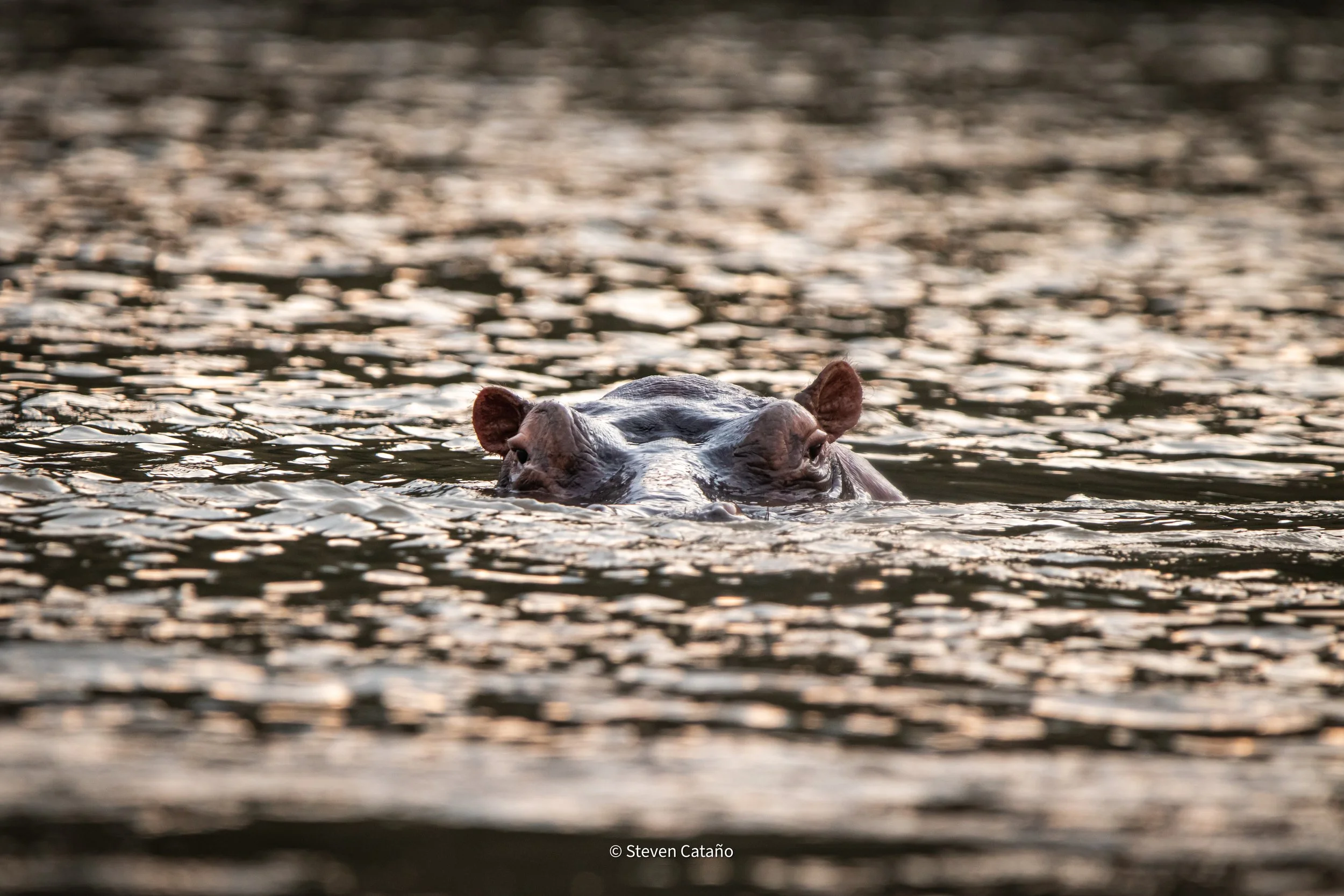
Wild Colombian hippo resting in the Magdalena River. Credit Steven Castaño
Juliana Barberi/Juan Camilo Jaramillo: Nobody is sure exactly when the hippos arrived in Colombia. But we know it was Pablo Escobar who built a private zoo in one of his haciendas where he introduced animals illegally imported from different places in the world. These included four hippos (Hippopotamus amphibius), one male and three females, who were presumably purchased from the San Diego Zoo in the 1980s.
In 1993, when Escobar was killed, some of the exotic animals who lived in the hacienda were relocated to other zoos in the country, but a couple of hippopotamuses remained on the property. The Colombian government did nothing to manage the animals, and due to a complicated legal process of "extinction of domain" the animals remained there and began to roam freely without any supervision, reproducing spontaneously and naturally.
In 2009, the Ministry of the Environment issued a "control hunting permit" order to eliminate a pair of hippopotamuses who had escaped the ranch in 2007 with their freeborn calf. That same year, Pepe, the male, was killed by a hunter hired by the government, causing a wave of indignation among the local community and animal protection organizations, which demanded nonlethal measures for managing the hippos. This community response forced the authorities to suspend the order, but they did not quickly seek other options to control a situation that was starting to get out of hand. With no natural predators in adulthood and finding favorable climate and geographic conditions, the hippos have increased their population to about 160 or 170 individuals distributed along the Magdalena River, the largest in Colombia.
MB: What is happening to them now?
JB/JCJ: Some hippos are still confined in the hacienda, but for the rest, nobody knows exactly how many are roaming along the banks of the Magdalena River and its tributaries. Some reports have spotted them 150 kilometers away from their original holding place, with ecological conditions very similar to those in their native range in Africa, making it easy for them to become established. They are respected and even loved by the locals who consider the hippos part of their communities, although sometimes feared because of their imposing size and strength. Although there have been several incidents reported of close human encounters mainly when people approach mothers with newborn calves, there have been no fatalities so far. Some car accidents have occurred when the hippos traverse roads, and ranchers have illegally killed a few animals, blaming them for damages to their fences.
MB: Can you explain the different attitudes about invasive species of traditional conservationists and those who favor coexistence and compassionate conservation?
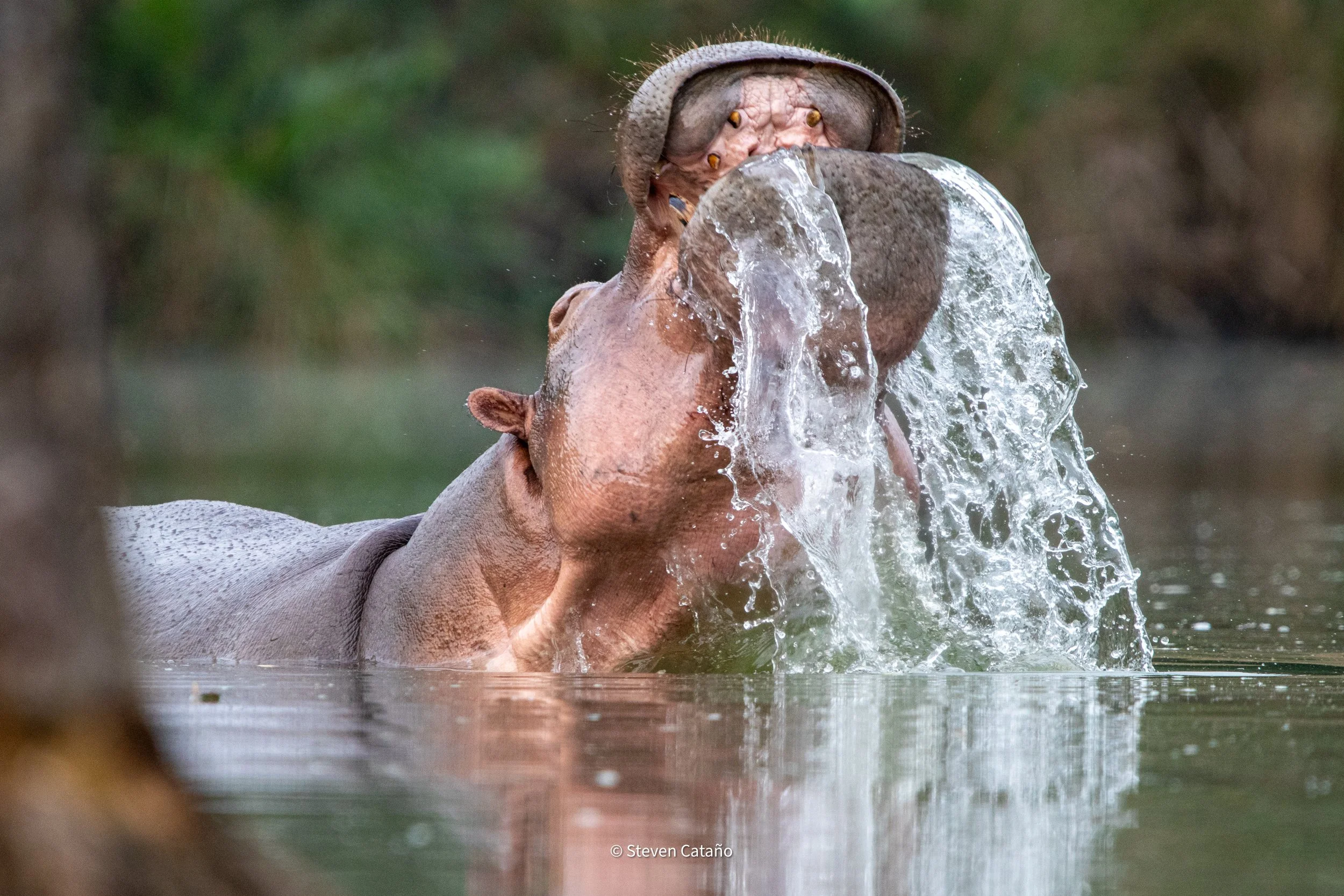
Wild Colombian hippo in the Magdalena River. Credit Steven Castaño
JB/JCJ: Like everywhere else, Colombia has two contradictory positions about introduced or alien species. Traditional conservationists, stuck in the old dogma many times refuted by modern ecologists, that “invasive” species have to be eliminated at all cost, argue that the presence of hippos in the country is a threat to native species, especially giant otters, manatees, and also to humans, so they advocate for their lethal extermination. We are calling this attitude "Bioxenophobia’".
However, there is no proof that hippos cause any damage to the local ecosystems, which, by the way, are already significantly degraded by human activities such as cattle ranching, deforestation, pollution, indiscriminate sewage discharge, oil palm tree cultivation, and petroleum extraction. On the other hand, activists have advocated for nonlethal methods of population control, such as relocating the animals to sanctuaries or sterilizing them to prevent their reproduction.2 The issue has become very polarizing in Colombian society. Recently, the Ministry of the Environment officially labeled hippos as an "invasive" species, opening the door for the lethal control of these beautiful giant herbivores, and again causing indignation in the rural communities where they live.
MB: Why is it important to view these amazing animals sentient beings who deserve to be protected and allowed to live?
JB/JCJ: There is no doubt that hippos are sentient beings; research clearly shows that that all mammals and many other animals are. All individuals have an intrinsic value as living organisms. Besides, hippos are a vulnerable species in Africa where their population is declining dramatically, it makes no sense to kill almost 200 of them because of the unproven perception that they can destroy habitats and native species in Colombia. They should be protected, as all species and individuals on the planet.
MB: Are you hopeful the hippos will be allowed to live in peace?
JB/JCJ: It is difficult to predict what is going to happen. The sterilization of hippos is difficult and costly, yes, but the lethal extermination option makes absolutely no sense,. We think there is a unique historical opportunity to prove that we can coexist with nature, and the Colombian hippos are the perfect example to demonstrate that all nature must be protected, regardless of the place of origin of the species. So, we hope that the authorities will reconsider their position and that the local communities will prevail in saving the hippos.
At this point, here in Colombia, only the voices for the extermination of the hippos are being considered by the decision makers, and we want to counterweight that, before it is too late for the animals. The dogma of the "invasive" species is difficult to shake for most researchers, despite mounting evidence to the contrary. Science is not immune to dogmas, and we want to help the cause of respecting the "new wild". Killing nature, to "protect" nature, makes no sense at all.3
References
Bekoff, Marc. The Emotional Lives of Animals: A Leading Scientist Explores Animal Joy, Sorrow, and Empathy―and Why They Matter. New World Library, 2024.
Bolotnikova, Marina. It’s time to stop demonizing “invasive” species. Vox, November 28, 2023.
1) For more information on New Zealand's heartless campaign and discussions about the rights and freedoms of native versus invasive species see: Is There Hope for Ending New Zealand's War on Possums?; Jane Goodall Says Don't Use 1080, Jan Wright Says Use More; New Zealand Kids Get Into Killing Animals and Love Doing It; Teaching New Zealand Kids to Kill Animals Is Very Worrisome; Why New Zealand's Policy of Killing Animals Harms Children; The "Possum Stomp" vs. Compassionate Conservation and Ethics; Does Everybody Really Hate Possums? The Bandwagon Effect; Calling Animals "Pests" Is More About Us Than Them.
2) For more on compassionate conservation in which the life of every single individual is valued, click here. Also see: Wildlife Conservation: Bringing Compassion to Wild Animals; Compassionate Conservation Matures and Comes of Age.
3) Bioxenophobia: The Dilemma Of Invasive Species And The Unusual Case Of Colombian Hippopotamuses, by Juliana Barberi and Juan Camilo Jaramillo. (I'm including the abstract of their essay with permission because as of now it is only available in Spanish.)
Abstract: The only wild hippopotamus population that exists outside of Africa is in Colombia. Three hippopotamuses were brought to Colombia from a zoo in the United States by drug lord Pablo Escobar for his private zoo, which was filled with exotic animals that he obtained illegally. After Escobar's death (1993), the animals confined there were relocated by the State, but the hippopotamuses were abandoned and escaped, later relocating to a sector of the Magdalena River.
For traditional conservationists, the growing population of hippos, now estimated at around 200 individuals, represents a risk to local biodiversity, and they seek to exterminate them, using the argument of the purity of the ecosystem, in what we will call ecological nationalism, bioxenophobia or green xenophobia.
The different Colombian governments have been neglectful of this situation, even though there have been several offers of international aid and that, before reaching this number, it would have been much easier to control the group of hippopotamuses and their reproduction. However, many authors are beginning to question the discourse of biological invasions, because it is not adjusted to the planetary reality and the impact that humans have on the Earth system, and because it assigns to other species the responsibility for degradation, which is entirely ours. Furthermore, given the training and dogmatism of researchers who support the extermination of introduced species, there is a bias that prevents them from recognizing that, in general, these species replace roles that extinct or already displaced species had, and that they can adapt to degraded ecosystems by generating new biotic interactions.
Ecological adaptability is a novel concept coined by ecology to understand ecosystems as highly random and dynamic, and which contradicts classical ideas of co-evolution. Introduced and native species quickly accommodate each other by adapting and re-organizing efficiently. It is essential to understand that the species that manage to adapt to these new ecosystems are the future of biological diversity, since they are the ones capable of overcoming the affectations caused by humans and continue creating ecosystemic relationships. On the other hand, it is notable that the hegemonic discourse of traditional conservation does not consider the sentience or consciousness of animals, pigeonholing them as simple pieces of the ecosystem or automatons that only fulfill a certain role, without considering their intrinsic value. This is why killing disguised as “ethical euthanasia”, “culling” and other euphemisms are easily advocated for the supposed purpose of native purity.
The case of the Colombian hippopotamuses is a clear example of bioxenophobia and bias in traditional conservation, but at the same time it is an opportunity to demonstrate true values of coexistence with other species, to make us responsible for our impact on the Earth and to contribute so that Colombia can emerge from the historical whirlwind of violence, massacres and annihilation that has always characterized it.